
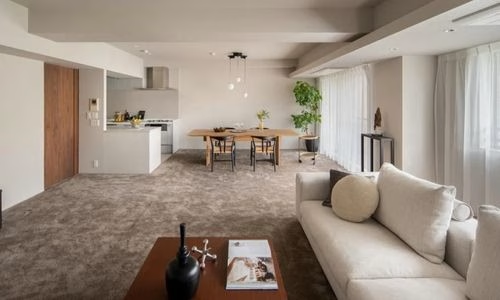

Choosing a 1 bedroom apartment in Japan is a popular choice for singles, couples, and international professionals. These compact yet functional spaces offer privacy, convenience, and access to Japan’s efficient urban infrastructure. This guide offers key insights to help you make an informed decision. It provides information on apartment types, rental costs, and layouts. Additionally, it includes details on salaries and the choice to buy property in Tokyo.
Understanding 1 Bedroom Apartments in Japan
In the Japanese housing market, the classification of apartment types is crucial. Types like 1K, 1DK, and 1LDK decide both functionality and livability. A 1K apartment usually consists of a single room. It has a compact kitchen separated by a door. This setup is suitable for minimalist lifestyles or short-term stays. Meanwhile, a 1DK offers a slightly more spacious dining and kitchen area. It also includes the main room, providing better separation of daily activities.
Among these, the 1LDK format remains the most desirable for long-term residents. It is especially appealing to professionals or couples seeking greater comfort and personal space. The inclusion of a defined living and dining zone in a 1LDK allows for a more versatile layout. This often makes it feel closer to a small condominium than a basic rental unit.
In terms of size, the average apartment in Tokyo classified as 1LDK ranges from 35 to 45 square meters. These units are designed to maximize efficiency. They include open-plan living areas and built-in storage. Rooms are carefully partitioned to suit modern urban life. Outside the capital, apartments often offer more generous proportions.
In cities like Nagoya, Fukuoka, or Sapporo, the average apartment size for a 1LDK unit in Japan varies. It can range from 40 to 55 square meters. This is the typical range. It reflects lower land prices and different urban planning priorities. This difference in spatial planning affects regional variations in rent and property value. It influences the lifestyle and financial decisions of potential tenants or buyers.

Japanese Apartment Layout Comparison
Price Range for One-Bedroom Rentals
Rental prices for one-bedroom apartments in Japan differ significantly. They vary based on geographic location, access to transportation, and proximity to city centres. In metropolitan areas like Tokyo, space is limited. Demand is consistently high. Rent for a one-bedroom unit typically falls within the range of ¥85,000 to ¥200,000 per month. Prices are especially steep in the 23 central wards. Many apartments are located near commercial hubs, train lines, and shopping districts.
To offer a clearer picture, here is a regional overview of the average monthly rent for 1LDK apartments across several key locations:
Aichi Prefecture (Nagoya and nearby cities): ¥55,000 to ¥90,000
Tokyo (central wards): ¥140,000 to ¥200,000
Tokyo (suburban areas): ¥85,000 to ¥130,000
Osaka: ¥65,000 to ¥100,000
Fukuoka and Sapporo: ¥50,000 to ¥80,000
The average rent on the market in the 23 districts is as follows.
| County | 1R | 1K・1DK | 1LDK・2K・2DK |
| Minato | 10.610 ¥ | 11.390 ¥ | 18.200 ¥ |
| Crabs | 10.070 ¥ | 10.440 ¥ | 17.070 ¥ |
| Chiyoda | 10.410 ¥ | 11.960 ¥ | 22.690 ¥ |
| Shinjyuku | 7.520 ¥ | 8.840 ¥ | 13.110 ¥ |
| Bunkyo | 7.280 ¥ | 8.280 ¥ | 12.060 ¥ |
| Taito | 7.020 ¥ | 8.620 ¥ | 12.580 ¥ |
| Sumida | 6.750 ¥ | 7.970 ¥ | 10.320 ¥ |
| Koto | 6.950 ¥ | 8.050 ¥ | 9.440 ¥ |
| Shinagawa | 7.490 ¥ | 8.220 ¥ | 12.530 ¥ |
| Meguro | 7.620 ¥ | 8.460 ¥ | 13.220 ¥ |
| Ota | 6.670 ¥ | 7.480 ¥ | 10.260 ¥ |
| Setagaya | 6.810 ¥ | 7.220 ¥ | 11.280 ¥ |
| Shibuya | 8.750 ¥ | 9.740 ¥ | 18.950 ¥ |
| Nakano | 6.020 ¥ | 6.950 ¥ | 10.330 ¥ |
| Suginami | 6.190 JPY | 6.940 ¥ | 10.110 ¥ |
| Toshima | 6.970 JPY | 7.400 ¥ | 10.620 ¥ |
| Kita | 6.000 JPY | 7.010 ¥ | 9.200 ¥ |
| Arakawa | 6.440 JPY | 7.020 ¥ | 8.850 ¥ |
| Itabashi | 5.680 JPY | 6.500 ¥ | 8.380 ¥ |
| Nerima | 5.520 JPY | 6.350 ¥ | 8.490 ¥ |
| Adachi | 5.480 JPY | 6.100 ¥ | 7.150 ¥ |
| Katsushika | 5.300 JPY | 6.170 ¥ | 7.190 ¥ |
| Edogawa | 5.610 JPY | 6.250 ¥ | 7.750 ¥ |
These figures show standard market conditions for single-bedroom units. They can vary depending on building age, floor level, included amenities, and distance from train stations. Suburban and regional cities generally offer more competitive rent. They often give larger living spaces. These spaces are significantly lower in price compared to central Tokyo.
For individuals considering relocation to Aichi Prefecture, financial planning should also take into account the region’s wage benchmarks. The Aichi Prefecture lowest wage in 2025 is projected to reach ¥1,030 per hour. This is slightly below the average hourly pay in Japan. This average is estimated to climb to approximately ¥1,113 in the same year. Nevertheless, it remains a livable standard for many workers when paired with the area’s moderate housing costs. This balance between income and rental pricing makes Aichi an attractive choice for those seeking affordability. It offers access to urban infrastructure without significant sacrifice.
Salary and Income Benchmarks in Japan
When evaluating housing options in Japan, especially in major urban centres like Tokyo or Osaka, income level is central. It determines what is realistically affordable. This is especially important for international residents. They often face upfront costs like deposits, key money, and agency fees. These are along with monthly rent or mortgage payments.
As of 2025, salary benchmarks in Japan offer a helpful baseline for both local and foreign workers. The average salary in Japan now ranges between ¥4.5 million and ¥5.2 million, depending on job type, experience level, and company size. When performance bonuses and seasonal allowances are factored in, the average annual income in Japan rises to approximately ¥5.5 million.
For a detailed, in-depth breakdown of the average salary in Japan by industry, experience, and metropolitan area (e.g., Tokyo, Osaka), consult the full benchmark report here: https://blog.arealty.jp/average-salary-in-japan-a-2025/
Highly skilled professionals, especially those with bilingual abilities or experience in international business environments, earn considerably more. It is not uncommon for foreign specialists and executives to get total compensation packages exceeding ¥6 million annually. These higher income brackets offer more housing options. This is particularly true for those considering property ownership or relocating to central Tokyo.
Online searches related to Japanese income often include varied spellings. Examples include “average salary in Japan” or “average salary Japan.” Still, all refer to the same set of national statistics. Whether you’re aiming to rent a modest 1LDK, you must align your housing budget with your income. If you are looking into the apartments for sale in Tokyo, your housing budget must also align with your income. A stable salary that meets or exceeds the national average provides access to safe, well-located housing. This is possible whether you’re a tenant or a buyer in Japan’s urban real estate market.

How Income Affects Tokyo Housing
Inside the Compact 1K/1LDK Tokyo Apartment Features
Most 1 bedroom apartments in Tokyo are designed with space efficiency in mind. Despite their compact size, they typically feature a separate bathroom and toilet. There is a compact kitchen or kitchenette. They include air conditioning. A balcony often doubles as a space for drying laundry. Many units are also semi-furnished, equipped with essential appliances and built-in storage, which streamlines the move-in process for tenants.
The typical Japanese apartment layout emphasizes purpose over form, prioritizing practicality in every detail. These units are often smaller than apartments commonly found in Western countries. Still, they are newer and better maintained. They are thoughtfully designed to suit the needs of urban living. In cities like Tokyo, newer 1LDK apartments come with added features like security access. They have earthquake-resistant construction and modern utility systems. These features make them a smart and reliable choice for singles or couples living in Japan.

Efficient Living in Japan’s Capital
How to Find a 1 Bedroom Apartment in Tokyo
Finding an apartment in Tokyo can be a daunting task, especially for foreigners unfamiliar with the local market. High demand, limited English support, and cultural differences in the rental process often create barriers. These challenges can be tackled by focusing on foreigner-friendly apartments. Another way is by partnering with agencies that specialize in serving international clients.
Non-Japanese residents commonly use specific search terms. They search for “apartment for rent Tokyo 1LDK”, “apartments in Tokyo for sale”, or “apartment hunting in Tokyo”. These individuals seek listings with bilingual support, flexible requirements, or simplified application procedures. Real estate platforms that cater to expats often list properties that allow tenants without guarantors, a major advantage for newcomers.
When applying for a rental unit, tenants are usually asked to supply key documents. These include a valid passport, visa, residence card, and proof of income. While some properties still ask for a guarantor, many modern listings now offer no-guarantor options to accommodate foreigners.
Besides the monthly rent, tenants should budget for several first costs:
Cleaning or maintenance fees, sometimes charged upfront
Security deposit (shikikin): 1–2 months’ rent
First reiki in fee: 1–2 months of rent, paid as a non-returnable sum
Real estate commission: typically one month’s rent
Real-World Rental Cost Example (Maison Nishigikubo KM)
This 1K apartment clearly demonstrates the financial advantages of securing a foreigner-friendly lease. Its fee structure drastically cuts down on traditional deposit requirements, making the property highly accessible.
- Total Monthly Fee: Stable at ¥71,050 (including ¥60,000 rent).
- Total Move-in Cost: Only ¥243,000 (equivalent to just 3.4 times the monthly fee).
- Key Savings: The property requires ¥0 Deposit (Shikikin) and very low Key Money (Reikin) at ¥30,000.
- No Guarantor: The property accepts a Guarantee Fee (¥35,000), eliminating the need for a personal Japanese guarantor.
- Location Value: Excellent transit access—just a 4-minute walk to the JR Chūō Line.
Whether you’re looking to buy or secure a low-cost rental like the example above, partner with a specialist. Contact Arealty for transparent and effective support: https://arealty.jp/#/map/room-details/40000155
Buying vs. Renting a One-Bedroom Apartment in Tokyo
The Tokyo real estate market offers distinct paths for long-term buyers/investors and short-term renters prioritizing flexibility. Understanding the costs and requirements for both is key to making a successful move.
Buying Property (1LDK Apartment for Sale)
Buying a 1LDK is suitable for long-term planning and investment, offering greater stability. While the investment is significant, ownership provides autonomy and potential for capital appreciation over time.
Search Terms: Apartment for sale in Tokyo, Tokyo Japan apartment for sale.
Estimated Price: Ranges from ¥45 million to ¥85 million in Tokyo, depending on location (Shibuya, Setagaya, etc.).
Requirements: Buyers need valid residency, stable income, and a 10% to 20% down payment.
Renting Property (1K Apartment for Rent)
Renting is the most flexible choice for newcomers, but the traditional market structure demands significant financial preparation for first costs. Seeking out properties with simplified fee structures is crucial for minimizing upfront expenses.
- General Hurdle: Upfront costs are high, typically 4–6 times the monthly rent. It is essential to focus on listings that are “No Guarantor” (using a company instead).
- Search Terms: Apartment for rent Tokyo 1LDK, rent apartment Tokyo foreigner.
Should You Rent or Buy?
Choosing between renting and buying a one-bedroom apartment in Japan depends on several personal and financial factors. These include your visa type, income level, and how long you intend to stay in the country.
Renting is typically the better choice for short-term residents, like students, digital nomads, or professionals on limited-term contracts. It offers flexibility and requires less upfront investment, which is ideal if your plans change within a few years.
In contrast, buying an apartment is more suitable for those with long-term intentions. Individuals with a stable job find it especially suitable. Those with permanent residency or a spouse visa also consider it. If your annual salary in Japan exceeds ¥6 million, purchasing property is more cost-effective. This is true if you’re planning to stay in the country for at least five years. This is especially true given the rising housing demand in Tokyo and other major cities.
Ultimately, the right decision depends on your current lifestyle, long-term stability, and financial outlook. Both renting and buying offer clear advantages. What matters most is choosing the path that aligns with your personal goals in Japan.

Renting vs Buying in Japan
Living in Japan as a Foreigner
Japan is one of the most livable countries for foreigners. This is due to its strong public safety, modern infrastructure, and highly efficient transportation systems. These factors contribute to a comfortable daily life, even for individuals who choose to live alone in Japan.
As we move into 2025, the cost of living in Japan is gradually increasing. This is particularly noticeable in cities like Tokyo. Rent prices are rising. Higher utility bills also impact budgets. Inflation-related expenses need careful financial planning. This is especially true for international residents on limited budgets.
With thoughtful budgeting that accounts for income, housing, and lifestyle needs, foreigners can keep a stable life in Japan. This allows them to have a satisfying experience. Whether you’re renting short-term or considering property ownership, a 1 bedroom apartment remains practical and flexible. It is also a popular housing choice. It balances affordability, comfort, and access to urban convenience.
Conclusion
Finding a 1 bedroom apartment in Japan is easier when you understand the market. By aligning your income with rental or buying costs, you can make informed, confident decisions.
Whether you plan to rent or buy, Japan offers housing options for every budget and lifestyle. For a smoother experience, especially for foreigners, Arealty provides multilingual support. They offer curated listings to help you settle in with ease.
With the right preparation and guidance, your transition to life in a 1LDK apartment can be both simple and stress-free.



Leave a Reply