
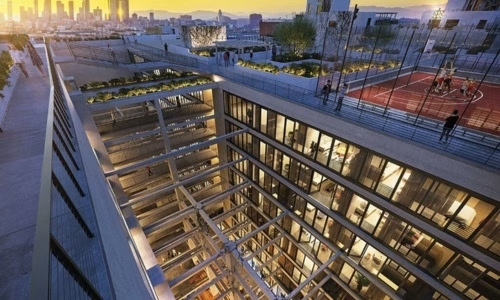

Office to residential conversion Japan is leading a bold shift as cities worldwide reassess urban space. Backed by major global institutional investors, this trend is accelerating, driven by Japan’s unique economic conditions, legal reforms, and strong housing demand.
Executive Summary
In a significant development reshaping Japan’s urban real estate landscape, global investors are committing $684 million to the country’s growing office-to-residential conversion sector. As vacancy rates continue to rise in central business districts, particularly in major hubs like Tokyo and Osaka, this strategy offers a timely solution to underutilised commercial space. At the same time, Japan is witnessing a steady increase in demand for affordable, centrally located housing, especially among younger professionals and urban migrants.
This dual pressure, vacant office buildings and a need for rental housing have opened the door for large-scale redevelopment. Japan’s unique market characteristics make it a standout destination for such investment. The country benefits from a combination of legal flexibility in zoning and use conversion, persistently low interest rates, and a stable, long-term rental market. These conditions not only reduce risk for developers but also create a sustainable path for revitalising aging city infrastructure.
As international funds continue to search for resilient and forward-looking real estate opportunities, Japan is positioning itself as a global model in adaptive reuse. This shift is not just about maximising return on investment, it’s about reshaping the urban core to meet the evolving needs of a modern, mobile, and space-conscious population.

Inside the Deal: Why $684M Now?
Morgan Stanley, along with a consortium of sovereign wealth funds and pension-backed investment vehicles, is making a substantial bet on the future of Japan’s urban real estate. This isn’t a random move; it’s a carefully calculated strategy based on current global market dynamics and Japan’s unique investment appeal.
While the U.S. and Europe are grappling with rising interest rates and tighter monetary conditions, Japan remains an outlier with ultra-low borrowing costs and stable economic fundamentals. As a result, Japan is now delivering more favourable risk-adjusted returns compared to many Western property markets. Investors are drawn to this yield advantage, which has become more pronounced as rate differentials widen.
Moreover, the ongoing depreciation of the Japanese yen creates an additional layer of opportunity. For dollar-based investors, the current exchange rate environment, combined with effective currency hedging strategies, enhances the potential for higher real returns. These factors make Japan not only a relatively safer haven but also a highly competitive and rewarding market for large institutional players seeking both stability and upside potential.
In short, this wave of capital flowing into Japan’s urban transformation is being driven by solid macroeconomic reasoning and strategic positioning, not short-term speculation.

Fund Structure & Key Players
The current wave of capital entering Japan’s property sector is being channelled through a diversified investment pool made up of global institutional funds, real estate investment trusts (REITs), and private equity firms. This collaborative approach reflects growing confidence in the long-term viability of office-to-residential conversions in urban Japan.
Structured as a co-investment platform, the fund allows both international and domestic investors to participate in the transformation of underperforming office buildings into build-to-rent (BTR) residential assets. This structure not only spreads risk but also combines global capital expertise with local market insight, creating a more agile and responsive development pipeline.
The platform focuses on assets in core urban areas, particularly in Tokyo, Osaka, and Nagoya, where rental demand remains resilient. Depending on the location, building type, and redevelopment scope, target internal rates of return (IRRs) are projected between 12% and 20%. Assets in prime districts with strong infrastructure and tenant demand tend to deliver returns at the higher end of that range, while properties requiring more intensive repositioning fall toward the lower end, but still represent attractive yields compared to other developed markets.
This hybrid model of capital deployment, paired with Japan’s favourable conditions for real estate transformation, is setting a new precedent for value-add investment strategies in Asia.

Source: Japan’s Venture Capital Industry
Asset Allocation Breakdown
The fund’s current portfolio allocation reflects a strategic blend of asset classes, designed to capture both short-term upside and long-term income security. Approximately 55% of capital is directed toward office conversion projects, which serve as the primary engine for value creation through repositioning underutilised assets into modern residential use.
Meanwhile, 25% is allocated to logistics facilities, capitalising on sustained demand for last-mile delivery and warehouse space amid the continued rise of e-commerce in Japan. These assets provide relatively stable returns and help hedge against market volatility.
The remaining 20% is invested in build-to-rent (BTR) apartment developments, particularly in high-demand urban neighbourhoods where rental housing remains undersupplied. This segment supports the fund’s recurring income goals and offers predictable cash flow over the long term.
Overall, this balanced diversification enables investors to participate in both capital appreciation through redevelopment and steady rental income, a combination that enhances risk-adjusted returns while positioning the portfolio for resilience across market cycles.

Source: investopedia
Project Timeline & Milestones
The development timeline is structured around several key phases, each aligned with Japan’s urban development framework and broader national housing initiatives.
- Q3 2024 – Site Acquisition & Regulatory Approvals: The project kicks off with land procurement and securing the necessary zoning and building permits. This stage involves close coordination with local authorities to ensure full compliance with planning regulations and smooth approval processes.
- Q1 2025 – Construction & Conversion Begins: Physical transformation of the targeted office buildings into build-to-rent residential units begins. This includes both structural adjustments and interior redesign, tailored to meet modern housing standards and tenant preferences.
- Q4 2026 – First Units Completed & Released to Market: The first wave of residential apartments will be delivered and ready for occupancy. These units are expected to cater primarily to young professionals and urban families seeking affordable, centrally located housing.
This phased rollout not only ensures operational efficiency but also aligns with Japan’s long-term urban housing strategies, supporting city revitalisation and improving residential accessibility in key metropolitan areas.
Why Japan Leads in Office-to-Residential Projects
Japan’s real estate market presents unique structural advantages that set it apart from other developed economies, particularly when it comes to repurposing office space into residential use.
One of the most pressing issues is the country’s aging office stock, much of which features outdated layouts no longer suited to modern work environments or tenant expectations. As hybrid work trends continue to reshape office demand, many of these underutilised buildings present a prime opportunity for conversion.
At the same time, rental demand in city centres remains strong, fueled by a growing population of young professionals, students, and single-person households. Unlike many Western cities, Japan has a long-standing cultural acceptance of compact living, especially in metropolitan areas like Tokyo and Osaka, where space is at a premium.
There’s also a critical need for workforce and student housing, particularly in districts near universities, business hubs, and major transit stations. This unmet demand is creating room for new development strategies that prioritise efficient space usage without compromising on design or functionality.
The success of micro-apartments in Tokyo further proves that small, well-planned units can thrive in dense urban settings. These compact homes appeal to cost-conscious tenants who prioritise location, connectivity, and modern amenities, making them an ideal product in Japan’s evolving housing market.

Legal and Regulatory Tailwinds
A major turning point for Japan’s office-to-residential conversion market came with the 2022 revision of the Building Standards Act (建築基準法改正). This legislative update marked a significant shift in national policy, aimed at revitalising underused urban infrastructure while easing the pressure on housing supply.
The reform streamlined the regulatory framework, making it substantially easier to repurpose outdated office buildings for residential use. By removing several layers of bureaucratic hurdles and simplifying zoning compliance, the new rules shortened approval timelines and lowered renovation costs, two key barriers that previously discouraged adaptive reuse projects.
For developers and institutional investors, this legal change dramatically improved the economic feasibility of conversion strategies. Projects that once faced long lead times and unpredictable expenses can now be executed more efficiently, with greater clarity around compliance and return on investment.
In effect, the 2022 amendment has unlocked a new wave of development potential, transforming dormant commercial properties into high-demand housing while aligning with the government’s broader urban renewal and livability goals.

Tokyo vs. Osaka: Vacancy Math
The supply-demand dynamics in Japan’s major cities strongly support the push toward adaptive reuse. In Tokyo, office vacancy rates are hovering around 6.5%, reflecting a surplus of commercial space in central business areas. In contrast, the residential sector maintains an occupancy rate above 96%, indicating sustained demand for housing in the capital’s urban core.
Similarly, Osaka is witnessing a comparable trend. Office vacancy has climbed to approximately 7.2%, particularly in older buildings, while rental demand remains stable in well-connected central districts. This growing mismatch between excess commercial inventory and undersupplied housing underscores the strong business case for converting outdated offices into rental apartments.
As cities evolve post-pandemic, this imbalance makes office-to-residential conversions not only viable but economically and socially necessary to meet changing urban needs.
ESG & “Brown-to-Green” Opportunity
Beyond financial returns, environmental benefits are also a major draw for investors entering Japan’s office-to-residential conversion space. Transforming aging office stock into modern, energy-efficient housing directly supports ESG (Environmental, Social, and Governance) objectives, aligning real estate portfolios with global sustainability standards.
These projects often involve retrofitting buildings with greener systems, such as upgraded insulation, efficient HVAC, and smart energy controls, which significantly reduce carbon footprints. In doing so, they unlock what’s known as the “brown-to-green premium”: higher asset valuations tied to improved environmental performance.
Buildings that meet recognised green certification benchmarks not only command better pricing but also tend to enjoy lower operational expenses, higher tenant satisfaction, and stronger occupancy stability. For institutional investors prioritising long-term value and impact, this environmental upside makes conversion strategies even more compelling.
The Return of Global Capital
After years of prioritising assets in the U.S. and European markets, many global investment funds are now refocusing on Japan, and with good reason. The country offers a rare combination of economic resilience, favourable currency conditions, and steady rental income, all of which have become increasingly attractive in today’s uncertain global landscape.
What makes this renewed interest even more notable is the diversity of capital sources involved. From family offices and pension fund managers to real asset-focused institutional investors, a broad range of long-term allocators are returning to Japan in search of stability and yield. These players are not chasing short-term arbitrage; they’re building portfolios that align with long-horizon strategies and global ESG mandates.
As Japan continues to modernise its urban infrastructure and adapt underutilized buildings for new residential use, this influx of international capital is expected to accelerate, cementing Japan’s role as a top-tier destination for adaptive reuse and sustainable real estate investment.
Macro Trends Supporting the Shift
Several broad economic and policy factors are reinforcing the appeal of Japan’s office-to-residential conversion wave. These macro-level trends provide a strong foundation for long-term investor confidence.
Yield Gap vs. Western Core Cities
Rental yields in Japan continue to outperform those in many Western core cities. As cap rates have compressed in markets like the U.S., U.K., and Germany, Japan offers a relatively more attractive return profile, particularly in urban rental segments. This widening yield gap is prompting capital to rebalance toward Asian assets with stronger fundamentals.
FX & Hedging Advantage
The weakened yen provides foreign investors with a rare entry window at a discount. When combined with the current environment of low hedging costs, Japan stands out as a strategic destination for dollar- and euro-based capital. Historically, such FX conditions have proven highly advantageous for long-term investors seeking real asset exposure in stable economies.
BOJ Stability & Tax Incentives
The Bank of Japan’s accommodative stance continues to support borrowing and long-term real estate investment. Unlike other major central banks that have tightened aggressively, the BOJ has maintained low interest rates, creating a financing environment that favours large-scale redevelopment. In addition, government tax incentives tied to urban renewal and housing supply initiatives further boost returns while reducing downside risk.
Real-World Success Stories
Japan’s conversion boom isn’t just theoretical; several high-performing projects across major cities have already proven the model’s viability and profitability.
Tokyo Micro-Apartment Project (IRR ~20%)
In the heart of Shinjuku, a former business hotel, left largely unused after the tourism slowdown, was transformed into a series of compact rental apartments designed for solo urban dwellers. Thanks to efficient unit layouts, modern amenities, and proximity to transit hubs, the property reached nearly 100% occupancy within two months of launch. The project’s internal rate of return (IRR) approached 20%, underscoring the high demand for small-scale, well-located housing in Tokyo’s dense rental market.
Osaka Office Tower Conversion (IRR ~15%)
In Namba, a central business district in Osaka, an aging 1980s office tower was strategically retrofitted into residential flats aimed at young professionals and university students. The property was repositioned with shared common areas, Wi-Fi-enabled workspaces, and rental plans catering to flexible lifestyles. The redevelopment yielded an IRR of approximately 15% while significantly increasing asset utilisation in a previously underperforming commercial zone.
These case studies highlight how thoughtful conversions, backed by strong market fundamentals, can deliver both social value and strong financial performance.
Risk Factors & How Funds Mitigate Them
While Japan’s office-to-residential transformation offers strong upside, it also comes with specific risks that require thoughtful planning. Leading investors are addressing these challenges with targeted strategies:
- Zoning Uncertainty: Early and consistent collaboration with local governments helps streamline permitting, align with zoning laws, and avoid costly delays.
- Construction Costs: Rising materials and labour expenses are mitigated through pre-negotiated contracts and long-term partnerships with local contractors to maintain cost control and ensure timely delivery.
- Market Risk: Projects are strategically located in high-demand rental zones, such as central business districts and areas near major train stations, to tap into strong, stable tenant demand and reduce leasing risk.
Expert Commentary
Japan brings together a rare mix of factors that few other markets can match,” remarks a senior fund manager from one of the participating institutional investors. “The country’s high urban density, especially in cities like Tokyo and Osaka, provides a natural foundation for adaptive reuse. At the same time, demographic shifts—such as aging populations and smaller household sizes- are driving structural demand for compact, well-located rental housing.”
He adds, “What sets Japan apart is the regulatory clarity and government support for urban renewal. Unlike in many global cities where zoning laws are a major hurdle, Japan offers a more predictable and transparent approval process. This combination makes it one of the most promising markets globally for office-to-residential conversions, not only from a return perspective but also in terms of long-term stability and sustainability.
2025–2030 Market Outlook
Analysts forecast that Japan’s office-to-residential conversion trend will gain even greater momentum through the end of the decade. Leading the transformation are Tokyo, Osaka, and Fukuoka, cities that combine high urban density, well-developed infrastructure, and sustained rental demand.
However, growth is not expected to remain limited to the capital region. The build-to-rent (BTR) and multi-family residential segments are projected to expand into regional cities and secondary markets, where aging commercial buildings remain underutilised and housing needs continue to rise.
With continued support from government initiatives and increased interest from global capital, Japan is well-positioned to become Asia’s premier market for adaptive reuse, offering investors long-term value, stable income potential, and meaningful contributions to sustainable urban development.
Smart Moves for Property Investors and End-Users
As Japan’s conversion market matures, smart capital is shifting toward targeted, well-informed strategies. Strategic moves to help investors unlock long-term value:
- Focus on High-Vacancy, High-Demand Zones: Prioritise areas in Tokyo and Osaka where underused offices coincide with strong rental need, ideal conditions for adaptive reuse.
- Choose Transit-Friendly Locations: Properties near train stations, universities, or employment hubs tend to lease faster and retain tenants longer.
- Partner with Local Experts: Work with Japanese developers who understand planning regulations and can navigate approvals smoothly.
Investor & Market FAQs
Q: Why is Japan an attractive market for office-to-residential conversions?
A: Japan offers a rare combination of strong urban rental demand, low financing costs, regulatory clarity, and a large stock of aging office buildings, making it a prime environment for adaptive reuse.
Q: What are the typical returns for investors in this market?
A: Most projects aim for internal rates of return (IRR) between 12% and 20% housing in tokyo, depending on location, asset condition, and development complexity.
Q: How can international investors gain access to these opportunities?
A: Foreign capital typically enters through co-investment vehicles, joint ventures with local developers, or Japan-focused real estate funds that specialise in conversion strategies.
Conclusion
Office to residential conversion Japan sits at the intersection of necessity and opportunity. With a growing mismatch between commercial supply and residential demand, global capital is targeting outdated buildings for transformation into modern, efficient homes.
Backed by favourable regulations, attractive yields, and environmental benefits, this trend is driving a structural evolution in urban planning and offering a blueprint for future-ready cities.




Leave a Reply