

For expatriates and international residents contemplating a move, understanding Japan’s apartment rental market is crucial. This complex market requires a thorough examination as the first step. The decision regarding location frequently centers on a detailed analysis of Japan’s two foremost economic centers: Tokyo and Osaka. This comprehensive guide provides a definitive Rent Price Comparison Tokyo vs Osaka. It offers crucial, detailed insights into securing quality housing. There is a sharp focus on prevailing costs. The guide examines nuanced neighborhood dynamics. Additionally, it delves into the intricate rental procedures for securing desirable apartments in tokyo Japan.
Detailed Rental Prices: The Financial Divide Between Tokyo and Osaka
The core of this analysis focuses on the substantial financial difference that defines the Rent Price Comparison Tokyo vs Osaka. Tokyo consistently ranks as one of the world’s most expensive cities. This ranking directly elevates and impacts the average Japan tokyo apartment rent. On the other hand, Osaka presents a compelling argument for greater affordability.
Rental Price Analysis in Tokyo (within the 23 Wards, as of 2025)
The high Japan tokyo apartment rent is driven by several unique and powerful factors. Its unmatched urban population density increases demand. It is also a global corporate and financial epicenter. Furthermore, its superior, highly reliable public transportation network enhances its appeal. As of 2025, apartment prices in Tokyo’s 23 central wards reflect this premium status. They exhibit ranges that are significantly higher than Osaka.
- Studio Apartments (1R): These smaller units demand a premium, with monthly rents typically falling between ¥80,000 to ¥120,000.
- One-Bedroom Units (1K/1DK): For slightly larger space, the price range escalates to approximately ¥100,000 to ¥150,000 per month. This space is essential for couples.
- Family-Sized Units (2LDK/3LDK): Larger apartments are suitable for families. They offer multiple bedrooms and start at ¥180,000. Prices can easily exceed ¥300,000 per month, especially if located in highly desirable, prime central wards.
The cost disparity within Tokyo is striking. Properties in the absolute city center are inherently the most expensive in the country. This includes areas such as Shibuya, Shinjuku, Minato Ward (home to Roppongi and Azabu), and Chuo Ward (home to Ginza and Nihonbashi). For example, securing a luxury 2LDK apartment in Minato Ward can easily command a monthly rent exceeding ¥400,000. Modest but necessary savings are genuinely possible. You can strategically opt for areas slightly further out, like Adachi or Nerima Wards. You need to accept a longer commute.
Rental Price Analysis in Osaka (City Center, as of 2025)
Osaka presents a compelling proposition. It offers a remarkably lower overall cost of living. At the same time, it guarantees a dynamic and rich urban experience with equally robust infrastructure. For comparable proximity to the city center, Osaka provides substantially better value than Tokyo.
- Studio Apartments (1R): Rent for these compact units typically ranges between a highly competitive ¥50,000 to ¥80,000 per month.
- One-Bedroom Units (1K/1DK): Prices for these essential units are generally lower than Tokyo’s studios. They range from ¥60,000 to ¥100,000 per month.
- Family-Sized Units (2LDK/3LDK): Even larger apartments, ideal for family living, are significantly more accessible, typically costing between ¥120,000 to ¥200,000.
Rental costs are highest in central commercial areas. This is especially true around the major hubs of Umeda, Shinsaibashi, and Namba. However, the market remains consistently more reasonable than Tokyo’s equivalent prime locations. Osaka is an excellent choice for budget-conscious professionals. It is also a pragmatic choice for families seeking greater space. This is true if they are willing to accept a regional job market concentration.

Public Transport Systems
The efficiency and extent of the public transport networks are critical factors. The extent of these networks influences the cost of living. It also affects the daily quality of life in these metropolitan areas. Understanding this relationship is key to an accurate Rent Price Comparison Tokyo vs Osaka.
Tokyo’s Rail Network and Density
The transportation network in Tokyo is globally renowned for its unmatched complexity and density. The sheer number of interconnected rail lines ensures that commuters can effectively reach virtually any destination across the metropolitan area. This convenience has a downside. The system can become extremely crowded and intense during peak rush hours. It demands high tolerance from daily commuters. The network’s vast scale results in frequent transfers between lines. Overall travel times, especially from suburban areas, can be long.
Osaka’s Efficiency and Comfort
While Osaka does not possess the same overwhelming number of lines as Tokyo, its core transportation system is highly convenient. It comprises the subway, JR, and private railways. It is more concentrated. Notably, the Osaka subway system is designed to facilitate easy and comfortable transfers. This design makes navigation relatively straightforward even for new residents. Crucially, while still busy, the rush hour periods in Osaka often present with fewer severe traffic jams. They also have fewer crowds compared to the intense density experienced in the Tokyo-Kanto region. This contributes to a perceptibly less stressful daily commute.
Food and Daily Living Expenses
Beyond the monthly rent, the daily cost of living significantly impacts the overall budget. A clear contrast exists between the two cities in this category.
Consumption Costs in Tokyo
In Tokyo, expenses related to both eating out and everyday consumables are demonstrably higher. The average price for a casual lunch, particularly within central districts, can frequently reach ¥1,000 to ¥1,500. The city provides an abundance of diverse, high-quality dining options. It also offers international supermarkets. However, expats must budget a higher amount for groceries and dining compared to other regions.
Consumption Costs in Osaka
Osaka, proudly bearing the nickname “Japan’s Kitchen,” offers significantly lower food costs than Tokyo. Dining out is generally more reasonably priced, with casual meals often found for less than ¥1,000. Osaka has a strong culture of providing “cheap and delicious” food (kuidaore). This ensures that residents consistently find satisfying and highly affordable options for groceries and dining out.

Famous Hub Stations and Pace of Life
The major terminal stations define the financial and commercial heart of both cities. They offer essential access points for residents. They also dictate the overall culture.
Tokyo: Fast Pace and Global Opportunities
Tokyo hosts several of the world’s busiest train stations, which function as major hubs for both the Yamanote loop line and extensive commuter networks:
- Shinjuku Station: Officially the world’s busiest station, Shinjuku is a massive commercial and entertainment hub. It is a key residential and business location for expats, offering unmatched professional opportunities.
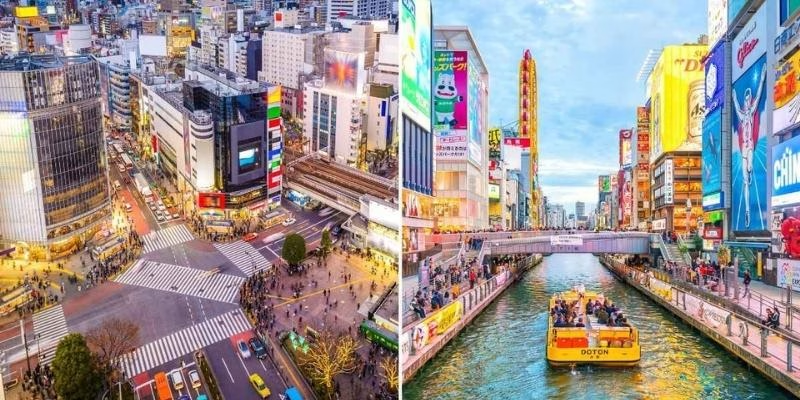
- Shibuya Station: Renowned globally for the iconic “Scramble Crossing,” Shibuya is a major fashion, technology, and commercial center.
- Pace of Life: Tokyo is characterized by a very fast-paced, work-centered life. It offers unparalleled opportunities, making it the premier choice for those seeking maximum professional excitement and global business access.
Osaka: Laid-back Atmosphere and Culinary Focus
Osaka’s central stations, while processing fewer passengers than Tokyo’s biggest, are highly efficient and concentrate activity into distinct districts:
- Umeda Station (Osaka-Umeda): This is Osaka’s most important and busiest hub. It is located in the Kita (North) district. It serves as the core commercial, business, and transportation center.
- Namba Station: Located in the Minami (South) district. Namba is the primary center for entertainment, food, and culture. It is near the famous Dotonbori area.
- Pace of Life: Osaka maintains a friendly, warm, and distinctly laid-back atmosphere. The local population is renowned for being welcoming. This makes it easier for first-time residents to settle in. They can enjoy the wide variety of food and entertainment options.

Leveraging Arealty to Secure Your Apartment in Tokyo Japan
Navigating the traditional Japanese residential rental market can be overwhelmingly complex. This is especially true for the competitive environment for apartments in tokyo japan. The complexity arises due to entrenched language barriers, unique contractual terms, and stringent guarantor requirements. For international residents, partnering with a specialized real estate agency is crucial. An “arealty” specialist is often an absolute logistical and legal necessity..
The Role of an Expert Arealty Specialist
An Arealty specialist whose focus is explicitly dedicated to assisting foreign residents provides invaluable, professional assistance throughout every stage of the convoluted rental process:
- Critical Bilingual Support: They bridge the significant language gap between you and Japanese landlords. They also address the cultural gap with property managers. This mediation ensures that all contractual terms, obligations, and clauses are clearly understood by both parties. They are legally and comprehensively reviewed before any commitment is made.
- Guarantor Solutions Facilitation: The majority of Japanese landlords universally require a native Japanese guarantor to co-sign the lease. Specialized Arealty agencies can often help. They either directly offer professional third-party guarantee services. Alternatively, they facilitate access to these services if you are unable to secure a personal guarantor. This assistance removes a major obstacle to tenancy.
- Curated Property Listings: Crucially, the Arealty specialist systematically filters out properties with policies not accepting foreign residents. This process saves you an immense amount of time, effort, and frustration. These landlords may reject applications based solely on a lack of Japanese residency or credit history. This is a barrier which the expert agency can preemptively address or circumvent.
Ready to confidently find and secure your ideal home in Japan? Contact a reputable Arealty firm today to receive personalized, filtered listings. They will provide professional contract negotiation assistance. This guarantees a smooth and legally compliant transition into your new life in either Tokyo or Osaka.
Conclusion
Ultimately, the choice for your apartments in japan hinges on personal and professional priorities. The Rent Price Comparison Tokyo vs Osaka clearly indicates that while Tokyo offers unparalleled global business concentration. It provides a fast-paced environment at a significant price premium. Osaka provides superior financial accessibility and value across all apartment categories. It is coupled with a friendlier, more relaxed lifestyle. Choose Tokyo if career access is paramount. Choose Osaka if achieving a lower cost of living and larger living space is your main objective.



Leave a Reply