
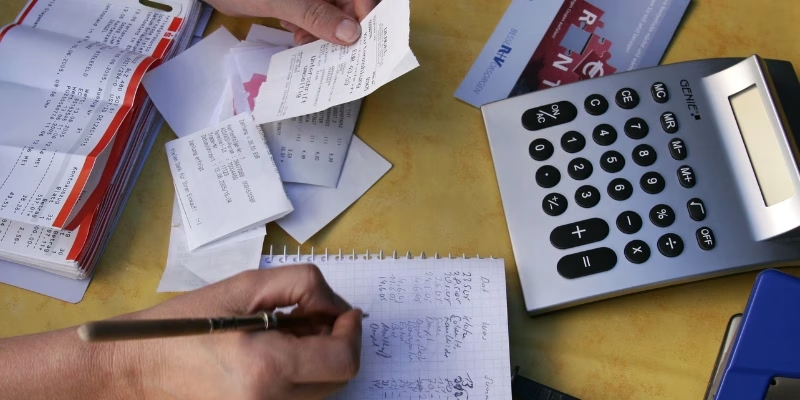

For anyone moving to Japan, one of the first things to learn is how to pay utility bills in Japan. From electricity and gas to water, internet, and mobile services, each utility has its own billing system, which can feel confusing at first – especially when everything is written in Japanese. Fortunately, paying utility bills in Japan is much easier once you understand the process.
There are several convenient payment options available, including konbini (convenience stores), bank transfers, automatic withdrawals, and online payments. Each method has its pros and cons depending on personal preferences and lifestyle. This guide will help newcomers understand how to set up utilities, read their bills, and choose the most practical way to manage payments – making life in Japan smoother and more stress-free from the start.

Understanding Utility Services in Japan
Utility services in Japan include electricity, gas, water, internet, and mobile connections. The electricity and gas industries were liberalized in 2016 and 2017, allowing new companies to enter the market with more competitive prices.
Japan’s electricity network is mainly run by ten major providers, such as TEPCO in Tokyo, all operating under the Federation of Electric Power Companies of Japan (FEPC). Local municipalities are responsible for managing water supply services.
Japanese energy providers are focusing on sustainability, aiming to reduce greenhouse gas emissions by 46% by 2030. Solar power is expected to make up about 14% of the country’s energy mix by then.
Utility | Application Time | Activation Time |
Electricity | Approximately a week before your move-in date | Same day (2–3 hours to process) |
Gas | About a week ahead of your move-in | Around 10 minutes before use |
Water | Upon moving in | Usually already active; just register an account |
Utility bills are issued every one or two months. Payments can be made in several ways cash, bank transfer, credit card, or online. Some credit cards even offer rewards for paying bills, typically between 0.5% and 2% back.
Average Utility Costs for One Person Living in Japan
The table below shows the average monthly costs for basic utilities for one person living alone in Japan. Prices vary depending on region, usage, and season.
Utility Service | Average Monthly Cost (JPY) | Billing Frequency | Notes |
Electricity | ¥3,000 – ¥6,000 | Monthly | Costs rise in summer and winter due to air conditioning or heating. |
Gas | ¥2,000 – ¥4,000 (City Gas) ¥4,000 – ¥8,000 (if using Propane Gas) | Monthly | Propane Gas can cost nearly twice as much as City Gas. |
Water | ¥2,000 – ¥3,000 (City Water) | Every two months | Charges vary slightly by city or ward. Some rural areas may have higher water fees. |
Internet | ¥4,000 – ¥6,000 | Monthly | Depends on speed and provider. |
Mobile Phone | ¥3,000 – ¥6,000 | Monthly | It varies depending on your plan and data usage. |
Top Ways to Pay Your Bills in Japan
In Japan, most utility bills (electricity, gas, water, internet, etc.) are posted to your home address every month. Each bill comes with a payment slip (払込取扱票 – haraikomitorihikihyō) that includes a barcode for easy payment at convenience stores, banks, or post offices. Some providers also offer email or online billing, but paper bills are still the most common, especially for new residents.
Through a Convenience Store (Konbini)
Paying bills at a convenience store is one of the simplest ways to handle utility payments in Japan. Just bring your bill to a nearby 7-Eleven, Lawson, FamilyMart, or another convenience store and hand it to the cashier.
Pros:
- Open 24 hours
- Stores are everywhere (7-Eleven, Lawson, FamilyMart, etc.)
- Simple and fast process: the cashier scans the barcode, and you pay in cash or with electronic money such as nanaco (at 7-Eleven). You’ll receive a stamped receipt as proof of payment – keep it for records or tax purposes.
Cons:
- Credit cards are not accepted
- Some payments may include a small handling fee

Through Bank Transfer
If you prefer to pay from home rather than visiting a convenience store, you can make a bank transfer, known in Japanese as 口座振込 (kouza furikomi).
Pros:
- No need to wait in line
- Simple to monitor your online transactions
- Can be arranged for monthly auto-pay
Cons:
- Basic Japanese reading ability is usually required (though banks like Shinsei or Sony Bank offer English support)
- Entering billing information can be time-consuming
- Most banks charge a small transaction fee, even if the payment fails due to incorrect details
You can also bring your bill directly to a nearby bank branch or ATM to make the payment. Reading Japanese is usually necessary, and a small processing fee applies.
If you do not yet have a Japanese bank account, refer to this detailed guide on how to open one and see a sample application form below.
Useful Resources:
- How to Open a Bank Account in Japan (+ Sample Application Form)
- Japan Post Bank Account Application Form (ゆうちょ銀行)

Automatic Withdrawal
If convenience and saving time are your top priorities, you can arrange to have your utility bills automatically deducted from your bank account or charged to your credit card. To do this, request an application form from the utility provider, fill in your account or card details, and return it.
Pros:
- No monthly effort required
- Payments are always on time
- You’ll receive monthly confirmation of payment
Cons:
- Paper application is required
- Setup usually takes about one month
- You’ll need to use another payment method until it’s activated

Directly at the company’s office or store
As a last resort especially if you’ve missed a payment you can pay your bills directly at the company’s customer service center or retail office.
Pros:
- The only option if your account is overdue or the bill can’t be processed at a convenience store or ATM
- Works well for mobile phone payments, as these companies have physical stores
Cons:
- Time-consuming; limited to business hours
- Usually cash payments only
Frequently Asked Questions About Paying Utility Bills in Japan
Q1. What are the main utilities in Japan?
Electricity, gas, water, internet, and mobile phone services are standard. TEPCO supplies electricity, Tokyo Gas handles gas, and local bureaus manage water.
Q2. What types of bills should I expect?
You’ll receive bills for electricity, gas, water, and telecommunications. Electricity and gas bills come monthly, while water bills are usually issued every two months.
Q3. How much do you typically pay for utilities in Japan?
For one person living in a small apartment, monthly costs typically range from 2,000 to 7,000 yen depending on usage and location.
Q4. How can I pay utility bills in Japan?
Common methods include paying at convenience stores, via bank transfer, automatic debit, or by credit card. Convenience stores are a favorite because they’re open 24 hours.
Q5. What information appears on Japanese utility bills?
Bills include your name, customer number, billing date, total amount due, due date, and usage details. A barcode is also printed for easy payment at convenience stores.
Q6. Can I pay bills online?
Yes. Many companies allow payments through their websites or apps, where you can view bills, track consumption, and pay digitally. Some have switched to paperless e-bills for convenience.
Q7. What should you do if you forget to pay your bill?
If you miss a payment, your utility service may be suspended. You’ll need to contact the service provider, usually in Japanese, to have it reactivated. Keep all your receipts as evidence of payment.
Tips for Choosing the Best Way to Pay
The best way to pay your utility bills depends on your habits and preferences.
If you don’t mind a quick trip each month, paying at a convenience store (konbini) is simple and accessible. But if you prefer never to worry about due dates, setting up automatic payments via bank account or credit card is the most reliable option.
More people are switching to digital or automatic billing to avoid paper fees and support environmental goals. Automatic payments save time and reduce the chance of missed bills.
Whatever method you choose, keeping track of payment dates and retaining receipts will help you stay organized and avoid issues.

Conclusion
Understanding how to pay utility bills in Japan is an important step toward comfortable, stress-free living. Whether you prefer paying at a konbini, through bank transfers, or setting up automatic withdrawals, knowing your options will help you stay organized, avoid late fees, and manage your budget with ease.
If you’re planning to move or looking for a new place to live, A-Realty offers a wide range of apartments across Tokyo and nearby prefectures – many with no key money or deposit, making it easier to settle in without the high upfront costs.
Explore current property options here:
- Apartments in Nakano Ward with No Deposit and No Key Money
- Shinjuku Apartments with No Key Money and No Deposit
- Affordable Apartments in Saitama with No Deposit
- Affordable No Deposit Apartments in Kanagawa
Finding the right apartment and understanding your utilities go hand in hand when starting life in Japan — and A-Realty is here to make both steps easier for you.



Leave a Reply