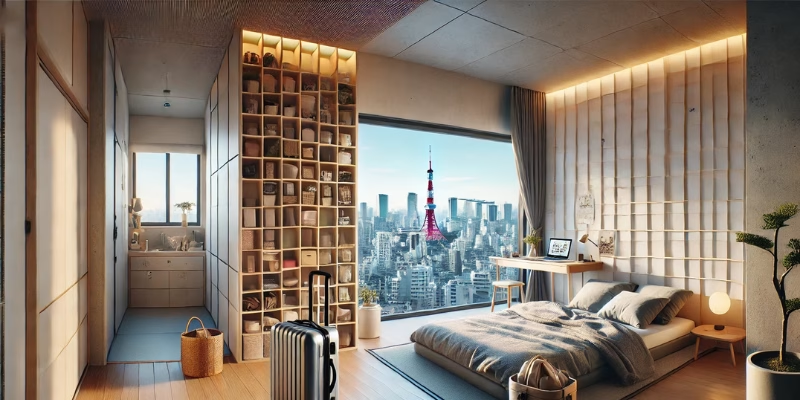

The question of the Average Rent in Tokyo 2025 is essential for anyone moving to Japan’s capital. Finding apartments for rent in Tokyo Japan is complicated by high demand and significant price variations across diverse neighborhoods. This expert guide will analyze the nuances of Japan Tokyo apartment rent. It will offer actionable data and tips. These insights will help you secure an affordable apartment for rent Tokyo.

Understanding Tokyo’s Rental Dynamics
I have lived and worked in the Japanese content and real estate market. I can confirm that average rent in Tokyo 2025 is heavily influenced by location (立地). Apartment layout (間取り), building age (築年数), and amenities (設備) also play a significant role. The sheer cost of land in Tokyo ensures that rents will remain elevated compared to other prefectures.
Based on past statistics (H30 Housing and Land Survey), the national average monthly rent in Japan was ¥55,695. In stark contrast, the average for Tokyo Prefecture was ¥81,001, indicating that Tokyo rent is approximately 1.5 times the national average — a trend that continues to shape the average rent in Tokyo 2025.
However, this number only tells half the story. Tokyo’s rental market is characterized by vast price differences across different wards and cities. Your final budget will largely depend on whether you prioritize proximity to the city center or affordability — a key factor when analyzing the average rent in Tokyo 2025.
Detailed Breakdown of Rent in Tokyo by Area (23 Wards)
Tokyo’s rental market is highly stratified. We present a comprehensive table showing the average monthly rent across all 23 Wards, categorized by common Madori layouts. This data reflects general residential rates as of March 2023 (Source: At Home Co., Ltd. / アットホーム株式会社).
| Ward (区) | 1R–1K (Studio) | 1DK–2DK (1 Bed) | 2LDK–3DK (2-3 Bed) | 3LDK–4DK (3-4 Bed) | 4LDK+ (Family) |
| Central 3 | |||||
| Minato (港区) | 12.200 yen | 21.580 yen | 40.130 yen | 61.780 yen | 131.800 yen |
| Chiyoda (千代田区) | 11.410 yen | 22.690 yen | 37.390 yen | 59.820 yen | – |
| Chuo (中央区) | 10.940 yen | 17.340 yen | 26.150 yen | 34.870 yen | 40.180 yen |
| Core Wards | |||||
| Shibuya (渋谷区) | 10.140 yen | 19.430 yen | 35.220 yen | 61.590 yen | 130.370 yen |
| Shinjuku (新宿区) | 9.080 yen | 16.390 yen | 28.150 yen | 34.980 yen | 75.070 yen |
| Bunkyo (文京区) | 8.420 yen | 14.990 yen | 22.380 yen | 28.580 yen | 45.680 yen |
| Taito (台東区) | 8.420 yen | 13.510 yen | 21.400 yen | 25.390 yen | 30.190 yen |
| Shinagawa (品川区) | 8.910 yen | 14.870 yen | 30.120 yen | 38.860 yen | 135.760 yen |
| High-End Residential | |||||
| Meguro (目黒区) | 9.020 yen | 15.650 yen | 28.190 yen | 35.720 yen | 51.260 yen |
| Setagaya (世田谷区) | 7.520 yen | 12.370 yen | 18.780 yen | 26.480 yen | 41.110 yen |
| Mid-Range Wards | |||||
| Koto (江東区) | 8.940 yen | 11.940 yen | 20.940 yen | 23.700 yen | 23.880 yen |
| Sumida (墨田区) | 8.250 yen | 12.530 yen | 17.820 yen | 18.670 yen | 24.200 yen |
| Toshima (豊島区) | 8.100 yen | 12.960 yen | 20.620 yen | 23.280 yen | 32.800 yen |
| Ota (大田区) | 7.510 yen | 11.140 yen | 16.980 yen | 21.800 yen | 31.900 yen |
| Suginami (杉並区) | 7.110 yen | 11.610 yen | 17.990 yen | 23.640 yen | 32.430 yen |
| Nakano (中野区) | 7.370 yen | 112.450 yen | 19.450 yen | 22.040 yen | 26.180 yen |
| Budget Wards | |||||
| Kita (北区) | 7.350 yen | 11.020 yen | 17.440 yen | 19.670 yen | 24.900 yen |
| Arakawa (荒川区) | 7.280 yen | 10.260 yen | 18.700 yen | 20.090 yen | 22.450 yen |
| Itabashi (板橋区) | 6.830 yen | 10.510 yen | 14.650 yen | 17.740 yen | 23.850 yen |
| Nerima (練馬区) | 6.650 yen | 10.230 yen | 12.870 yen | 16.200 yen | 21.050 yen |
| Adachi (足立区) | 6.460 yen | 8.970 yen | 11.980 yen | 15.230 yen | 19.190 yen |
| Edogawa (江戸川区) | 6.420 yen | 8.650 yen | 12.040 yen | 14.920 yen | 18.330 yen |
| Katsushika (葛飾区) | 7.850 yen | 6.360 yen | 12.900 yen | 16.810 yen | 19.580 yen |
Key Trends and Observations
The data clearly illustrates Tokyo’s rental polarization:
- The Price Gap: For a mid-sized apartment (2LDK–3DK), the rent in the most expensive ward, Minato (¥40.13K), is over 3.3 times higher than in the most affordable major ward, Adachi (¥11.98K).
- Central Premium: The “Central 3 Wards” (Chiyoda, Chuo, Minato) and rapidly redeveloping Shibuya maintain the highest prices. This is due to high demand from corporate tenants. Luxury residential tenants also contribute to this demand.
- Value Wards: The Eastern and Northern Wards (Adachi, Edogawa, Katsushika, Nerima) consistently offer the best value. These areas are prime locations for those seeking to minimize their Japan Tokyo apartment rent.
- Luxury Residential Pockets: Even outside the Central 3, specific areas known as Kōkyū Jūtaku-gai (高級住宅街 – Luxury Residential Areas) exist. Areas such as Den-en-chōfu (Ota), Seijō (Setagaya), Aoba-dai (Meguro), Ikedayama, and Shimazuyama (Shinagawa) maintain significantly higher rents. This is due to their prestige and larger properties, which also pull up the average rent in Tokyo 2025 compared to suburban areas.

The Nuances of the Japanese Floor Plan (Madori)
Understanding the Madori code is essential for navigating apartments for rent in Tokyo Japan. The prefix number indicates the number of dedicated rooms, while the letter codes define the shared space:
| Code | Layout | Size Range | Ideal For | Price Impact |
| 1R | One Room (Studio) | 13m2 to 20m2 | Singles, tight budget | Lowest monthly rent. |
| 1K | One Room + Separated Kitchen | 13m2 to 25m2 | Singles, desire space separation | Low rent, slight premium over 1R. |
| 1DK | One Room + Dining Kitchen | 25m2 to 35m2 | Singles/Couples, need dining space | Moderate rent, significant jump from 1K. |
| 1LDK | One Room + Living, Dining, Kitchen | 30m2 to 40m2 | Couples, young families, need comfort | High rent, can be 50-100% higher than 1K. |
| 2LDK+ | Two Rooms + LDK | 50m2 and up | Families | Highest rent category. |
Key Definition: The difference between a 1K, 1DK, and 1LDK is determined by the size of the kitchen/dining area, often measured in tatami mats (approx. 1.62m2 per mat). The inclusion of the L (Living) component means there is ample space for a sofa and living area. This inclusion results in the highest price premium per square meter.
Beyond Location: Building Age and Amenities
Breakdown of Rent in Tokyo by Building Age (Chikunen-sū)
The age of the building heavily influences both rent and quality. All buildings constructed after 1981 must comply with modern earthquake-proofing standards (Shin-Taishin).
Analysis of standard properties (e.g., 70m2 near Tokyo Station) shows a clear trade-off:
| Building Age | Estimated Average Rent (70m²) | Rent Reduction vs. New (3 Yrs) |
| 3 Years Old | 34.200 yen | Baseline |
| 10 Years Old | 32.000 yen | -6.4% |
| 20 Years Old | 28.900 yen | -15.5% |
Cost-Saving Strategy: By opting for a property 20 years old instead of a new build, you can save approximately ¥5.3万 per month (over 15%) on your rent in Tokyo. while still benefiting from modern seismic standards.
Breakdown of Rent in Tokyo by Amenities (Setsubi)
Modern amenities can substantially inflate your monthly rent, particularly in central areas. The next are the most high-value features:
- Separated Toilet and Bath (Betsu-Buro): This design is highly sought after. It places the toilet in a separate room from the bathing area. It is a significant upgrade from the compact Unit Bath (all-in-one fiberglass unit).
- Auto-Lock (オートロック): A primary security feature, often mandatory in high-end manshon (condominiums).
- In-unit Washer Space: It is highly convenient to have connections for a washing machine inside the apartment. This setup is much better compared to having it in a communal area or on the balcony.
- Delivery Lockers: Essential in Tokyo for tenants who are often away during the day, ensuring secure package delivery.

Popular Yet Affordable Areas for Apartments for Rent in Tokyo based on the average rent in Tokyo 2025
The central wards are attractive. But, many of the most popular neighborhoods offer a great balance. They supply affordability, accessibility, and lifestyle. This balance is key when searching for your Japan Tokyo apartment rent.
| Station/Area | Line(s) | 1R/1K Average Rent | Key Feature |
| Hachioji | JR Chuo/Yokohama/Hachiko | ¥45,000 – ¥67,700 | Cheapest rent; convenient transport hub; direct line to Shinjuku. |
| Kasai | Tokyo Metro Tozai | ¥67,600 – ¥68,700 | Close to the city center; excellent local amenities; quiet residential atmosphere. |
| Machida | JR Yokohama/Odakyu | ¥65,500 – ¥71,200 | Major shopping hub; excellent connectivity to Yokohama and Shinjuku. |
| Kitasenju | JR Joban/Metro Hibiya/etc. | ¥70,100 – ¥77,000 | Major transfer station (4 companies, 5 lines); mix of large stores and local shōtengai. |
| Ogikubo | JR Chuo/Sobu/Metro Marunouchi | ¥73,700 – ¥80,300 | Highly-rated for safety, quiet, and great access; moderately priced within the 23 Wards. |
The Total Cost: Initial Move-In Fees (Initial Costs)
When budgeting for your apartment for rent Tokyo, you must consider the significant starting costs (初期費用). These costs are unique to the Japanese rental system. The standard starting payment is typically 4 to 6 months’ worth of rent.
| Fee Item | Cost Estimate | Notes |
| Security Deposit (敷金/Shikikin) | 0 to 2 months’ rent | Held by the landlord for damages; often fully/partially refunded. |
| Key Money (礼金/Reikin) | 0 to 2 months’ rent | A non-refundable “gift” to the landlord; often waived now. |
| First Month’s Rent (前家賃/Mae Yachin) | 1 month’s rent | Paid in advance. |
| Agency Fee (仲介手数料) | 0.5 to 1 month’s rent + tax | Paid to the real estate agent. |
Why Choose AREALTY for Your Tokyo Apartment Search?
AREALTY is a trusted real estate service dedicated to helping international residents settle in Japan with ease. We understand the unique needs and often complex challenges faced by foreigners. Our mission is to make your housing search utterly smooth, transparent, and stress-free.
Here’s a glance at AREALTY‘s strengths in helping you find your cheap apartment Tokyo:
- Multilingual Support: Our team offers comprehensive support. We guarantee clear and effective communication throughout your search for apartments for rent in Tokyo Japan.
- Local Knowledge: With deep knowledge of Tokyo’s diverse neighborhoods and rental market trends, we offer unique insights. Only a local expert can offer these insights. We include specific tips for finding budget-friendly options.
- Foreigner-Friendly Properties: We have access to a strong network of landlords. They offer properties specifically suited for international clients. This includes those with no-guarantor options and a robust range of foreigner friendly apartments Tokyo.
- Transparent & Comprehensive Assistance: We pride ourselves on clarity in every deal. We explain all fees and contract terms upfront about your rent in Tokyo. From property search and contract signing to move-in support and utility setup, AREALTY provides full guidance.
- Hassle-Free Process: Our customer-focused service ensures a smooth rental experience. It empowers you to feel confident and secure. You will know that a professional team is guiding you every step of the way.
With AREALTY, newcomers can feel confident and secure. They know they have a professional team guiding them every step of the way.
Save Money on Your Move with AREALTY!
Don’t let high starting fees stop your move. Our AREALTY agents specialize in finding affordable rentals with low first costs.
Contact AREALTY’s English-Speaking Agents for properties with Zero-Deposit and Free-Rent options!
Information:
Hotline: 050-6864-9697
Website: https://arealty.jp

Conclusion
Understanding the Average Rent in Tokyo 2025 is your first advantage. Now is the time to turn knowledge into action. You are seeking a luxury unit. Alternatively, you are looking for an affordable apartment for rent Tokyo in the suburbs. A structured search is key.
Ready to find the perfect balance of location, layout, and rent with professional guidance? Visit AREALTY today to explore comprehensive listings and find your dream Japan Tokyo apartment rent!



Leave a Reply