

With 20 man salary, how much rent can I afford in Japan? This is a common concern for newcomers who are planning their move. Tokyo is exciting but also one of the most expensive cities, and many foreigners wonder how to balance their income with the real cost of living in Japan. The article below will explore how much rent in Japan with a monthly salary of 200,000 yen is reasonable, what types of apartments in Tokyo are available, and practical tips for finding affordable and foreigner-friendly housing options.
Is 20 Man Salary Considered Average in Japan?
Earning 20 man per month (200,000 yen) is actually quite common in Japan, especially for newcomers, part-time workers, or those just starting their first full-time job. While it may not match the national average, which is closer to 300,000 yen, it’s still a manageable income if you plan wisely.
The good news is that Japan offers a wide range of housing options. From cheap apartment Tokyo listings to suburban apartments in Japan Tokyo, there are many choices that fit a 20 man budget. In fact, with careful spending, you can still enjoy the vibrant lifestyle of Tokyo or explore affordable homes for rent in Japan outside the capital.
Rather than seeing 20 man as a limitation, think of it as a chance to learn budgeting, discover hidden neighborhoods, and take advantage of foreigner-friendly apartments Tokyo that are designed to support international residents. With the right approach, a 20 man salary can cover not only rent but also daily expenses, allowing you to live comfortably while building a future in Japan.
Living Costs in Japan and How Much to Spend on Rent
When planning life in Japan with a 20 man salary (200,000 yen), it’s important to look beyond rent. The cost of living in Japan includes several monthly expenses you can’t avoid:
- Utilities (electricity, gas, water): ¥10,000–15,000
- Internet & Mobile phone: ¥6,000–8,000
- Transportation: ¥10,000–15,000 (depending on your commute)
- Food & groceries: ¥30,000–40,000
- Daily essentials & leisure: ¥15,000–20,000
That means even before paying rent, you’ll likely spend around 70,000–90,000 yen each month.
So how much rent is reasonable with 20 man salary?. Most financial planners in Japan recommend allocating 25–30% of your income to rent. For a 200,000 yen salary, that’s around 50,000 – 60,000 yen per month. At this level, you can keep your budget balanced while still enjoying the lifestyle Japan has to offer.
Average Rent Prices in Tokyo vs Other Cities
Apartments in Tokyo vary greatly by ward. Below is a comparison of typical monthly rent for a 1R (studio) or 1K unit:
Ward | 1R (Yen) | 1K / 1DK (Yen) |
Chiyoda | 108,000 | 110,000 |
Chuo | 102,000 | 104,000 |
Minato | 113,000 | 114,000 |
Shinjuku | 81,000 | 100,000 |
Bunkyo | 79,000 | 89,000 |
Taito | 84,000 | 99,000 |
Sumida | 82,000 | 89,000 |
Koto | 83,000 | 94,000 |
Shinagawa | 82,000 | 91,000 |
Meguro | 87,000 | 99,000 |
Ota | 70,000 | 81,000 |
Setagaya | 72,000 | 87,000 |
Shibuya | 98,000 | 105,000 |
Nakano | 70,000 | 86,000 |
Suginami | 67,000 | 81,000 |
Toshima | 72,000 | 86,000 |
Kita | 69,000 | 82,000 |
Arakawa | 71,000 | 82,000 |
Itabashi | 66,000 | 77,000 |
Nerima | 64,000 | 75,000 |
Adachi | 65,000 | 73,000 |
Katsushika | 59,000 | 73,000 |
Edogawa | 60,000 | 71,000 |
The table above highlights the rental price variations for 1R and 1K apartments across Tokyo’s 23 wards based on SUUMO’s 2025 data. Central areas such as Minato, Chiyoda, and Shibuya remain the most expensive, with monthly rents exceeding 100,000 yen, reflecting their prime location, accessibility, and lifestyle appeal. In contrast, outer wards like Katsushika, Edogawa, and Nerima offer more affordable options, averaging around 60,000–75,000 yen per month. The overall trend shows that prices tend to decrease gradually as you move away from central Tokyo.
To compare more detailed data across cities, check our full guide here: Japan Apartment Rent Prices 2025
Featured Listing: Grand Value Hachioji Kitano – Affordable 1R Apartment in Tokyo
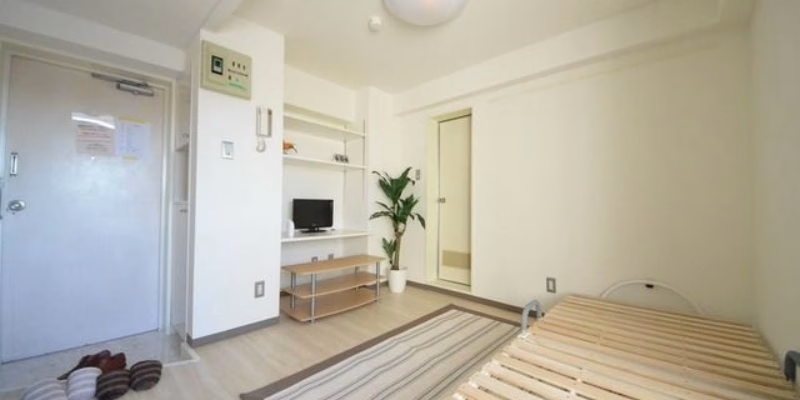
The Grand Value Hachioji Kitano offers an excellent opportunity for those seeking affordable and convenient housing in Tokyo. This 1R apartment is available for 49,000 yen per month, including the maintenance fee, and provides a comfortable living environment ideal for students, interns, and single professionals.
Located in Kitanomachi, Hachioji-shi, the property is approximately a 9-minute walk from Keio Line Kitano Station, offering direct access to central Tokyo. The unit has a total area of 16.39 m² and is situated on the third floor of a reinforced concrete building. Essential amenities include a system kitchen, bath, air conditioner, and internet Wi-Fi.
This property stands out for its no deposit, no key money policy and a low initial move-in cost of approximately 182,000 yen. In addition, credit card payment for initial fees is accepted, providing flexibility and convenience for tenants.
Property Details:
- Address: 568, Kitanomachi, Hachioji-shi, Tokyo
- Layout: 1R (16.39 m²)
- Rent: 49,000 yen/month
- Access: 9-minute walk from Keio Line, Kitano Station
- Ready for occupancy on: September 25, 2025
For further details, images, and inquiry options, please visit here.
Trying to find an apartment in Tokyo that fits your budget? Check out our selection of budget-friendly units:
Under 50,000 yen: Explore low-cost apartments in Tokyo.
Under 60,000 yen: Find affordable city living options in Tokyo.
Key Factors Influencing How Much Rent You Can Afford
When calculating how much rent in Japan with salary like 20 man, it’s not only about your income. Several factors directly influence whether you’ll find a cheap apartment Tokyo or end up stretching your budget.
Location
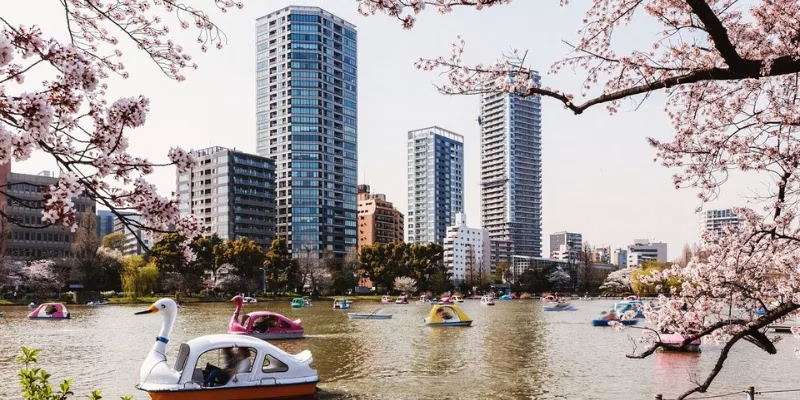
Location is the single most influential factor when looking for an apartment for rent in Japan. Rental prices can vary greatly from one area of the city to another. For instance, in Tokyo, a 1R unit in Shinjuku, Shibuya, or Minato often starts at ¥80,000–¥100,000, while a similar apartment in suburbs like Nerima or Edogawa can be found for ¥50,000–¥60,000.
If you prefer convenience, such as living close to a major station, along a direct train line, or near your company, you may need to accept higher rent or a smaller room size. This trade-off buys you time and comfort, especially if you value shorter commutes and easy access to Tokyo’s nightlife, shopping, and dining.
On the other hand, if you’re looking for cheaper rent and larger living space, moving further away from central Tokyo is the better choice. Suburban areas and neighboring prefectures (like Chiba or Saitama) often offer homes for rent in Japan that are more spacious and affordable, though you’ll spend more time commuting.
In short, choosing between convenience vs affordability is key. For someone living on a 20 man salary, it’s often a balance, deciding whether to cut commuting time and accept a smaller flat Tokyo, or to live further out and enjoy a bigger, cheaper apartment.
Apartment Type
The type of apartment also makes a big difference.
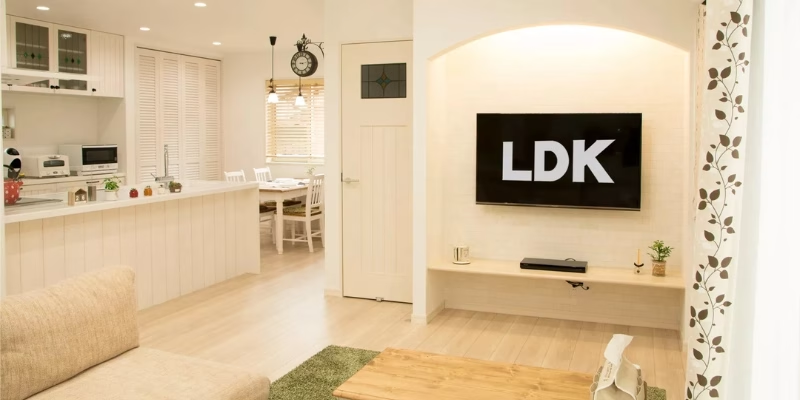
- 1R / 1K (studio): Ideal for singles and those on a lower budget. These are the most common options for foreigners searching for apartments in Tokyo to rent.
- 2DK / 2LDK: More spacious, designed for couples or families. These homes for rent in Japan can easily double the rent of a small studio, often ¥100,000 or more in Tokyo.
- Flat Tokyo style apartments: Modern layouts with convenient locations near train stations. While attractive, they often come at a higher cost compared to older buildings.
Choosing the right size depends on whether you want to save money or prioritize comfort and space.
Challenges for Foreigners Renting in Japan
Upfront Rental Costs
Unlike many countries where you only pay a deposit and first month’s rent, in Japan you may face multiple fees:
- Shikikin (security deposit): equivalent to 1–2 months’ rent, refundable upon move-out.
- Reikin (key money): Around 1 month, non-refundable.
- Agency fee: typically equivalent to one month’s rent plus tax.
- Guarantor requirement: Usually a Japanese citizen.
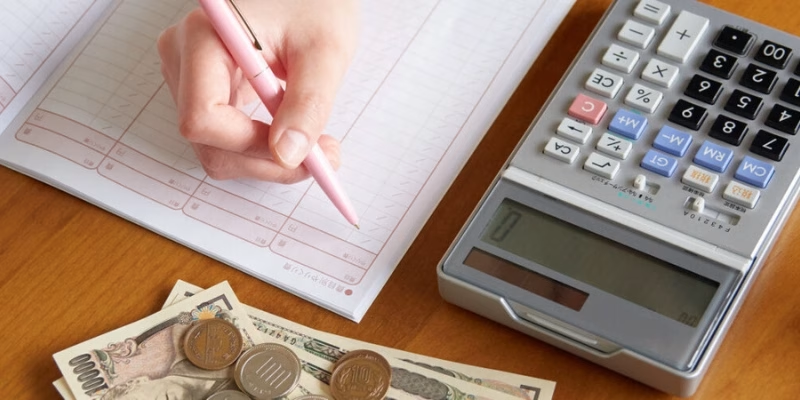
Altogether, moving in can cost 3–5 months’ rent upfront. For example, on a ¥70,000 apartment in Tokyo, this could total ¥250,000–¥300,000, which is more than one month’s income for someone earning 20 man.
For a complete breakdown of these costs and strategies to reduce them, see our full guide in Rental Costs in Japan Explained.
Foreigner-Friendly Options
Beyond the financial costs, foreigners often face another challenge: limited availability of apartments. Not every landlord in Japan is open to renting to non-Japanese tenants, which means the market for foreigner-friendly apartments Tokyo is smaller than it looks.
This limited supply leads to two common issues:
- Fewer options, faster competition: Good listings are often taken quickly, leaving newcomers with less choice.
- Lengthy approval process: Even if you apply, it may take 2–3 weeks before you know whether your application is accepted. This can be stressful for those who need housing on short notice.
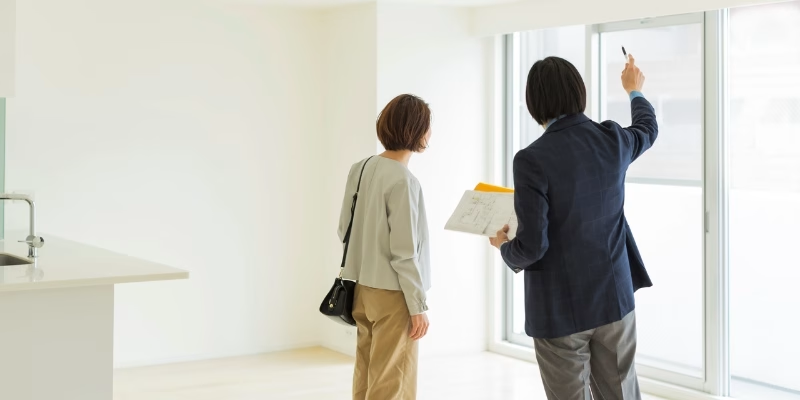
Because of these hurdles, many foreigners rely on specialized agencies that focus on apartments for rent in Tokyo Japan. These agencies help navigate restrictions, present realistic options, and improve your chances of securing a place faster.
Limits on Shared Housing
In many countries, sharing an apartment with friends or colleagues is the most common way to reduce housing costs. However, in Japan, this practice is not widely accepted. Many apartments in Japan explicitly prohibit room sharing or subletting unless the tenants are legally related.
In fact, most landlords only allow multiple occupants if they are family members, such as a married couple or siblings. Renting with friends or unrelated roommates is often against the rules of the lease, and breaking this condition can even lead to eviction.
While share houses are available as an alternative, they are usually designed for students or young professionals and often come with strict application requirements and communal living rules. This makes it difficult for someone earning a 20 man salary to rely on shared housing as a cost-cutting solution, unlike in many other countries.
The takeaway: if you’re hoping to save money by splitting rent, your options will be limited. It’s usually better to focus on cheap apartment Tokyo listings or suburban apartments in Japan Tokyo where a single tenant can comfortably afford the rent.
Finding the Right Balance Between Rent and Lifestyle Costs
With a 20 man (200,000 yen) salary, the key challenge is keeping rent within a sustainable range. Experts recommend allocating no more than 25–30% of income to housing, which means around 50,000–60,000 yen per month. Spending beyond that, for example 80,000 yen or more, often forces tenants to cut back on food, transport, or savings.
Choosing cheaper apartments in suburban areas helps reduce costs, but usually adds commuting time and train expenses. For instance, living in Saitama at 55,000 yen may save money compared to 85,000 yen in Shinjuku, but the trade-off is a 40–50 minute commute.
Ultimately, the balance depends on priorities, whether you prefer location and convenience with a tighter budget, or more space at a lower rent further from the city. Careful budgeting makes it possible to live reasonably well, even on a 20 man salary.
Practical Tips for Renting on a 20 Man Salary
With a 20 man (200,000 yen) salary, housing expenses can quickly consume your budget if not managed carefully. Experts recommend limiting rent to about 25–30% of income (around ¥50,000– ¥60,000), leaving room for other essentials like food, transport, and savings. To stretch your budget further, try these approaches:
- Search outside central Tokyo. Suburban areas such as Edogawa, Saitama, or Chiba offer larger and cheaper units. For instance, a 1K apartment might cost ¥55,000 compared to ¥85,000 in Shibuya. The downside is a longer daily commute.
- Target foreigner-friendly apartments. Some agencies specialize in apartments for rent Tokyo that require no key money or guarantor. These reduce the 3–5 months of upfront fees that can otherwise overwhelm newcomers.
- Apply early. Foreigner-friendly listings are limited and in high demand. Applications often take 2–3 weeks for approval, so starting the process early is crucial.
- Consider smaller layouts. Compact units like 1R or 1K may be the most practical choice for singles trying to balance rent with other costs.
- Compare overall expenses. A cheap apartment Tokyo far from your workplace may increase train costs, while a slightly higher rent near your office could save money and time in the long run.
Balancing these factors helps newcomers secure apartments in Japan that are both affordable and practical, even with a modest 20 man salary.
Begin Your Japan Housing Journey with Arealty
For newcomers, renting in Japan can feel complicated. From guarantor requirements and additional fees to lengthy contracts and language barriers, the process is often very different from what most international residents are used to. The right support can truly change your experience.
Why work with Arealty?
- Multilingual assistance: Friendly staff who can communicate in English, Japanese, and Vietnamese.
- Specialized knowledge: Deep understanding of Tokyo’s rental market and the difficulties foreigners often face.
- End-to-end service: Guidance through every stage, from property search and viewings to signing contracts and moving in.
- Transparent process: Clear explanations and straightforward steps so you feel confident throughout.
With Arealty, finding an apartment for rent Tokyo becomes far less stressful. Instead of struggling with paperwork and unfamiliar rules, you can focus on your studies, career, or enjoying life in Japan.
Contact: 050-6864-9697
Website: https://arealty.jp
Conclusion
With a 20 man salary, how much rent can I afford in Japan? The answer is that it is still possible to rent an apartment in Japan with this income, especially if you budget wisely. Allocating around 50,000–60,000 yen for rent allows you to balance daily living costs while exploring options such as a cheap apartment Tokyo, foreigner-friendly apartments Tokyo, or homes for rent in Japan’s suburbs. By understanding Tokyo apartment rent trends and comparing rentals in Tokyo Japan with other areas, you can make practical choices that save both money and commuting time, ensuring a more comfortable life in Japan.
If you are looking for budget-friendly options, explore our listings of affordable apartments in major cities:



Leave a Reply