
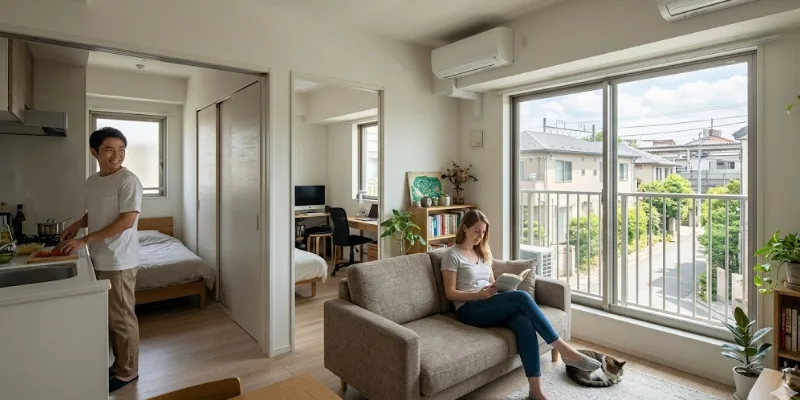

2 bedroom apartments in Tokyo for foreigners — known locally as 2LDK (two rooms plus a living/dining/kitchen space) — rent for an average of ¥150,000 per month citywide in 2026, according to SUUMO quarterly market data. For foreign nationals, 2 bedroom apartments in Tokyo are among the most consistently available unit types, with landlords and management companies in most wards now accustomed to foreign applicants.
This guide covers ward-by-ward prices, move-in costs, the application process for foreigners, and which neighborhoods offer the best value for 2 bedroom apartments in Tokyo.
What Is a 2LDK? Layout Explained
Japanese apartments use a specific notation for room count:
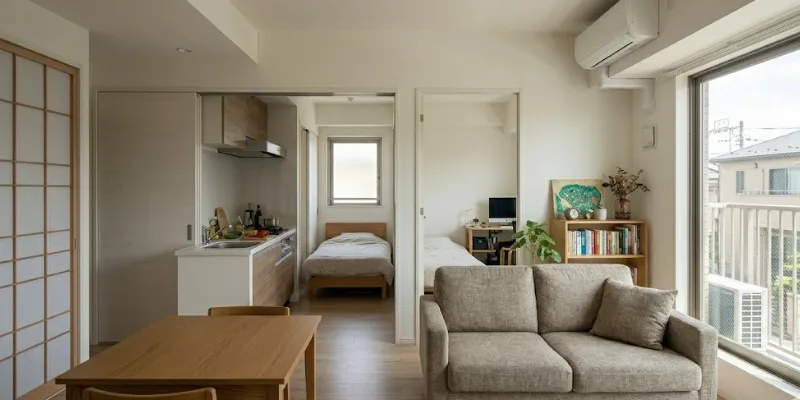
- 2LDK = 2 separate bedrooms + 1 Living/Dining/Kitchen room. Total area: 45–65㎡.
- 2DK = 2 rooms + Dining/Kitchen, no separate living room. Smaller (35–50㎡), cheaper.
- 2SLDK = 2LDK + Service room (windowless, used as study or storage).
For foreigners searching for 2 bedroom apartments in Tokyo, the LDK distinction is significant: a proper living room makes the space livable for couples and families in a way that a 2DK typically does not. See our full 2LDK apartments in Tokyo for foreigners for a detailed breakdown.
2 Bedroom Apartment Prices in Tokyo by Ward (2026)
| Ward | Avg. 2LDK rent/month | Character |
| Minato-ku | ¥220,000–¥280,000 | Roppongi, Azabu, Hiroo — expat hub |
| Shibuya-ku | ¥200,000–¥260,000 | Daikanyama, Ebisu |
| Shinjuku-ku | ¥170,000–¥220,000 | Popular with expat families |
| Meguro-ku | ¥160,000–¥210,000 | Nakameguro, Jiyugaoka |
| Bunkyo-ku | ¥150,000–¥190,000 | Academic area, near Tokyo University |
| Suginami-ku | ¥130,000–¥165,000 | Good value, quiet residential |
| Nerima-ku | ¥120,000–¥150,000 | Outer west, slower commute |
| Adachi-ku | ¥118,000–¥140,000 | Most affordable, northeast |
Source: Arealty, Q1 2026.
For value within the inner wards, Suginami-ku consistently offers 2 bedroom apartments in Tokyo at 20–30% below Shinjuku prices with solid train access.
Move-In Costs for 2 Bedroom Apartments in Tokyo
Initial costs follow a formula based on monthly rent. For a ¥150,000/month 2LDK:
| Cost item | Typical amount |
| Security deposit (敷金) | ¥150,000–¥300,000 (1–2 months) |
| Key money (礼金) | ¥0–¥150,000 — many listings now waive this |
| First month’s rent | ¥150,000 |
| Agency fee | ¥150,000–¥165,000 (1–1.1 months) |
| Guarantee company fee | ¥75,000–¥150,000 (0.5–1 month) |
| Fire insurance | ¥15,000–¥20,000 |
| Total | ¥540,000–¥935,000 |
To reduce upfront costs, filter for no-key-money (礼金ゼロ) listings. See our Tokyo no key money apartments guide.
SUUMO Tokyo Rental Market Report Q1 2026 — source for price data in this article.
How Foreigners Apply for 2 Bedroom Apartments in Tokyo
The application process for 2 bedroom apartments in Tokyo is standard across all unit types. Required documents for foreigners:
- Residence Card (在留カード) + passport copy
- Proof of income — employment contract or 3 months’ payslips
- Guarantor — personal Japanese guarantor or guarantee company
- Emergency contact in Japan
Income requirement: The standard landlord rule is that monthly rent should not exceed one-third of monthly household income. For a ¥150,000/month 2 bedroom apartment in Tokyo, that means demonstrating ¥450,000/month (¥5.4M/year) combined household income.
For couples where both partners work, combined income is accepted by most guarantee companies. Confirm this with your agency when submitting.
Tokyo Metropolitan Government — Housing for Foreign Residents — official guidance on foreigner housing rights.
Best Areas for Foreigners Renting 2 Bedroom Apartments in Tokyo
Expat families with international school needs: Minato-ku has the highest concentration of international schools, English-speaking services, and foreigner-ready landlords. Premium price, but infrastructure is unmatched.
Couples seeking value and lifestyle: Meguro-ku sits between the high-cost central wards and the outer commuter belt — café culture, strong train access, 2LDK from ¥160,000.
Budget-conscious families: Koto-ku or Suginami-ku offer 2 bedroom apartments in Tokyo under ¥150,000 with reasonable commute times.
Near Ikebukuro: Often overlooked but practical — 2LDK in Toshima-ku from ¥150,000 with direct access to multiple train lines.
Furnished 2 Bedroom Apartments in Tokyo for Foreigners
Standard Japanese 2LDK apartments are unfurnished. Budget ¥150,000–¥300,000 to furnish from scratch (secondhand shops like Hard Off or 2nd Street can halve this cost).
Furnished 2 bedroom options in Tokyo include:
- Monthly mansion — fully furnished, all-inclusive, from 1 month. Expect ¥250,000–¥400,000/month for a 2LDK in a central ward.
- Expat relocation apartments — managed furnished lets through operators like Sakura House or Oakhouse.
FAQ: 2 Bedroom Apartments in Tokyo for Foreigners
Can foreigners rent a 2LDK without a Japanese guarantor? Yes. Rental guarantee companies (GTN, Roommate, Leonet) are accepted at most 2LDK listings and specifically serve foreign applicants.
Is a 2LDK big enough for a family of three? A typical 2LDK is 45–60㎡ — workable for two adults and one young child. For two children, a 3LDK or 2SLDK is more comfortable.
How long does the application take? 10–21 days total: 2–5 days guarantor screening, 3–7 days contract preparation.
Are 2LDK apartments in Tokyo usually furnished? No — almost all private 2LDK listings are unfurnished. Monthly mansions are the exception.
→ Browse 2 bedroom apartments in Tokyo for foreigners
2LDK vs 3LDK: When to Size Up
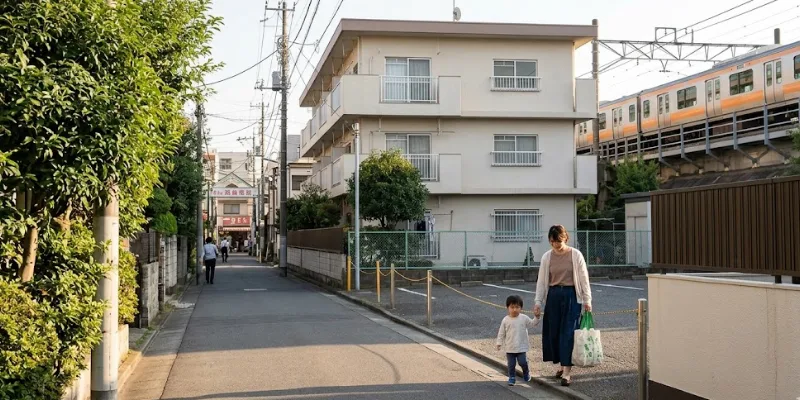
A 2LDK works well for couples and small families with one young child, but families with two children or those who need a dedicated home office often outgrow it. The key questions to ask before deciding:
- Will both bedrooms function as bedrooms? If one room becomes a permanent home office or nursery that can’t double as a guest space, you may need a 3LDK or 2SLDK sooner than expected.
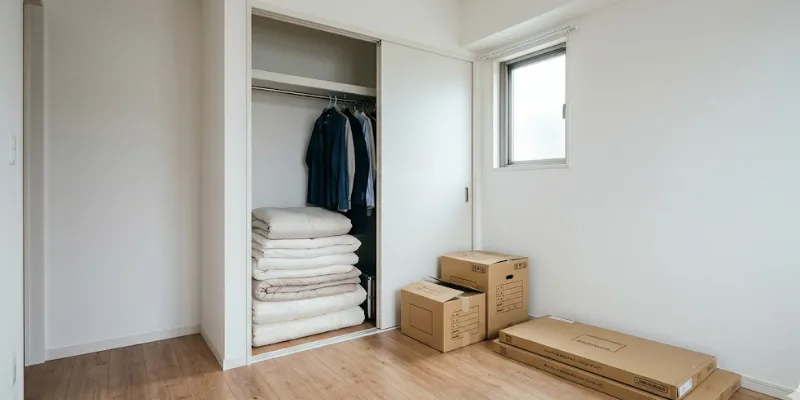
- How much storage do you need? 2LDK apartments in Tokyo typically include one to two small closets (押入れ, oshiire) per bedroom. Families with substantial belongings — especially those relocating internationally with shipped household goods — often find storage tighter than expected.
- Is the LDK large enough for your furniture? LDK size varies significantly even within the 2LDK category — anywhere from 12㎡ to 20㎡. If you own a large dining table or sofa from overseas, measure carefully before committing.
For larger households, see our guide on 3-bedroom apartments in Japan and our breakdown of 3LDK layout benefits for what the extra room actually buys you in practice.
Renting a 2LDK as a Couple Without Children
2LDK apartments aren’t only for families — many couples in Tokyo choose 2LDK over 1LDK specifically to have a guest room, home office, or hobby space. This is increasingly common among remote workers and dual-income couples who value the flexibility.
If you’re renting as a couple, note the following:
- Both names on the lease. Most landlords allow co-tenancy for married couples and increasingly for unmarried partners, though some older buildings still require a single named tenant plus the partner listed as an occupant. Clarify this with your agency before applying.
- Combined income calculation. As noted earlier, guarantee companies generally accept combined household income for the 1/3 rent-to-income ratio. Bring both partners’ employment documentation to speed up screening.
- Marriage certificate isn’t required in most cases — a shared address application and emergency contact information is usually sufficient for unmarried co-tenants.
Pet-Friendly 2LDK Apartments in Tokyo
Pet-friendly listings are a meaningful subset of the 2LDK market — roughly 15–20% of available units in most wards, according to SUUMO’s filtered search data. Pet deposits (typically an additional 1 month’s rent) and pet-specific cleaning fees at move-out are standard. Larger 2LDK units are particularly suited to pet owners since the LDK space gives animals more room to move than a compact 1K or 1DK.
For a full list of pet-friendly options and what documentation landlords require for pets, see our pet-friendly apartments in Tokyo guide.
Renewing a 2LDK Lease: What to Expect
Standard Tokyo leases run 2 years, with a renewal fee (更新料) typically equal to 1 month’s rent due if you choose to stay beyond the initial term. For a ¥150,000/month 2LDK, that’s a ¥150,000 cost roughly every 2 years — worth factoring into your long-term housing budget. Some buildings, particularly those managed by larger property companies, have moved to renewal-fee-free contracts as a competitive differentiator; ask your agency to flag these specifically if cost predictability matters to you.
For more detail on what’s negotiable at renewal time and how rent increases are typically handled, see our rental lease length in Japan guide.
Common Issues to Check When Viewing a 2LDK
Bedroom window orientation. In a 2LDK, it’s common for one bedroom to face a less favorable direction (north or facing an adjacent building) than the other. Ask which room gets more natural light — this affects both comfort and heating/cooling costs.
Soundproofing between the two bedrooms. Older 2LDK units, especially in wood-frame (木造, mokuzō) buildings, can have thin interior walls. If you need separate, quiet spaces — for remote work calls or different sleep schedules — ask about the building’s construction type. Reinforced concrete (RC) buildings generally offer better sound insulation between rooms.
Kitchen size relative to the LDK. Some 2LDK layouts have a galley-style kitchen that’s separated from the main living area; others have an open kitchen integrated into the LDK. If you cook frequently or entertain, check which layout the specific unit uses before committing — listing photos don’t always make this clear.
Internal Resources for 2 Bedroom Apartment Seekers
- How much is a 2-bedroom apartment in Japan — national price comparison beyond Tokyo
- Two-bedroom apartment Tokyo — additional ward-level detail and floor plan variations
- What is a 2LDK apartment in Japan: complete guide — layout terminology deep dive
- Difference between 2DK and 2LDK — full comparison if you’re still deciding between the two layouts
Negotiating Rent on a 2LDK in Tokyo
Rent negotiation in Tokyo is more common than many foreigners expect, particularly for 2LDK units that have been listed for more than a month. A few practical levers:
- Off-peak timing. Listings posted in December–February or July–August (outside Japan’s main moving seasons of March–April and September) are more likely to accept a small rent reduction or waived key money, since landlords want to avoid extended vacancy.
- Longer initial commitment. Offering to sign a 2-year lease upfront (rather than the shorter terms some foreigners request) can give you leverage to ask for reduced or waived key money.
- Bundling negotiation through your agency. Individual tenants negotiating directly with a landlord often have less success than an agency representing multiple prospective tenants per property. This is one practical advantage of working with an established agency rather than approaching listings independently.
Negotiation works best when approached respectfully and through the proper channel (your agent, not directly contacting the landlord) — Japanese rental culture values process, and skipping the agency to negotiate directly can backfire.

Real estate advisor at Arealty Japan, specialising in helping foreign residents navigate the Tokyo and Osaka rental markets. Lucy has guided hundreds of international renters — from Working Holiday visa holders to corporate relocations — through Japan’s apartment application process. Her writing draws on firsthand experience with landlord screening, guarantor companies, and foreigner-friendly listings across all 23 Tokyo wards and major Kansai cities.




Leave a Reply