
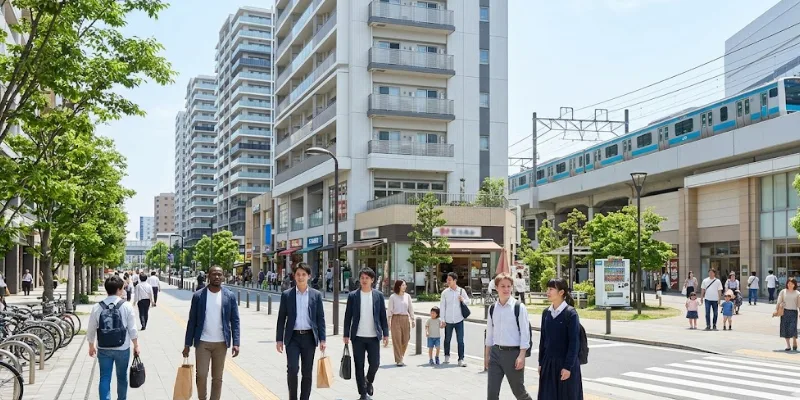

Kawasaki apartments for rent for foreigners start from ¥65,000 per month for a 1K unit — roughly 25–30% cheaper than equivalent apartments in Shinjuku or Shibuya — with direct train access to Shinagawa in 16 minutes and Shinjuku in 24–32 minutes, according to JR East and Tokyu timetable data (2026). For foreigners working or studying in central Tokyo, Kawasaki apartments for rent for foreigners offer a rare combination of lower rent, high foreigner acceptance, and genuine city infrastructure.
This guide covers Kawasaki’s neighborhoods, price by apartment type, commute times, and everything foreigners need to know about the rental process in Kawasaki.
Why Foreigners Choose Kawasaki Apartments for Rent
Kawasaki sits in Kanagawa Prefecture directly south of Tokyo, integrated into the Tokyo metropolitan transit network. It is not a distant commuter suburb — Kawasaki-shi has its own economy, including the Lazona Kawasaki commercial district, a major industrial corridor, and approximately 3.8% of its population are foreign residents (Kawasaki City Statistics, 2025), one of the highest ratios in Kanagawa.
Key reasons foreigners choose Kawasaki apartments for rent:
- Lower rent — 1K units average ¥68,000–¥80,000 vs ¥85,000–¥95,000 in Shinjuku
- High foreigner acceptance — landlords experienced with foreign nationals
- No key money common — zero-reikin contracts are standard practice in many Kawasaki buildings
- English-language support — Kawasaki International Association (KIAN) at City Hall
Kawasaki Neighborhoods: Which Area Is Right for You?
Kawasaki is a long north-south city. Your neighborhood choice within Kawasaki matters as much as choosing Kawasaki itself.
Kawasaki-ku — Central Kawasaki, Kawasaki Station area
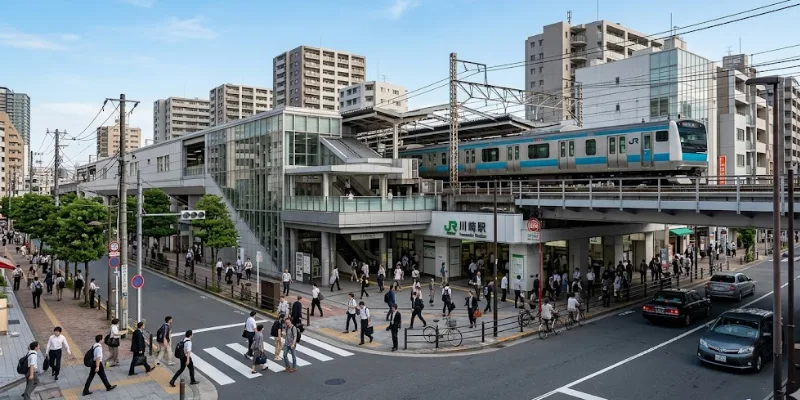
The main commercial hub. Kawasaki Station connects JR Keihin-Tohoku Line and Tokyu Toyoko Line with direct access to Shinagawa (16 min), Yokohama (9 min), and Shibuya (30 min).
- Kawasaki apartments rent: 1K from ¥65,000, 1LDK from ¥88,000
- Character: Urban, dense, 24-hour convenience
- Best for: Professionals commuting to central Tokyo or Yokohama
Nakahara-ku — Musashi-Kosugi
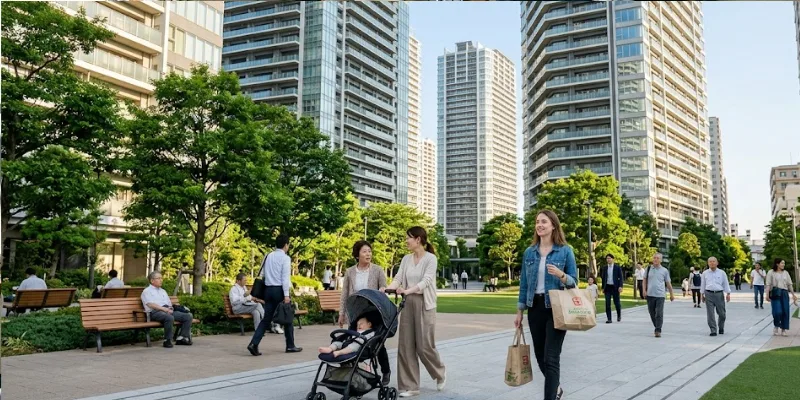
Musashi-Kosugi has transformed into one of the most sought-after Tokyo-adjacent neighborhoods — a cluster of high-rise condominiums with excellent access to Shinjuku (Shonan-Shinjuku Line: 24 min) and Shibuya (Tokyu Toyoko: 21 min).
- Kawasaki apartments rent: 1K from ¥78,000, 1LDK from ¥105,000 (premium within Kawasaki)
- Character: Modern, family-oriented, high-rise residential
- Best for: Couples, young families, commute-time priority
Takatsu-ku / Miyamae-ku — Tokyu Den-en-toshi Line corridor
These wards follow the same line covered in our Den-en-toshi Line apartments for rent guide. Quieter residential character, good schools, slightly longer commute to Shibuya (30–38 min), lower rents.
- Kawasaki apartments rent: 1K from ¥67,000, 1LDK from ¥90,000
- Character: Suburban residential, quiet, family-oriented
- Best for: Families prioritizing space and quiet over central access
Kawasaki Apartments for Rent for Foreigners: Prices by Type (2026)
| Type | Size | Avg. monthly rent | Notes |
| 1R | 18–22㎡ | ¥58,000–¥70,000 | Small single room |
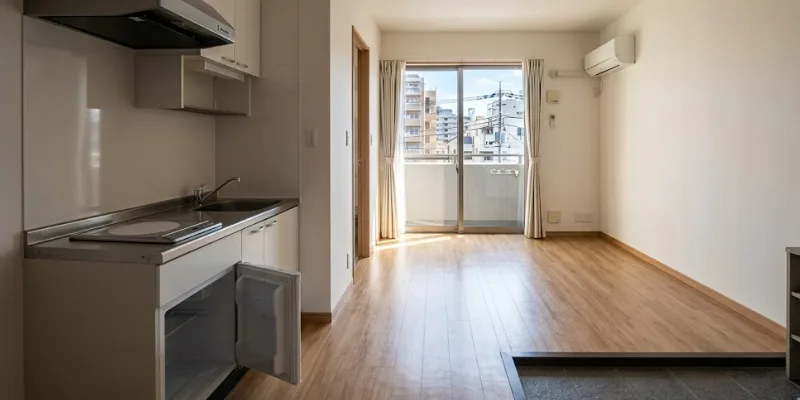
| 1K | 20–28㎡ | ¥65,000–¥82,000 | Standard studio with kitchen |
| 1LDK | 35–50㎡ | ¥88,000–¥120,000 | Living room + bedroom |
| 2LDK | 50–70㎡ | ¥120,000–¥158,000 | Two bedrooms |
Source: SUUMO Kawasaki rental data, Q1 2026.
Commute Times from Kawasaki to Central Tokyo
| From | To | Line | Time |
| Kawasaki Station | Shinagawa | JR Keihin-Tohoku | 16 min |
| Kawasaki Station | Yokohama | JR Keihin-Tohoku | 9 min |
| Kawasaki Station | Shibuya | Tokyu Toyoko | 30 min |
| Musashi-Kosugi | Shinjuku | JR Shonan-Shinjuku | 24 min |
| Musashi-Kosugi | Shibuya | Tokyu Toyoko | 21 min |
| Tama-Plaza | Shibuya | Tokyu Den-en-toshi | 31 min |
Source: JR East / Tokyu timetable data, 2026. External reference: Tokyu Railway route map and timetables.
How Foreigners Rent Kawasaki Apartments for Rent
The Kawasaki apartment rental process follows standard Japanese procedure. For foreigners:
Documents required:
- Residence Card (在留カード) + passport copy
- Proof of income — employment contract or 3 months’ payslips
- Guarantor — rental guarantee company accepted at most Kawasaki listings
- Emergency contact in Japan
Kawasaki-specific notes:
- Kawasaki City Hall’s KIAN (International Center) provides multi-language housing consultation — useful if you hit friction in the application
- Many Kawasaki landlords are private individuals; using an agency with foreigner application experience removes most of this friction
- Working holiday visa holders: provide a 6-month bank statement and guarantee company approval — most Kawasaki landlords accept this
External reference: Kawasaki City International Association (KIAN) — official support for foreign residents, including housing assistance.
For the full document and process overview, see our guide on how to rent a Japan apartment from overseas before arrival.
Kawasaki vs. Inner Tokyo Wards: Is the Trade-Off Worth It?
| Kawasaki 1K | Shinjuku 1K | |
| Monthly rent | ¥68,000–¥80,000 | ¥85,000–¥95,000 |
| Monthly saving | ¥15,000–¥25,000 | — |
| Annual saving | ¥180,000–¥300,000 | — |
| Commute to Shinjuku | 24–32 min | 0–15 min |
| Foreigner acceptance | High | High |
Over a 2-year lease, Kawasaki apartments for rent for foreigners save ¥360,000–¥600,000 vs an equivalent Shinjuku unit. For most foreigners, the commute trade-off is easily justified.
FAQ: Kawasaki Apartments for Rent for Foreigners
Do Kawasaki landlords accept foreign nationals? Yes. Kawasaki has one of the highest foreign resident ratios in Kanagawa Prefecture, and most professional landlords and management companies are experienced with foreign applicants.
Is Kawasaki in Tokyo? No — Kawasaki is in Kanagawa Prefecture, but it is directly adjacent to Tokyo and fully integrated into the Tokyo metropolitan rail network.
Can I register my address at a Kawasaki apartment? Yes. Register at the ward office (区役所) of your specific ward with your Residence Card and lease agreement.
What visa types are accepted? Most visa types: work, engineer/specialist, student, working holiday, spouse. Working holiday holders may need a guarantee company plus a 6-month bank statement.
Is Musashi-Kosugi good for foreigners? Yes — popular with both Japanese and foreign residents, with modern high-rises, international-level supermarkets, and English-friendly infrastructure. Rents are higher than the Kawasaki average but still below central Tokyo.
For what to check before signing any apartment in the Kawasaki or Tokyo area, see our Japan apartment rental mistakes foreigners should avoid.
→ Browse Kawasaki and Tokyo apartments for foreigners
Schools and Family Life in Kawasaki
For families considering Kawasaki apartments for rent, education infrastructure is a major factor. Kawasaki has a mix of public schools (requiring Japanese language proficiency for full integration) and several international school options accessible via the Tokyu lines:
- Yokohama International School — accessible from Musashi-Kosugi via a combination of Tokyu and JR lines, roughly 35–40 minutes
- St. Maur International School (Yokohama) — similarly accessible, popular with expat families in the Kawasaki/Yokohama corridor
- Local public schools — Kawasaki City’s Board of Education provides Japanese language support programs for non-native speaking children, though the intensity of support varies by ward
Families prioritizing proximity to international schools may find that the time saved by living in central Tokyo is offset by higher rent — running the numbers on door-to-door commute time for children, not just adults, is worth doing before settling on Kawasaki versus a central ward.
Healthcare Access in Kawasaki
Kawasaki has solid healthcare infrastructure for foreign residents, including:
- Kawasaki Municipal Hospital — general hospital with some English-language support capacity
- St. Marianna University School of Medicine Hospital — a major teaching hospital in the city, well-equipped for specialist care
- Numerous private clinics, particularly concentrated around Kawasaki Station and Musashi-Kosugi, though English-language capacity varies clinic to clinic
The Kawasaki International Association (KIAN) maintains an updated list of medical facilities with multilingual support — a useful resource to bookmark before you need it rather than searching for it during a medical situation.
Shopping, Daily Life, and Amenities
Kawasaki’s daily living infrastructure compares favorably with central Tokyo wards at a lower cost base:
- Lazona Kawasaki Plaza — one of the largest shopping complexes in the Kanto region, directly connected to Kawasaki Station, with a full range of retail, dining, and a large supermarket
- Musashi-Kosugi’s Grand Tree Musashi-Kosugi — a major shopping mall serving the high-rise residential area, with an international grocery section catering to the area’s expat population
- 100-yen shops, drugstores, and convenience stores — standard Japanese urban density throughout Kawasaki-ku and Nakahara-ku
For grocery shopping specifically, foreign residents in Kawasaki report good access to international ingredients through stores like Seijo Ishii (multiple locations) and the international section at major supermarkets near Musashi-Kosugi.
Comparing Kawasaki to Other Tokyo-Adjacent Cities
Kawasaki isn’t the only lower-cost alternative to central Tokyo. Here’s how it stacks up against other commonly considered options:
| City | Avg. 1K rent | Commute to Shinjuku | Foreign resident ratio |
| Kawasaki | ¥65,000–¥82,000 | 24–32 min | ~3.8% |
| Saitama City | ¥58,000–¥75,000 | 25–35 min | ~2.9% |
| Chiba City | ¥55,000–¥70,000 | 35–45 min | ~3.1% |
| Yokohama | ¥70,000–¥90,000 | 30–40 min | ~3.5% |
Kawasaki’s advantage over Saitama and Chiba is primarily commute time and the strength of the Tokyu rail network’s connections into Shibuya specifically — useful if your workplace or social life is concentrated in that part of Tokyo rather than Shinjuku or the eastern side of the city.
Internal Resources for Kawasaki and Kanagawa Renters
- Kanagawa apartments for rent for foreigners — prefecture-wide overview beyond Kawasaki specifically
- Den-en-toshi Line apartments for rent — detailed look at the rail corridor connecting western Kawasaki to Shibuya
- Sagamihara apartments for rent near Camp Zama — for those considering other parts of Kanagawa Prefecture
- Yokosuka apartment for rent near the Navy base — further south in Kanagawa, relevant for military-affiliated renters
Moving Logistics: Kawasaki-Specific Considerations
Moving into a Kawasaki apartment follows the same general process as moving anywhere in Japan, with a few city-specific points worth noting:
Garbage sorting rules differ by ward. Kawasaki’s waste separation rules (burnable, non-burnable, recyclables, oversized items) follow the same general Japanese framework as Tokyo, but specific collection days and sorting categories vary by ward within Kawasaki. Your apartment management company or landlord typically provides a printed schedule at move-in — keep it, since rules are strictly enforced and incorrectly sorted garbage is often left uncollected with a warning tag.
Utility setup timing. Electricity and water can usually be activated same-day or next-day in Kawasaki, similar to Tokyo. Gas requires an in-person technician visit to turn on the meter and inspect connections — book this at least 3–5 days in advance, particularly during the high-demand moving seasons of March–April and September.
Moving company costs. Given Kawasaki’s slightly more affordable market overall, moving company quotes for relocating within or into Kawasaki tend to run 10–15% lower than equivalent moves within central Tokyo wards, reflecting both lower demand density and easier truck access in less congested areas.

Real estate advisor at Arealty Japan, specialising in helping foreign residents navigate the Tokyo and Osaka rental markets. Lucy has guided hundreds of international renters — from Working Holiday visa holders to corporate relocations — through Japan’s apartment application process. Her writing draws on firsthand experience with landlord screening, guarantor companies, and foreigner-friendly listings across all 23 Tokyo wards and major Kansai cities.



Leave a Reply