


Setagaya is Tokyo’s most populous ward — home to roughly 950,000 residents across a sprawling network of residential neighborhoods, each with its own character. It is also one of the wards with the highest long-term expat retention: international residents who move here tend to stay, often for years longer than originally planned.
This guide covers everything you need to know to find an apartment for rent in Setagaya: how rents break down by unit type and neighborhood, which areas suit which lifestyles, commute times to major business districts, and how to navigate the application process as a foreign resident.
If you’re ready to browse listings now, see Arealty’s current Setagaya apartments for rent. Otherwise, read on for the full picture.
Why Foreign Residents Choose Setagaya
Setagaya sits southwest of central Tokyo, served by the Tokyu Den-en-toshi, Tokyu Oimachi, Keio Inokashira, Odakyu, and Setagaya (tram) lines. It is not the closest ward to Tokyo’s business core — but for a large share of the city’s international community, it offers a combination that closer wards do not.
Transit access without inner-city density. Sangenjaya reaches Shibuya in 3 minutes. Shimokitazawa reaches Shinjuku in 15. Yet both neighborhoods are low-rise, green, and quiet by Tokyo standards — a contrast that residents from high-density inner wards notice immediately.
An established expat ecosystem. Setagaya has decades of international resident history. International schools — including Seisen International School and Tokyo International School — are within the ward or its immediate surroundings. English-speaking doctors, international supermarket access, and a rental market practiced in handling foreign applications are built into the ward’s infrastructure.
Value relative to Minato. For a comparable 1LDK, Setagaya typically runs ¥40,000–¥70,000 per month less than Minato ward — while offering shorter commutes to Shibuya and comparable access to international community infrastructure.
For a full comparison of Setagaya against all 23 Tokyo wards across rent, commute, and foreigner-friendliness, see our Tokyo 23 Wards Apartment Rental Comparison Guide.
How Much Does It Cost to Rent in Setagaya?
Setagaya’s size means rent varies considerably by neighborhood and proximity to station. The table below reflects market ranges as of Q2 2026.
| Unit type | Monthly rent range | Notes |
| 1K / Studio | ¥85,000–¥115,000 | Compact units near station |
| 1DK | ¥95,000–¥130,000 | Popular with single professionals |
| 1LDK | ¥120,000–¥175,000 | Most common for couples |
| 2LDK | ¥160,000–¥230,000 | Families, residential streets |
| 3LDK+ | ¥200,000–¥320,000+ | Denenchofu, Yoga, premium pockets |
The lower end of each range corresponds to areas further from major stations or buildings with higher chikunensu (building age). The upper end reflects newer builds in desirable pockets like Sangenjaya, Yoga, and Futako-tamagawa.
For broader Tokyo pricing context and how Setagaya’s ranges compare to neighboring wards, see our Tokyo apartment rent trends 2026 guide.
One cost that catches many renters off guard: restoration fees when you eventually move out. Japanese landlords can deduct these from your deposit, though tenant protections under Japanese law are stronger than many foreign residents realize. Read our guide to restoration costs in Japan before signing any lease.
Setagaya’s Main Neighborhoods — Which One Fits Your Lifestyle?
Setagaya is not one neighborhood — it is a collection of distinct micro-areas connected by rail lines. Your experience of living in the ward depends almost entirely on which part you choose.
Sangenjaya — Best for Young Professionals and Social Life
Sangenjaya sits three minutes from Shibuya on the Tokyu Den-en-toshi Line and has developed into one of Tokyo’s most consistently popular neighborhoods for international residents in their 20s and 30s. The area around the station is dense with cafés, izakayas, independent restaurants, and a nightlife scene that draws residents from across the city.
Despite its proximity to Shibuya, Sangenjaya retains a distinctly local character — the Sangen-jaya shotengai (covered shopping street) and surrounding residential blocks feel markedly less commercial than the areas immediately around Shibuya or Ebisu.
Average 1K rent: ¥90,000–¥115,000. For a detailed neighborhood breakdown including specific streets and building types, see our Sangenjaya neighborhood guide.
Shimokitazawa — Best for Creative Professionals
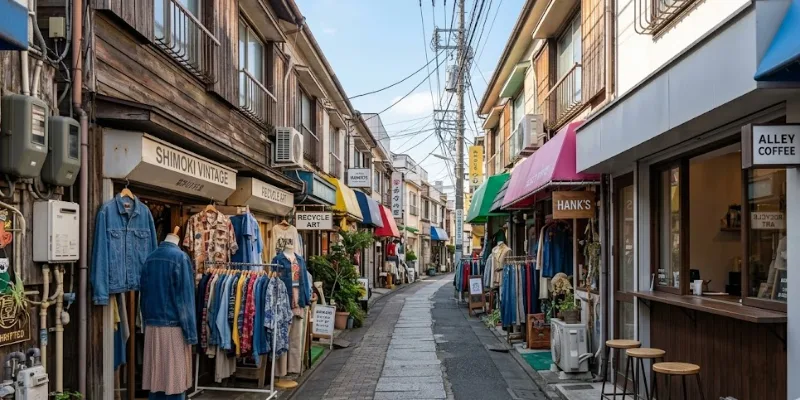
Shimokitazawa is Tokyo’s center for live music, independent theater, and vintage fashion — a neighborhood with a decades-long creative subculture that continues to draw artists, musicians, and international residents who value that environment. Streets are narrow and pedestrian-scaled, building density is low, and the neighborhood has successfully resisted the large-scale commercial development that has transformed comparable areas in other wards.
Shimokitazawa reaches Shibuya in 5 minutes (Keio Inokashira Line) and Shinjuku in approximately 15 minutes via the Odakyu Line. Average 1K rent: ¥88,000–¥110,000 — some of the best value in the ward for its access level.
Yoga and Futako-tamagawa — Best for Families
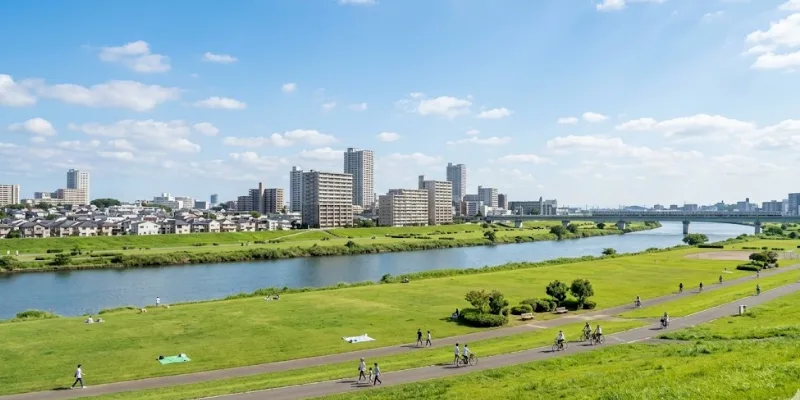
Yoga and Futako-tamagawa sit further along the Tokyu Den-en-toshi Line — 12–18 minutes from Shibuya — and offer a significantly more spacious, family-oriented residential environment. Futako-tamagawa’s riverside location along the Tama River provides cycling paths, parks, and open space that is rare in central Tokyo. The area is also home to Rakuten’s headquarters, making it a natural base for tech industry professionals.
International school access is strong from this part of the ward — Seisen International School and Tokyo International School are both within reasonable distance. Larger unit types (2LDK and above) are more common here than in the station-adjacent neighborhoods, and building quality skews newer.
Denenchofu — Premium Garden Suburb
Denenchofu is Setagaya’s most prestigious residential enclave — a planned garden suburb of circular tree-lined streets, large plots, and a quiet exclusivity that is unusual in Tokyo. Modeled loosely on English garden city principles when developed in the early 20th century, it has retained its character while becoming home to some of Tokyo’s most expensive residential real estate.
The Tokyu Toyoko Line reaches Shibuya in approximately 15 minutes. Rents start at ¥150,000+ for a 1LDK and rise sharply for larger units. Denenchofu suits senior executives, families with significant housing budgets, or those relocating from comparable luxury residential environments abroad.
Setagaya and Sangenchaya — Quiet Residential Value
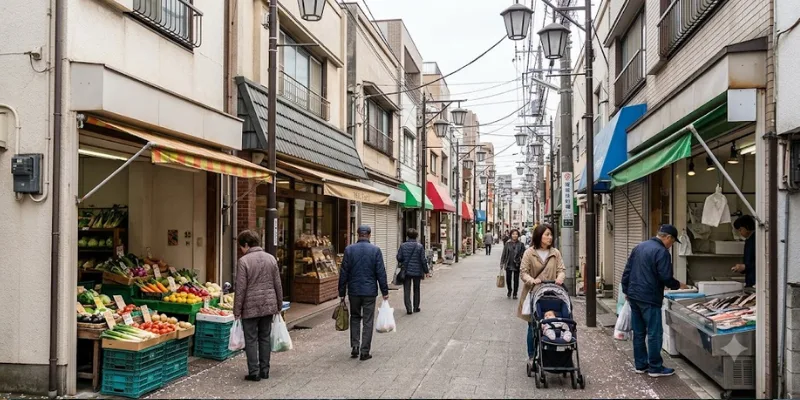
Away from the station hubs, Setagaya’s residential backstreets offer a quieter, more local experience at rents that trend toward the lower end of the ward range. The Setagaya Line — a vintage tram that runs between Sangenjaya and Shimotakaido — adds genuine character and provides slow but convenient access between neighborhoods. This part of the ward suits long-term residents who have settled into Tokyo life and prioritize calm over convenience.
Commute Times from Setagaya
| Destination | From Sangenjaya | From Shimokitazawa | From Yoga |
| Shibuya | 3 min | 5 min | 12 min |
| Shinjuku | 18 min | 15 min | 25 min |
| Otemachi / Tokyo Station | 30 min | 35 min | 28 min |
| Shinagawa | 25 min | 30 min | 20 min |
| Ikebukuro | 30 min | 25 min | 35 min |
All figures are approximate door-to-platform times using standard services; peak-hour transfer times at Shibuya should be added for onward journeys. From Shibuya, connections to the Yamanote, Ginza, Hanzomon, and Fukutoshin lines put virtually every major business district in Tokyo within 40–45 minutes of most Setagaya neighborhoods.
For a full methodology on calculating realistic commute times — including walking pace, transfer complexity, and train type variables — see our Tokyo commute time guide.
What Foreign Residents Need to Know About Renting in Setagaya
Foreigner-Friendliness
Setagaya is one of the more reliably foreigner-friendly wards in Tokyo from a landlord perspective. Its long history of international residents means many landlords in the ward — particularly those in Sangenjaya, Yoga, and Shimokitazawa — have prior experience with foreign tenants and are comfortable with guarantor company applications in lieu of a personal Japanese guarantor.
That said, the rental market still operates in Japanese, and lease documents are not standardized in English. Working with an agency that can communicate with landlords on your behalf and translate key lease clauses before you sign remains essential. Our step-by-step guide to renting in Japan as a foreigner covers the full application process across all Tokyo wards.
Documents to Prepare
- Residence card (zairyu card, 在留カード)
- Proof of employment and income (gensen choshu hyo or employment contract with salary stated)
- Three months of bank statements
- Passport copy
- Guarantor company application (Arealty can connect you with accepted providers)
Initial Costs: What to Budget
| Fee | Typical amount |
| Shikikin (security deposit) | 1–2 months’ rent |
| Reikin (key money) | 0–2 months’ rent |
| Agency fee | 1 month’s rent |
| Guarantor company fee | 0.5 month’s rent |
| Fire insurance + lock change | ¥15,000–¥25,000 |
| Total upfront (typical) | ¥300,000–¥600,000 |
Some landlords in Setagaya — particularly on newer buildings — waive key money entirely. This is worth asking about specifically during your search, as it can meaningfully reduce your initial outlay.
What Residents Say About Living in Setagaya
The following experiences are drawn from Arealty client placements in Setagaya; names have been withheld at client request.
A British couple who relocated from London to Sangenjaya: “We’d been looking at Hiroo first because we assumed that’s where we should be. Our advisor at Arealty suggested Sangenjaya — Shibuya in 3 minutes, much more residential feel, and we saved around ¥60,000 a month on rent. We’ve been here two years and wouldn’t move.”
An American professional in Shimokitazawa: “The neighborhood has everything I wanted from Tokyo without the noise or the price tag. I take the train to Shinjuku in 15 minutes every morning. The coffee shops and the music venues are a 5-minute walk. It’s a good life.”
An Australian family in Futako-tamagawa: “The riverside parks were honestly the deciding factor. The kids cycle down to the river on weekends. We have more space than we did in Sydney. It took us a while to find — we needed a 3LDK with a specific school catchment — but Arealty found it within about three weeks.”
Find Your Setagaya Apartment with Arealty
Arealty maintains curated listings across Setagaya’s main neighborhoods, filtered for foreigner-friendly landlords and with clearly explained fee structures. Every listing includes full Japanese lease documentation with English explanation provided by our advisory team before signing.
Browse current Setagaya apartments for rent →
Our multilingual team is available for consultations in English and Japanese — whether you’re comparing neighborhoods, calculating total move-in costs, or ready to submit an application. There are no hidden fees on Arealty’s side of the transaction.
Conclusion
Setagaya offers what most international residents come to Tokyo looking for: a residential environment with genuine character, strong transit access to the places that matter, and a community infrastructure that has been built up over decades of international presence. It is not the cheapest ward in Tokyo, nor the most central — but for livability per yen, it consistently outperforms wards at comparable or higher price points.
Which neighborhood suits you depends on what you’re optimizing for: Sangenjaya for social proximity to Shibuya, Shimokitazawa for creative calm, Yoga and Futako-tamagawa for family space, Denenchofu for premium quiet. The commute math works across all of them.
To compare Setagaya against every other Tokyo ward across rent, commute time, and foreigner-friendliness, see our Tokyo 23 Wards Apartment Rental Comparison Guide.
Further Reading
- Tokyo 23 Wards Apartment Rental Comparison 2026
- Sangenjaya Neighborhood Guide
- Renting in Japan as a Foreigner — Step by Step
- Tokyo Apartment Rent Trends 2026
- Restoration Costs When Moving Out in Japan
- Tokyo Commute Time Guide
References
- Tokyo Metropolitan Government. Setagaya Ward: Population and Administrative Overview. 2025.
- Ministry of Land, Infrastructure, Transport and Tourism. Rent Level Survey by Prefecture and City, 2025.
- Tokyu Corporation. Den-en-toshi and Toyoko Line Transit Time Data.

Real estate advisor at Arealty Japan, specialising in helping foreign residents navigate the Tokyo and Osaka rental markets. Lucy has guided hundreds of international renters — from Working Holiday visa holders to corporate relocations — through Japan’s apartment application process. Her writing draws on firsthand experience with landlord screening, guarantor companies, and foreigner-friendly listings across all 23 Tokyo wards and major Kansai cities.




Leave a Reply