


Where you live in Tokyo affects every morning and evening of your working life. Yet most apartment searches begin with a ward name or a rent range — not with a realistic assessment of what the daily journey will actually look and feel like. This guide explains how commute times work in Tokyo, which trade-offs matter most, and how to use transit data to make a better housing decision.
How Long Is the Average Commute in Tokyo?
Japan’s commute data is well-documented. According to the 2021 Social Life Basic Survey by the Statistics Bureau of Japan, the national average one-way commute is approximately 39.5 minutes. Within the Kanto region, that figure rises considerably.
| Region | Average one-way commute |
| National average | 39.5 minutes |
| Tokyo Metropolis | 47.5 minutes |
| Kanagawa Prefecture | 50.0 minutes (longest nationally) |
| Osaka | ~40 minutes |
For Tokyo residents, this translates to roughly 95 minutes of transit per working day — nearly 8 hours per week spent on trains. That number has a direct effect on energy levels, free time, and quality of life, which is why commute time consistently ranks as the top factor in apartment decisions among both domestic and international residents in Japan.
A separate survey by A-realty of 300 Tokyo-area residents found that 68% cited commute time as their primary criterion when selecting a rental — ranking above rent, floor area, and building age.
Renters vs. Owners: A Key Distinction
Data from the 2018 Housing and Land Survey shows that approximately 61% of rental tenants in Japan commute less than 30 minutes one-way, compared to a significantly lower share of homeowners. This reflects the practical advantage of renting: the ability to relocate when a job changes, without being tied to a fixed asset. For foreign professionals on work visas — whose employers or roles may shift — this flexibility is especially relevant.

Why “Distance” Is the Wrong Metric
In Tokyo, the number of kilometers between home and office is almost meaningless as a planning metric. What matters is door-to-door time: from apartment entrance to office floor, accounting for walking pace, lift wait times, platform transfers, train frequency, and exit navigation at the destination.
Japanese real estate listings standardize walking time at 80 meters per minute, but this baseline excludes several real-world variables that can add 5–10 minutes to a listed walk time:
- Steep inclines or long staircases (common in hillside neighborhoods such as parts of Meguro and Shibuya)
- Level crossings (fumikiri, 踏切) that close frequently during peak hours
- Long station concourses at major interchanges — Shinjuku Station, for instance, has over 50 exits and can take 5–7 minutes to navigate end-to-end
- Weather: Tokyo’s summer humidity and winter rain slow walking pace and increase platform crowding
The practical rule: before committing to any apartment, simulate the commute in person during morning peak hours — ideally on a Tuesday, Wednesday, or Thursday, which represent typical peak-load days on Tokyo’s network.
Transfer Frequency and Train Type: The Variables That Matter Most
Two routes with identical listed travel times can feel completely different depending on how many transfers are involved and what type of service runs the line.
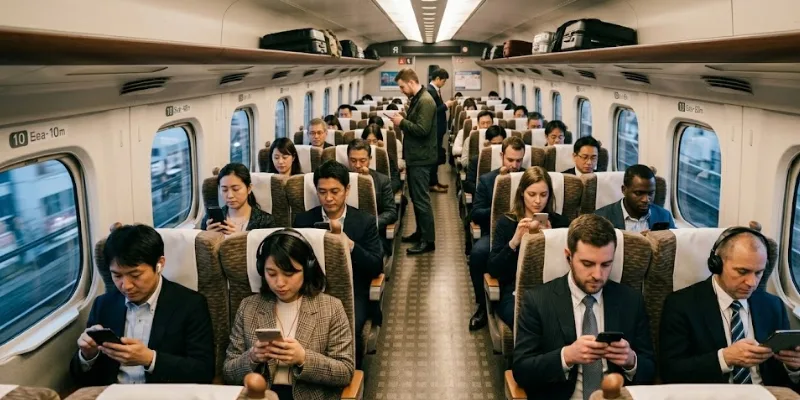
Zero-transfer commutes are significantly more comfortable than those requiring one or two changes, even if the journey is slightly longer. Standing in a crowded carriage for 35 minutes on a direct line is objectively less fatiguing than 25 minutes involving two platform changes with tight connection windows.
Train type matters on the same line. Many Tokyo lines run multiple service types on the same tracks:
- Local (kakueki-teisha, 各駅停車): Stops at every station — slower, but easier to board
- Rapid (kaisoku, 快速) / Express (kyūkō, 急行): Skips smaller stations — faster overall, but only useful if your home and destination stations are served
- Limited Express (tokkyū, 特急): Fastest, but may require a surcharge and seat reservation
Living on a line that offers express services — and at a station those services actually stop at — can cut 10–15 minutes from a daily commute compared to a local-only station of nominally similar distance.
Neighborhoods With Strong Commute-to-Rent Ratios
The best area to live for commuting in Tokyo depends entirely on where your office is located. That said, several neighborhoods consistently offer strong transit access without the rent premium of central wards. Each of the areas below connects directly to major business districts while maintaining a more residential character. For current rent levels by ward and neighborhood type, see our Tokyo apartment rent trends for 2026.
For Shinjuku and West Tokyo workplaces
Nakano sits two stops west of Shinjuku on the Chuo Line — 4–6 minutes by rapid service. It retains a local, neighbourhood feel while being one of the most accessible residential areas in the city. Rents run notably lower than Shinjuku itself for comparable floor plans.
Mitaka is the western terminus of the Chuo-Sobu local line and a Chuo Rapid Line stop — 19 minutes to Shinjuku. Because trains originate here, boarding an empty carriage in the morning is reliably possible, making it a popular choice for professionals who want to read or work during their commute.
For Shibuya, Ebisu, and South-Central workplaces
Sangenjaya sits two stops from Shibuya on the Tokyu Den-en-toshi Line — 5 minutes direct — and has long been popular among younger professionals and international residents for its independent cafés, restaurants, and residential streets.
Jiyūgaoka offers access to both Shibuya (Tokyu Toyoko Line, ~15 minutes) and Meguro (short taxi or bus), with a distinctly residential atmosphere and a high concentration of international-friendly businesses.
For Ueno, Akihabara, and East Tokyo workplaces
Ueno itself functions as a transit gateway to northeastern Tokyo and Saitama, with Shinkansen access from Ueno Station for those who travel between cities. Living in adjacent neighborhoods like Yanaka or Nezu provides a quieter residential base while remaining within walking distance of the Yamanote and Ginza lines.
For a full neighborhood comparison including rent ranges, proximity to international schools, and walkability scores, see our guide to affordable neighborhoods in Tokyo for foreign residents.
The Rent-vs-Commute Calculation
There is a consistent mathematical relationship between station proximity and rent in Tokyo. Centrally located wards — Minato, Chuo, Chiyoda — command significant premiums because they eliminate transit time. Moving two or three stations away from a major hub typically reduces rent by 15–20% for a comparable unit, while adding 10–15 minutes to the daily journey.
Whether that trade-off makes sense depends on your specific situation. A useful framework:
Calculate the total monthly cost of each option:
- Rent + commuter pass cost (teikiken, 定期券) at the longer-commute apartment
- Rent alone at the centrally located apartment (or lower pass cost)
The difference is often smaller than expected, because Japanese employers legally require commuter pass reimbursement for most full-time roles. Confirm your employer’s policy before treating commute cost as entirely personal.
Apply the 30% rule: Housing costs — rent plus associated fees — should ideally remain below 30% of monthly take-home income. For context on what income ranges look like across different professions in Japan, our Japan average salary guide covers industry benchmarks for both Japanese and internationally-hired professionals.
Common Compromises in Central Tokyo
If a short commute is non-negotiable, expect to trade on one or more of the following:
- Floor area: Studio and 1K apartments in central wards typically range from 20–35㎡ — significantly smaller than equivalent-rent options further out
- Building age: Older buildings (higher chikunensu, 築年数) are more common in established central neighborhoods, though many have been retrofitted to post-2000 earthquake standards
- Natural light and floor level: High-density central areas mean more units with limited direct sunlight or lower floor positions

Using Commute-Based Search Filters Effectively
Most major Japanese real estate platforms — SUUMO, HOMES, Arealty — include a “time to station” filter. Rather than browsing by ward name, try this approach:
- Set your destination station (your office’s nearest station)
- Filter for a maximum door-to-door time of 30 or 40 minutes
- Expand from there based on rent range and apartment type
This often surfaces options in neighborhoods you would not have searched manually — areas with excellent transit links but lower brand recognition than wards like Shibuya or Roppongi. Our guide to finding apartments in Tokyo as a foreign resident explains how to navigate Japanese listing platforms and what filters matter most for international applicants.
Verify Before You Commit
Before signing any lease, the following checks are worth doing in person:
- Walk the route from apartment entrance to station platform at your normal pace — during morning peak hours if possible
- Confirm elevator availability if commuting with luggage, a stroller, or cycling equipment
- Identify at least one backup route in case of service disruption — Tokyo’s network is highly reliable, but line suspensions do occur, particularly after earthquakes
Initial Costs and What to Budget for
Whichever neighborhood you choose, Japan’s rental system involves significant upfront costs beyond the first month’s rent. These typically include a security deposit (shikikin), key money (reikin), agency fee, and guarantor company fee — collectively often totalling four to six months’ rent before moving in. Our guide to restoration costs in Japan also explains what you may be charged when you eventually leave, which is worth understanding before committing to a lease.
For English-language support navigating these fees — and for working with agencies that have established relationships with landlords open to international applicants — see our list of top real estate agencies in Tokyo for foreigners.
Conclusion: Plan Around the Journey, Not Just the Destination
Choosing where to live in Tokyo is ultimately a decision about how you want to spend your time. The average one-way commute of 47.5 minutes is not inevitable — it is a starting point. With careful line selection, realistic door-to-door calculations, and a willingness to explore neighborhoods beyond the most familiar ward names, most professionals can find an apartment in Tokyo that keeps the daily journey under 35–40 minutes while staying within a sensible budget.
The most effective approach is to map your commute first, then filter for apartments — not the other way around.
Further Reading
- Affordable neighborhoods in Tokyo for foreign residents
- Tokyo apartment rent trends 2026
- Renting in Tokyo as a foreigner — step-by-step
- Restoration costs when moving out in Japan
- Average salary in Japan 2026 — by industry and visa type
Looking for apartments in Tokyo filtered by commute time? Browse Arealty’s Tokyo listings or speak with our multilingual advisory team.
References
- Statistics Bureau of Japan. 2021 Social Life Basic Survey (Shakai Seikatsu Kihon Chōsa). Ministry of Internal Affairs and Communications.
- Statistics Bureau of Japan. 2018 Housing and Land Survey.

Real estate advisor at Arealty Japan, specialising in helping foreign residents navigate the Tokyo and Osaka rental markets. Lucy has guided hundreds of international renters — from Working Holiday visa holders to corporate relocations — through Japan’s apartment application process. Her writing draws on firsthand experience with landlord screening, guarantor companies, and foreigner-friendly listings across all 23 Tokyo wards and major Kansai cities.




Leave a Reply