
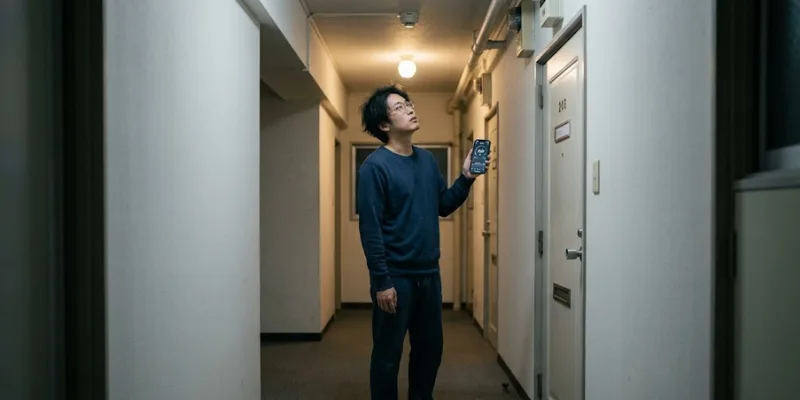

If you have noisy neighbors upstairs in Japan, do not knock on their door. Japanese rental protocol requires you to contact the management company (kanri kaisha 管理会社) with documented evidence — timestamps, decibel readings, and noise type. Japan’s Ministry of the Environment sets nighttime noise limits at 45 dB for residential areas (22:00–06:00). If sound exceeds this consistently, your landlord is legally obligated to act under the Act on Land and Building Leases.
This guide explains the exact protocol Japanese tenants use to resolve upstairs noise issues, the prohibited actions that will damage your standing as a tenant, and when relocation becomes the right choice.
Legal Noise Limits in Japan
Japan’s noise standards come from the Ministry of the Environment (環境省), under the Environmental Quality Standards for Noise (騒音に係る環境基準).
| Time Period | Residential Limit | AA-Type Quiet Area |
| Daytime (06:00–22:00) | 55 dB | 50 dB |
| Nighttime (22:00–06:00) | 45 dB | 40 dB |
Key facts (April 2026):
- These are environmental standards, not direct legal violations — but they form the basis for civil claims and management company action
- A normal conversation at 1 meter measures roughly 60 dB
- Footsteps on hardwood floor without rugs typically register 55–70 dB at the unit below
- Vacuum cleaners produce 70–80 dB; running washing machines, 60–75 dB
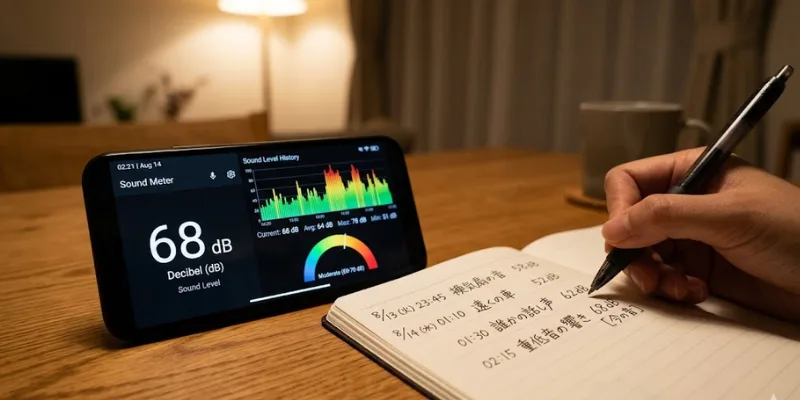
- Standard smartphones can measure decibel levels accurately enough for documentation using apps like “Sound Meter” (Android) or “Decibel X” (iOS)
Source: Ministry of the Environment — Environmental Quality Standards for Noise
For verifying whether your building’s sound transfer is within typical Japanese standards, see our guide on how to check soundproofing during apartment viewing.
Two Types of Apartment Noise
Most noise complaints in Japanese apartments fall into two categories. Misdiagnosing the source is the #1 reason complaints fail to resolve.
Airborne Sound (空気伝搬音)
Sound traveling through air — voices, TV, music, dog barking. Travels through walls and windows. Generally easier to dampen with soundproof curtains, weatherstripping, or wall panels.
Structure-Borne Sound (固体伝搬音)
Sound traveling through the building’s structural frame — footfalls, chair scraping, washing machine vibrations, dropped objects. Cannot be dampened with curtains — it requires architectural intervention.
Diagnosis test: If your complaint is about footsteps, banging, or vibrations, you have structure-borne sound. If it’s about voices, music, or TV, you have airborne sound.
Japanese landlords treat these differently. Structure-borne complaints carry more weight because they typically indicate either tenant violation (subwoofer on floor, child running at night) or building defect — both trigger landlord action. Airborne complaints are often dismissed as “normal living sounds” unless extreme.
The 4-Step Resolution Protocol
Standard 4-step protocol used across Japan in 2026. Do not skip steps.
Step 1: Verify the actual source (Days 1–3)
Before reporting, confirm the noise comes from the unit directly above. In steel-reinforced concrete buildings, vibrations travel laterally — sound that “feels” upstairs may originate from a diagonal unit, two floors up, or shared plumbing.
Test by listening at multiple times of day, placing your hand on ceiling vs. wall vs. floor to identify direction, and asking a trusted neighbor on the same floor whether they hear the same noise.
Step 2: Maintain a noise log (minimum 7 days)
A documented log is required for management company action. Vague descriptions like “they’re loud at night” will not produce results.
Example log entry:
April 22, 2026 — 02:15 to 03:00 (45 minutes) Dragging sounds across ceiling, intermittent banging Decibel reading: 58–67 dB (nighttime limit: 45 dB) Sound type: structure-borne (vibration felt through ceiling) Source verified: directly above (Unit 502)
Maintain at minimum 7 days of entries before contacting management. Best results come from 2-week logs showing consistent pattern.
Step 3: Contact the management company
Send your noise log via email or written notice — never just phone call. Email creates a paper trail. Include your unit number, complete log, suspected source unit, statement that nighttime readings exceed the 45 dB Ministry standard, and request for specific action.
Management companies typically respond in 3 escalation tiers:
- Tier 1 (within 1 week): General notice posted in building lobby
- Tier 2 (within 2–3 weeks): Flyers distributed to specific units if Tier 1 fails
- Tier 3 (within 4–6 weeks): Direct phone call or visit to offending tenant when evidence is substantial
Step 4: Escalate if needed (After 30 days)
If management has been contacted twice and noise persists past 30 days:
- Request landlord direct intervention
- File formal complaint with local ward office (区役所 ku-yakusho)
- Consult Tokyo Metropolitan Government Housing Information Center (free, multilingual)
- For severe cases, engage a lawyer specializing in Japanese rental law
For broader context on tenant rights, see our property damage compensation guide.
What NOT to Do (3 Prohibited Actions)
Japanese landlords maintain records on every tenant. Three actions can flip your case from “innocent victim” to “troublesome tenant.”
1. Direct confrontation
Knocking on the upstairs neighbor’s door is culturally and procedurally wrong in Japan. Even with the best intent, this is perceived as intimidation. Japanese tenants do not handle disputes face-to-face — they go through the management company. Foreign tenants who knock on doors are flagged in the building’s tenant log, and future noise complaints from them are deprioritized.
2. Retaliatory noise
Banging on the ceiling with a broom, kicking walls, or playing music loudly back is the #1 mistake foreign tenants make. The moment you make retaliatory noise, you become both complainant and offender. Your standing as the “victim” disappears, and your lease can be flagged for non-renewal.
3. Public posting on social media
Posting recordings or naming the unit number publicly violates Japan’s Act on the Protection of Personal Information (個人情報保護法). This exposes you to civil liability for privacy breach, counter-claim from the neighbor for defamation, and potential eviction for breach of community trust.
Keep all evidence in private documentation. Share only with management, landlord, ward office, or your attorney.
Building Construction Affects Everything
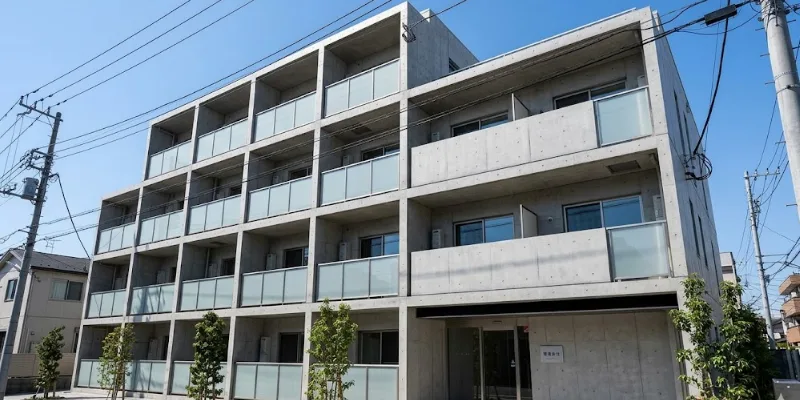
How much noise transfers through your ceiling depends almost entirely on construction type. This is the single most important factor.
| Construction Type | Japanese Name | Noise Transfer | Tokyo Rent Premium |
| Steel-Reinforced Concrete (SRC) | 鉄骨鉄筋コンクリート造 | Lowest | +15–25% |
| Reinforced Concrete (RC) | 鉄筋コンクリート造 | Low–Medium | +10–15% |
| Steel-Frame (S) | 鉄骨造 | Medium | Baseline |
| Wood-Frame (Mokuzou) | 木造 | Highest | −15–25% |
| Light Steel (LGS) | 軽量鉄骨造 | High | −10% |
Key facts (as of 2026):
- Apartments built after 1981 comply with modern earthquake standards, but earthquake-rated does not equal soundproof-rated
- Wood-frame buildings transfer 60–70% more sound between floors than RC buildings — structural, not fixable
- Newer SRC buildings (post-2010) often include floor impact isolation rated LL-45 or better, which significantly reduces footstep noise
If you’re currently in a wood-frame or light-steel building, the noise issue is likely structural rather than malicious. Relocating to an SRC or RC building solves what no protocol can fix.
For deeper analysis when searching for quieter apartments, see our soundproof rental apartment guide — including a list of LL-rated soundproof properties.
When to Move: Decision Framework
After 60 days of attempted resolution, foreign tenants face the decision: continue fighting, or relocate.
Move when any of these is true
- Building is wood-frame (mokuzou) — structural noise will not improve
- Management has refused to escalate beyond Tier 1 after 30+ days
- Health impact is documented (sleep deprivation confirmed by physician)
- Lease renewal approaching within 60 days
- Cost-benefit math favors moving (relocation cost ¥300,000–¥500,000 vs. ongoing noise impact)
Stay and continue when any of these is true
- You’re in SRC or RC building — pattern is unusual and likely behavioral
- Management has shown willingness to act (Tier 2 or 3 of escalation)
- Lease has 18+ months remaining (early termination penalties expensive)
- Specific neighbor identified — direct intervention often resolves cases
What to look for in your next apartment
- Construction: SRC or RC only — never mokuzou or light-steel
- Floor: Top floor eliminates upstairs neighbors entirely
- Position: Corner unit reduces shared walls
- Year built: Post-2010 for modern soundproofing
- LL-rating: LL-45 or better (lower number = better soundproofing)
- Viewing: Visit at multiple times — including evening and weekend
For complete viewing checklist, see our tips for checking soundproofing during viewings and restoration costs when moving out.
Frequently Asked Questions
What is the legal noise limit for apartments in Japan?
Japan’s Ministry of the Environment sets residential noise limits at 55 dB during daytime (06:00–22:00) and 45 dB during nighttime (22:00–06:00). AA-type quiet areas (near hospitals, schools) have stricter limits of 50 dB daytime and 40 dB nighttime.
Can I complain directly to my upstairs neighbor in Japan?
No. Direct confrontation is culturally and procedurally wrong in Japan. Always contact the management company (kanri kaisha 管理会社) with documented evidence — timestamps, decibel readings, and noise type. Foreign tenants who knock on neighbors’ doors are flagged in the building’s tenant log.
Should I record my upstairs neighbor’s noise as evidence?
Yes for documentation purposes. Use a smartphone decibel app to measure dB levels with timestamps. Do not post recordings on social media — this violates Japan’s Act on the Protection of Personal Information.
What if my apartment is wood-frame (mokuzou)?
Wood-frame buildings transfer 60–70% more sound between floors than reinforced concrete. The noise issue is largely structural. Relocation to an SRC or RC building is typically the only effective solution. Look for “鉄筋コンクリート造” or “鉄骨鉄筋コンクリート造” in property listings.
Can I break my lease early due to noise issues in Japan?
Standard Japanese leases have 1–2 month notice clauses. Breaking lease for noise reasons doesn’t waive penalties automatically. However, if you can document that the landlord failed to act on substantiated complaints, you may have grounds for a “constructive eviction” defense reducing penalties. Consult a Japanese rental law attorney.
Does my landlord have a legal duty to address neighbor noise?
Yes. Under Japan’s Act on Land and Building Leases (借地借家法), landlords have a duty to maintain the rented property in habitable condition. Persistent noise that exceeds Ministry of the Environment standards can constitute a breach if the landlord fails to act on documented complaints.
What’s the best apartment type to avoid noise issues?
Top-floor corner unit in an SRC building, post-2010 construction, with LL-45 or better floor rating. This combination eliminates upstairs neighbors, reduces shared walls, uses the highest-grade noise-isolating construction, and meets professional acoustic ratings. Expect 20–30% premium over standard listings.
Are there foreigner-friendly resources for noise disputes?
Yes. The Tokyo Metropolitan Government Housing Information Center offers free multilingual housing consultation. Many ward offices (区役所) provide foreign-language consultation. The Japan Federation of Bar Associations runs a foreigner consultation service in English, Chinese, Korean, and other languages. See our foreigners’ rental rejection guide for related tenant-rights topics.
Find a Quieter Apartment in Tokyo
If your noise situation cannot be resolved, Arealty specializes in matching foreign tenants with construction-grade apartments — verifying SRC/RC structures, LL-rated floors, and pre-screening for known noise-issue buildings. Our bilingual team handles property viewings at multiple times of day to test actual noise conditions.
Related guides:
- Soundproof Rental Apartments in Japan — what to look for, LL-ratings explained
- How to Check Soundproofing During Apartment Viewing
- Why Rental Applications Get Denied in Japan
- Foreigners’ Rental Rejection in Japan
- Top 5 Real Estate Agencies in Tokyo for Foreigners
- Restoration Costs When Moving Out
Contact our bilingual team for a confidential consultation on noise issues, building inspection requests, or relocation matching.

Real estate advisor at Arealty Japan, specialising in helping foreign residents navigate the Tokyo and Osaka rental markets. Lucy has guided hundreds of international renters — from Working Holiday visa holders to corporate relocations — through Japan’s apartment application process. Her writing draws on firsthand experience with landlord screening, guarantor companies, and foreigner-friendly listings across all 23 Tokyo wards and major Kansai cities.





Leave a Reply