

Foreigners can rent apartments in Japan without a job by passing Bank Balance Screening (Yokin Shinsa 預金審査) — typically requiring savings equal to 2 years of rent (¥1,920,000 for a ¥80,000/month apartment). The key is choosing the right type of guarantee company. Independent Guarantee Companies (独立系) are the most flexible for unemployed foreigners, evaluating bank balance and emergency contact rather than current employment. Plan for 30% higher upfront preparation than employed applicants.
This guide focuses on the specific approval strategy for foreigners renting without traditional employment income. For broader context on unemployed renting in Japan generally, see our companion guide on renting an apartment unemployed in Japan.
The 3 Types of Guarantee Companies (Choose the Right One)
In Japan, virtually all rentals require a Rent Guarantee Company (家賃保証会社) to act as your co-signer. There are three types, each with very different acceptance criteria for unemployed applicants. Choosing the right type determines your approval odds.
Type 1: Credit-Based (信販系 Shinpan-kei)
How they screen: Cross-check your global and domestic credit history through credit bureau networks (CIC, JICC).
Approval odds for unemployed: ❌ Low. These are the strictest. They view “no job” as automatic risk regardless of savings.
When to choose: Only if you have substantial domestic Japanese credit history with no late payments.
Type 2: Association-Based (協会系 LICC)
How they screen: Use the Nationwide Rental Guarantee Association database, which tracks rental payment history across member companies.
Approval odds for unemployed: ⚠️ Medium. They focus on past tenant behavior. If you’ve previously rented in Japan with clean payment record, you can pass even without current income.
When to choose: If you’ve rented in Japan before and never missed rent.
Type 3: Independent (独立系 Dokuritsu-kei) — BEST for Unemployed Foreigners
How they screen: Use their own internal criteria, not connected to credit bureaus or LICC. Focus on current bank balance and emergency contact reliability.
Approval odds for unemployed: ✅ Highest. They prioritize “ability to pay” through savings rather than monthly income. Most likely to approve foreigners on Yokin Shinsa (Bank Balance Screening).
When to choose: First-time renters in Japan, freelancers, students, career-transition foreigners.
| Type | Best For | Approval if Unemployed |
| Credit-Based | High-income employed | ❌ Difficult |
| Association-Based | Past Japan renters | ⚠️ Possible |
| Independent | Foreigners + Freelancers | ✅ Most flexible |
For deeper context on guarantee companies, see our guarantor company fee structure guide and how to get a guarantor in Japan.
Bank Balance Screening: The ¥1.92M Rule
Bank Balance Screening (Yokin Shinsa 預金審査) is the alternative path that lets unemployed foreigners qualify for rental approval without proving monthly income. This is the single most important method to understand.
The math: how much do you need?
The standard rule across Japanese guarantee companies is savings equivalent to 2 years of rent. This shows you can pay through any continued unemployment.
| Monthly Rent | Required Bank Balance |
| ¥60,000 | ¥1,440,000 |
| ¥80,000 | ¥1,920,000 |
| ¥100,000 | ¥2,400,000 |
| ¥120,000 | ¥2,880,000 |
| ¥150,000 | ¥3,600,000 |
Some flexibility exists:
- Independent guarantee companies often accept 1.5 years if other strong signals exist
- Pre-paying 6–12 months of rent can offset a slightly lower balance
- Joint Guarantor (Japanese national with stable income) can substitute for partial bank balance
What documents prove your balance?
You need official documentation, not just a screenshot:
- Zandaka Shomeisho (残高証明書) — Balance Certificate from your bank, dated within 30 days of application. Most preferred document.
- Bank statements for the last 3 months showing consistent or growing balance
- International accounts: HSBC, Citibank, JPMorgan Chase, and other major global banks are typically accepted by international-friendly guarantee companies. Smaller foreign banks may be rejected.
- Cryptocurrency holdings: Not accepted. Convert to fiat currency in a bank account before applying.
Important: balance must be stable, not borrowed
Guarantee companies check for sudden inflows. A balance that jumped from ¥200,000 to ¥2,000,000 the week before application looks like a borrowed deposit and triggers rejection. Maintain stable balance for at least 90 days before applying.
4 Pillars of Approval for Unemployed Foreigners
Beyond bank balance, four supporting pillars dramatically increase your approval odds.
Pillar 1: Job Hunting Evidence
Show that unemployment is temporary transition, not permanent state.
- Job Offer Letter (Naitei-sho 内定書) — strongest possible document. Even start dates 2–3 months out qualify you.
- Interview confirmation emails from established companies
- Recruitment agency registration: Hays, Robert Walters, Recruit Agent, Robert Half — these names carry weight with Japanese guarantee companies
- LinkedIn profile with recent activity showing professional career
Pillar 2: Past Payment Reliability
Prove past responsibility even without current income.
- Utility bill receipts (electricity, water, gas) showing on-time payments for 6+ months
- Mobile phone bills from major carriers (NTT Docomo, SoftBank, au) — Japanese providers carry more weight than international SIMs
- Previous landlord reference letters or rent payment certificates
Pillar 3: Joint Guarantor
If you have a Japanese national or PR holder willing to co-sign with proven income, this can override “unemployed” status entirely.
Required documents from the guarantor:
- Tax withholding slip (源泉徴収票 Gensen Choshu-hyo)
- Seal Registration Certificate (印鑑証明書 Inkan Shomeisho)
- Certificate of Employment
For step-by-step guidance, see our how to get a guarantor in Japan guide.
Pillar 4: Domestic Emergency Contact
Different from a guarantor — this is just someone in Japan landlords can reach. Required for virtually all foreigner applications:
- Japanese phone number is mandatory (international numbers not accepted)
- Can be a friend, colleague, classmate, or company contact
- Does not need to be a financial co-signer (unlike Joint Guarantor)
- Their address and relationship to you must be stated honestly
Document Checklist for Foreigners Without Income
Prepare these documents before starting your search. Approval speed depends on completeness — having documents ready often gets you priority access to limited-vacancy properties.
Mandatory documents
| Document | Why It Matters |
| Passport (clear copy) | Identity verification |
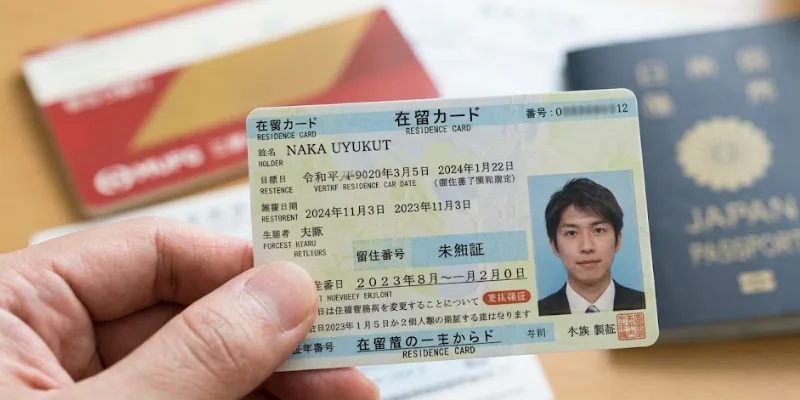
| Residence Card (在留カード Zairyu Card) | Visa status — must show ≥1 year remaining for most landlords |
| Bank Balance Certificate (残高証明書) | Yokin Shinsa screening basis |
| Bank statements (last 3 months) | Stability verification |
| Domestic Emergency Contact info | Japanese phone + address |
Strongly recommended
| Document | Why It Matters |
| Tax Payment Certificate (納税証明書) | If previously employed in Japan, proves clean record |
| Separation Notice (離職票 Rishoku-hyo) | Documents that unemployment is official, not job-fleeing |
| Job offer letter or interview confirmations | Shows transition is temporary |
| Past utility/phone bill receipts (6+ months) | Payment reliability proof |
| LinkedIn profile printout | Career legitimacy |
For complete document requirements covering all rental scenarios, see our required documents for renting in Japan guide.
Property Categories That Approve Unemployed Tenants
Not all apartments apply the same screening rigor. Four property categories are notably more flexible for unemployed foreigners.
1. Owner-Managed Properties (自主管理 Jishu Kanri)
Direct owner relationship without a management company middleman. Personal rapport with the owner can override rigid financial requirements. Many older buildings owned by individual landlords (rather than corporations) fall into this category.
How to find: Filter listings for “個人オーナー” or work with a bilingual agency that specializes in foreigner placement.
2. UR Housing (Urban Renaissance)
Government-affiliated housing. No guarantor or guarantee company required. Trade-off: requires upfront payment of 1 year of rent. Open to foreigners with proper visa documentation. Limited inventory but extremely streamlined approval.
3. Long-Vacant Properties
Properties listed for 3+ months are often open to “unconventional” tenants to fill the gap. Landlords prioritize occupancy over screening rigor. Listed rents on long-vacant units are often negotiable.
4. Short-Term and Serviced Apartments
Companies like Sakura House, Leopalace21, and monthly mansion operators have streamlined processes for those without traditional employment. Higher monthly cost but minimal screening — ideal as a 6–12 month transition while you find permanent employment.
For broader options:
- No-guarantor apartments in Japan guide
- Top 5 real estate agencies in Tokyo for foreigners
- Share house guide for Japan — share houses skip most screening
- 1K vs share house comparison for single residents
If You’re Rejected: 4-Step Recovery
A rejection is not permanent — it’s typically “not with this specific guarantee company.” Here’s the recovery playbook.
Step 1: Identify the rejection reason
While companies rarely give detailed explanations, your agent can usually determine if rejection was due to:
- Current income (most common — switch to Independent guarantee company)
- Credit history (rare for foreigners with no Japan history — often a misread)
- Visa concerns (less than 1 year remaining)
- Document incompleteness
Step 2: Offer Pre-Payment (前払い Maebarai)
Suggest paying 6 to 12 months of rent in advance. This eliminates default risk for the landlord and overrides employment concerns at most independent guarantee companies. Be prepared to provide additional bank balance proof to show this isn’t depleting your safety reserve.
Step 3: Broaden Location Search
Move from central wards (Minato, Shibuya, Shinjuku) to:
- Outer Tokyo wards (Edogawa, Adachi, Itabashi, Nerima)
- Kanagawa (Yokohama, Kawasaki)
- Saitama (Kawaguchi, Urawa)
- Chiba (Funabashi, Matsudo)
These areas have less landlord screening competition and faster approval timelines.
Step 4: Lower the Rent-to-Savings Ratio
If your rent target is ¥120,000 and you have ¥2.4M savings (exact 2-year ratio), apply for a ¥90,000 property instead. Now your ratio is 2.7 years of rent in savings — most independent guarantee companies approve at this level even with no income.
For a deeper analysis of rejection causes specific to foreigners, see our foreigners’ rental rejection in Japan guide and why rental applications get denied.
Frequently Asked Questions
Can foreigners really rent apartments in Japan without a job?
Yes. The standard pathway is Bank Balance Screening (Yokin Shinsa) through an Independent Guarantee Company. Show savings equal to 2 years of rent (¥1,920,000 for ¥80,000/month rent), provide proper documentation including a domestic emergency contact, and approval rates are comparable to employed applicants.
How much money do I need in my bank account to rent without a job?
The standard rule is savings equivalent to 2 years of rent. For ¥80,000/month rent, that’s ¥1,920,000 minimum. Some Independent Guarantee Companies accept 1.5 years (¥1,440,000) if you have other strong signals like a Joint Guarantor or job offer letter.
Which type of guarantee company is best for unemployed foreigners?
Independent Guarantee Companies (独立系 Dokuritsu-kei) are the most flexible. They use their own internal criteria, not connected to credit bureaus, and prioritize current bank balance over monthly income. Avoid Credit-Based companies (Shinpan-kei) which view “no job” as automatic disqualification.
Will my international bank balance count for Japanese rental approval?
International balances are accepted by international-friendly guarantee companies if from major global banks like HSBC, Citibank, JPMorgan Chase, or similar. Smaller foreign banks may be rejected. A domestic Japanese bank balance is always preferred and processes faster.
Can I pre-pay rent to overcome the “no job” issue?
Yes. Offering 6–12 months of pre-payment (前払い Maebarai) is a recognized strategy that overrides employment concerns at most Independent Guarantee Companies. Be prepared to show this doesn’t deplete your overall savings safety reserve.
What’s the difference between a guarantee company and a Joint Guarantor?
A guarantee company (保証会社) is a paid service that legally co-signs your rent for ¥30,000–¥60,000 one-time fee plus ¥10,000/year. A Joint Guarantor (連帯保証人) is an individual Japanese national who personally takes legal responsibility — typically a family member or close contact. Most modern Japanese rentals accept guarantee companies; Joint Guarantors are no longer commonly required.
Is UR Housing really easier for unemployed foreigners?
Yes. UR (Urban Renaissance) Housing does not require any guarantor or guarantee company. The trade-off is requiring upfront payment of 1 year of rent. For foreigners with sufficient savings but no Japan employment, UR is one of the fastest paths to approval. Inventory is limited and competition is high in central Tokyo, but suburban UR units are widely available.
How do landlords verify my “actively job-hunting” status?
They typically accept a combination of: job offer letter (strongest), interview confirmation emails, recruitment agency registration confirmation (Hays, Robert Walters, Recruit Agent), and recent LinkedIn activity. They generally do not call your interview companies — documentation is usually sufficient.
Find a Foreigner-Friendly Apartment
Arealty specializes in matching foreign tenants with Independent Guarantee Companies that accept Bank Balance Screening. Our bilingual team handles document preparation, application submission, and direct advocacy with landlords for unemployed foreigners.
Browse foreigner-friendly inventory:
- All Tokyo apartments for rent — full inventory across 23 wards
- Setagaya apartments — quiet, foreigner-friendly area
Related guides:
- Renting an Apartment Unemployed in Japan — broader unemployed renting guide
- No-Guarantor Apartments in Japan
- Guarantor Company Fee Structure in Japan
- How to Get a Guarantor in Japan
- Required Documents for Renting in Japan
- Foreigners’ Rental Rejection in Japan
- Why Rental Applications Get Denied
- Top 5 Real Estate Agencies in Tokyo for Foreigners
- Apartment Move-In Cost Japan
- Best Months to Move Apartments in Japan
Contact our bilingual team for a confidential consultation on Bank Balance Screening eligibility and pre-screened property matches.

Real estate advisor at Arealty Japan, specialising in helping foreign residents navigate the Tokyo and Osaka rental markets. Lucy has guided hundreds of international renters — from Working Holiday visa holders to corporate relocations — through Japan’s apartment application process. Her writing draws on firsthand experience with landlord screening, guarantor companies, and foreigner-friendly listings across all 23 Tokyo wards and major Kansai cities.




Leave a Reply