
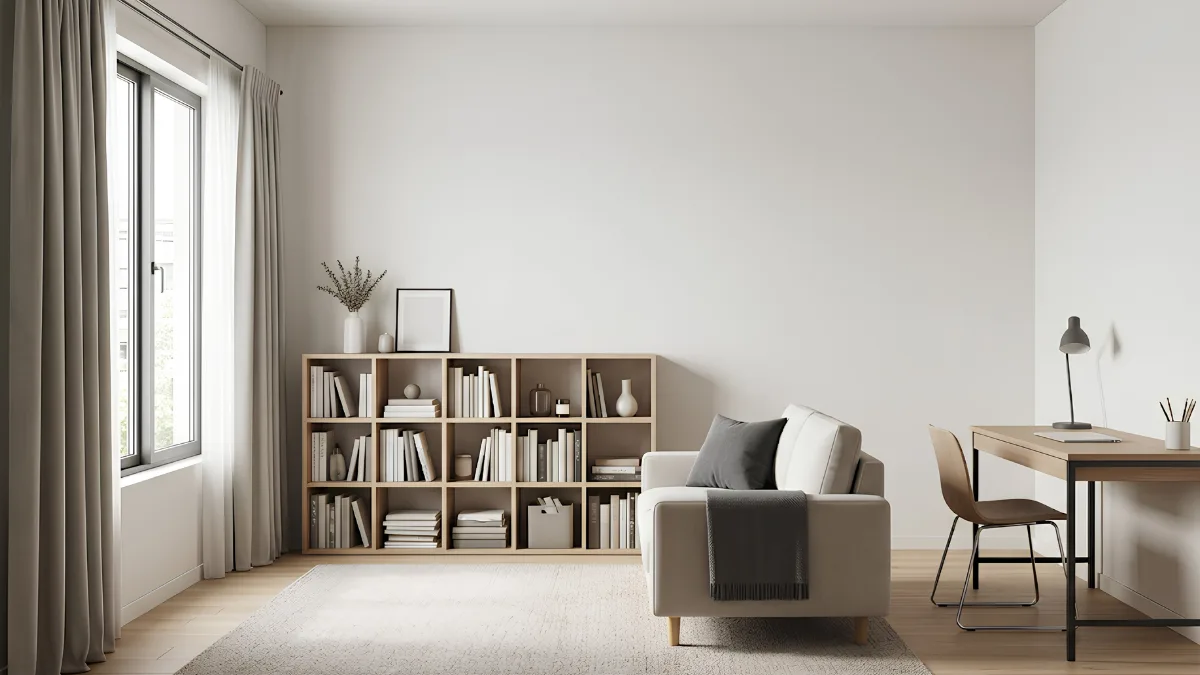

If you are trying to build a quieter home in Japan, the biggest mistake is buying products before you understand the problem. Many renters search for a soundproof apartment Japan solution and end up with curtains, rugs, or foam that only partly help because the real noise path was never identified in the first place.
This guide takes a more practical approach. It shows you how to diagnose noise first, understand the building metrics that matter, choose the right noise reducing items apartment renters can use safely, and avoid damaging the unit while trying to improve it.
If you specifically want a full structure comparison between RC and wood apartments, read this first:
Step 1: Diagnose before you sho
Before you buy anything, audit the noise.
The most expensive mistake is treating every sound as the same. A gap around the front door, a wall that carries TV voices, and footsteps from above do not respond to the same fix. Good how to soundproof apartment Japan decisions start with four basic questions.
First, where is the sound loudest? Is it the front door, a shared wall, the ceiling, the window, or the floor?
Second, how is it traveling? Through the wall itself, through a gap, through the ceiling, or through building vibration?
Third, what time of day does it happen? Traffic at 7 a.m. needs a different response from hallway conversation at midnight.
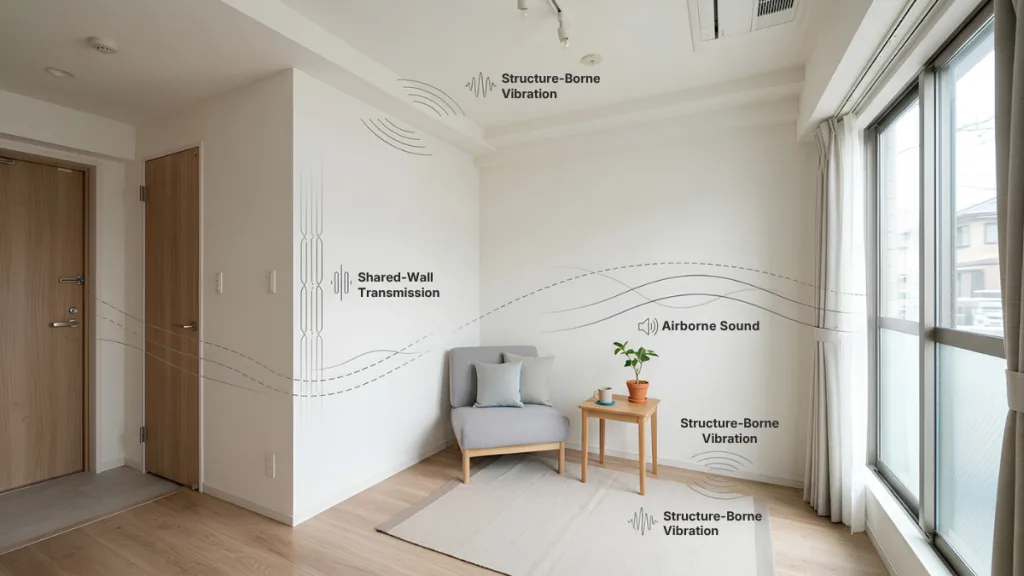
Fourth, is it airborne or structure-borne? This is the most important distinction.
In simple terms:
- Voices, TV, music, and barking are usually airborne
- Footsteps, furniture drag, door slam vibration, and bass thump are usually structure-borne
That distinction changes everything. Airborne noise often improves with gap sealing, curtains, soft furnishings, and selective absorption. Structure-borne noise is much harder, because the building itself transmits more vibration or carries low-frequency sound through the frame, floor, or ceiling.
A simple audit example helps. If you hear neighbors talking clearly near the entrance but not in the bedroom, the weak point may be the front door. If you feel a low thud through the chair or floor at night, you are probably dealing with structure-borne impact, not a curtain problem.
Step 2: Understand the numbers Japanese listings actually use
Most renters judge noise by “old building” or “looks solid,” but Japanese listings and management companies sometimes use more precise ratings.
For wall and partition sound insulation, one key term is Dr-value under JIS A 1419-1. This is used to indicate how well a partition reduces airborne sound. As a rough practical guide:
| Dr-value | Typical impression | Common building pattern |
| Dr-30 to Dr-35 | Basic performance | Wood-frame, lightweight steel |
| Dr-40 to Dr-45 | Moderate | Heavier steel, older RC |
| Dr-45 to Dr-55 | Stronger | Better RC / SRC buildings |
For floor impact sound, you may see LL-value or LH-value under JIS A 1418-2. Here, lower is better.
| Rating | Typical impression |
| LL-50 / LH-55 | Older standard |
| LL-45 | Minimum modern comfort line |
| LL-40 | Premium performance |
Door insulation may also be described with T-values, such as T-1 to T-3, especially in better-performing buildings.
This matters because DIY soundproofing has limits. A renter-safe setup may improve the experience by roughly 5 to 10 dB in the right conditions, which is meaningful, but it will not transform a Dr-30 building into a premium RC apartment.
A useful question to send management is:
このマンションのDr値とLL値を教えてください。
“Could you tell me the Dr and LL ratings for this building?”
Many agents will not have the answer immediately, but asking the question itself changes the quality of your search. It shows you are evaluating the building seriously, not just the wallpaper and layout.
Step 3: The 5-layer strategy
Once you know the noise type, apply fixes in the right order. A good DIY soundproofing rental Japan strategy is layered, not random.
Layer 1: Seal the gaps
This is usually the highest ROI. Use 隙間テープ around windows, balcony doors, and sometimes the front door frame. Budget: around ¥500 to a few thousand yen depending on the area covered.
Layer 2: Add absorption
Use curtains, rugs, fabric furniture, and soft surfaces to reduce echo and soften some airborne sound reflection. This does not create heavy blocking, but it makes the room behave better acoustically.
Layer 3: Add mass barriers selectively
If one shared wall is the problem, that is where denser barriers matter. Do not cover the whole room blindly. Target the problem wall or leakage path.
Layer 4: Decouple vibration
Use isolation pads, anti-vibration mats, and soft mechanical separation under speakers, desks, appliances, or chair legs. This helps reduce direct contact vibration.
Layer 5: Reposition furniture
This is the most overlooked layer and often costs ¥0. Moving a desk off a shared wall, shifting a speaker inward, or placing a bookshelf against the problem wall can change the room more than one extra product.
One rule is worth remembering: Layer 3 cannot fix what Layer 1 needed to fix. If the sound is pouring through a door gap, buying better foam for the wall is the wrong first move.
§4. Step 4: Shopping guide by noise type
The best noise reducing items apartment renters buy should match the actual noise source.
| Noise type | Best fix | What to do | Budget | Honest read |
| Footsteps from above | White noise + layout adjustment | Move bed or desk away from strongest ceiling zone; use white noise for sleep masking | ¥3,000-10,000 | You cannot fix upstairs impact from your floor covering alone |
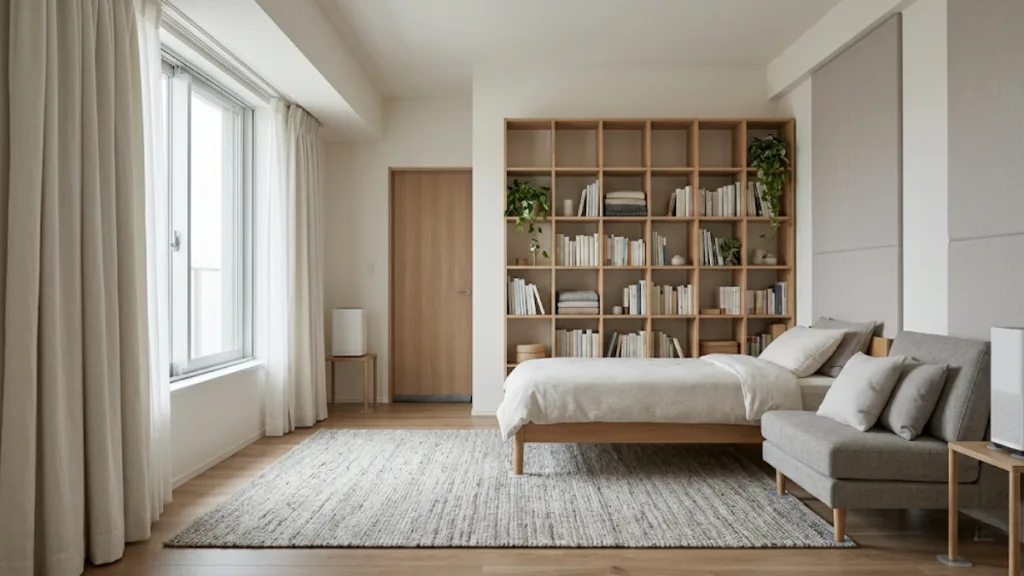
| Voices / TV through shared wall | Bookshelf + selective barrier + curtains | Add mass with furniture first, then targeted wall treatment if lease-safe | ¥3,000-15,000 | Better for mid-frequency airborne sound than for bass |
| Hallway voices through front door | Gap seal + door sweep | Seal frame, improve soft absorption near entry | ¥800-2,500 | One of the highest-ROI fixes |
| Street / traffic noise | Gap seal + heavier curtains | Start with windows, not walls | ¥500 + ¥4,000-10,000 | Curtains alone rarely solve it |
| Echo inside room | Rug + curtains + soft furniture | Reduce reflection before buying “acoustic” products | ¥3,000-15,000 | Makes the room feel calmer fast |
| Your own noise leaking out | Reposition + isolation + behavioral change | Headphones, lower speaker contact, move desk or setup inward | ¥0-80,000+ | Often solved more by setup than by product |
A key physics correction here: rugs or carpets on your floor do not solve footsteps coming from above. They help more with the noise you send downward, some internal echo, and some contact vibration around your own activity. If upstairs impact is the problem, masking and layout changes are usually more realistic than pretending a carpet fixes the ceiling.
A practical Arealty-style case helps illustrate this. A renter in a wood-frame 1K was taking late-night calls at a desk placed directly against a shared wall. Foam panels alone did very little. What helped more was moving the desk off the shared wall, sealing the nearby window gap, adding a heavy curtain, and placing a rug under the chair area. The result was not “studio quiet,” but the room became noticeably less echoey and leaked less speech into the neighboring side.
Step 5: Renter-safe installation rules
The safest upgrades are the ones you can remove cleanly.
Japanese rentals usually operate around the principle of 原状回復可能, meaning changes should be reversible and restorable. That affects how you install everything.
Adhesive ranking
- ❌ Not okay: super glue, contact cement, thick double-sided foam tape on wallpaper
- ⚠️ Risky: “removable” tapes left in place for six months or more
- ✅ Usually okay: pressure-fit systems, gravity-held items, small pins where permitted
- ✅ Best workaround: 養生テープ used carefully as a temporary protective intermediary, not as a long-term direct bond solution
By surface:
- Walls: highest risk for peeling wallpaper or board damage
- Floors: tape, pads, and dense items can trap dirt or moisture
- Windows: gap sealing is often low-risk and high value
- Doors: temporary seals are often safer than permanent changes
The single most important rule is the 5-minute removal test. If you cannot imagine removing the item safely in five minutes without panic, do not assume it is rental-safe.
Step 6: Three real scenarios
Scenario 1: Remote worker in a 1K wood apartment with hallway noise
Setup: front-door leakage, hard floor echo, late-night calls
Plan: seal the door frame, add a rug near the desk, reposition the desk away from the entry line
Layers used: 1 + 2 + 5
Total: about ¥4,500
Outcome: roughly 6–8 dB perceived improvement in the most annoying doorway spill
Scenario 2: Couple in a 1LDK steel-frame unit with neighbor TV through shared wall
Setup: side-wall airborne sound in the evening
Plan: place a loaded bookshelf on the shared wall, add a selective barrier behind it, soften the room with curtains
Layers used: 5 + 3 + 2
Total: about ¥18,000
Outcome: around 5–7 dB improvement for the TV bleed that mattered most
Scenario 3: Streamer in an RC 1LDK worried about their own voice leaking out
Setup: not a bad building, but poor interior setup
Plan: reposition the desk, isolate equipment, use headphones, add soft layers, apply careful temporary protection where needed
Layers used: 5 + 2 + 養生 workaround
Total: about ¥18,000
Outcome: practical resolution without needing heavy panel installation
The pattern is clear: in two of these three situations, Layer 5, the free setup change, did as much or more than the products.
When DIY isn’t enough
Sometimes the problem is structural, not decorative.
Three strong signs tell you that DIY is reaching its limit:
- You sealed gaps, added curtains and rugs, but still hear vibration clearly
- Bass or low-frequency sound still pushes through no matter what you add
- Footsteps remain sharp and obvious even after sensible softening and layout changes
At that point, the smarter mindset is not “this was a waste.” It is leverage for your next move. You now know what to screen for before signing the next lease.
If you are apartment hunting again, stronger RC performance, better LL ratings, and newer sound-conscious housing lines matter much more than one extra rug ever will.
Frequently asked questions (FAQ)
How much can DIY soundproofing really reduce noise?
For renter-safe improvements, about 5–10 dB is a realistic ceiling in many cases. That is enough to make life easier, but not enough to rewrite the building.
Will my landlord let me install soundproof panels?
Many accept reversible solutions, but permanent or adhesive-heavy installations are where problems begin.
Are noise complaints common in Japan rentals?
Yes. Noise is one of the most common sources of friction between households in shared buildings.
Can soundproof curtains alone solve traffic noise?
Usually no. Start with sealing gaps first, then use curtains as part of the solution.
Will a Roomba damage floor protection?
Possibly. It depends on the rug edge, the material, and whether grit builds up under wheels.
Can I break my lease over noise?
Generally not just because the apartment is noisier than hoped, unless the case is unusually severe and tied to larger lease or habitability issues. Check your lease and document the problem carefully.
§9. Talk to Arealty
Need a playbook for your current apartment and better screening for the next one? Arealty helps foreign renters choose quieter buildings before signing and make smarter soundproofing decisions after move-in.

As a real estate professional with 10 years of living and working in Japan, I write from the intersection of property expertise and lived experience. My perspective is rooted not only in an understanding of the Japanese rental market, but also in the nuances of building a life here as a foreigner, where practical decisions often carry personal meaning.
I see a home as more than a place to stay. It is part of how we move through the city, shape our routines, and create a sense of ease in everyday life. That is why my writing goes beyond surface-level advice, offering guidance that is informed, considered, and attuned to both lifestyle and reality. My goal is to make renting in Japan feel less overwhelming, more intentional, and ultimately more human.







Leave a Reply