
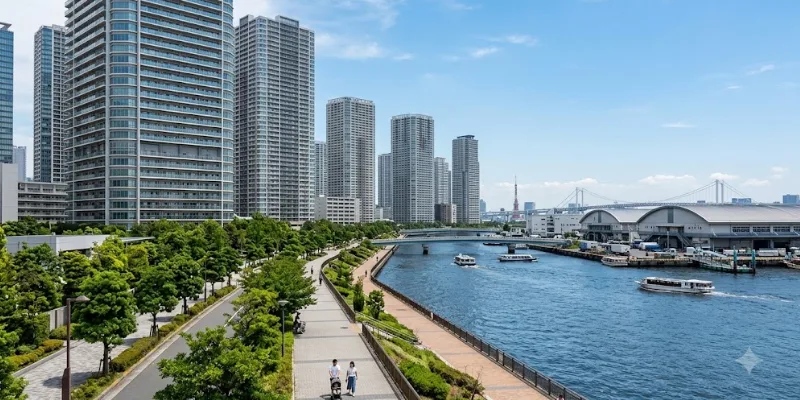

Toyosu is Koto-ku’s planned waterfront district, built from the ground up over the past two decades on former shipyard land. This Toyosu neighborhood guide covers rent, train access, family life, and who the area actually suits, so you can decide if it fits your move to Tokyo.
Toyosu at a Glance
| Category | Detail |
|---|---|
| Ward | Koto-ku (Tokyo Bay waterfront) |
| Main stations | Toyosu (Tokyo Metro Yurakucho Line, Yurikamome), Shin-Toyosu (Yurikamome) |
| To Tokyo Station | ~15 min |
| To Akihabara | ~15 min |
| To Shinjuku | ~30 min |
| 1K rent (Koto-ku average) | ¥89,194/month |
| 1DK rent (Koto-ku average) | ¥129,705/month |
| Best for | Families, remote workers who want modern buildings and green space, anyone drawn to new-build towers over older Tokyo housing stock |
| Less suited for | Renters who want traditional Shitamachi character or an established nightlife scene at street level |
What Makes This Toyosu Neighborhood Guide Different From a General Koto-ku Overview
Koto-ku spans everything from the traditional temple streets of Fukagawa to the sumo-adjacent charm of Kiyosumi-Shirakawa. Toyosu is neither. It’s a planned city built almost entirely since the early 2000s, with wide streets, large parks, and high-rise residential towers set back from the waterfront. Nothing here predates the redevelopment, which makes Toyosu the most consistently modern neighborhood in the ward.
That consistency is the trade-off at the center of this Toyosu neighborhood guide. You get new construction, family-friendly infrastructure, and open green space by the water. In exchange, you give up the older, more lived-in character found elsewhere in Koto-ku. For a broader comparison of Toyosu against Koto-ku’s other neighborhoods, see our Koto City area guide.
From Shipyard to Fish Market: A Short History of Toyosu
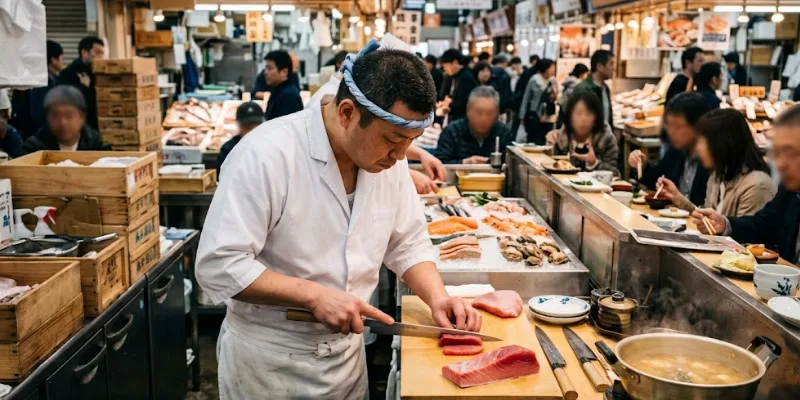
Toyosu sits on reclaimed land that was industrial and shipyard territory for most of the 20th century. Large-scale redevelopment began in the early 2000s, converting the waterfront into residential towers and office space over roughly two decades. The area’s most visible landmark today is Toyosu Market, which opened in October 2018 as the successor to the historic Tsukiji fish market (Toyosu Market, Wikipedia). At over 400,000 square meters, it’s one of the largest wholesale markets in the world, and its relocation brought a wave of food-industry businesses and workers into the neighborhood.
That industrial-to-residential shift explains why Toyosu feels so different from the rest of Koto-ku. There’s no old housing stock to renovate around, so buildings here are newer, layouts are more standardized, and the streets were designed for cars and pedestrians together rather than growing organically over centuries. For renters, this means predictable building quality, but less of the character that draws people to older Tokyo neighborhoods. It also means fewer surprises during apartment viewings, since most buildings share similar specifications, construction standards, and layouts rather than the wide variation you’d find comparing a 1980s walk-up to a converted machiya elsewhere in Tokyo.
Getting Around: Toyosu’s Train Access
Toyosu Station is served by the Tokyo Metro Yurakucho Line and the Yurikamome, an automated elevated line that loops through the wider waterfront area. Shin-Toyosu Station, one stop further on the Yurikamome, serves the TeamLab Planets digital art museum and the Ariake convention district.
Typical travel times from Toyosu Station:
- To Tokyo Station: About 15 minutes
- To Akihabara: About 15 minutes
- To Shibuya: About 25 minutes
- To Shinjuku: About 30 minutes
These times run longer than Koto-ku’s inland stations like Monzen-Nakacho or Kiyosumi-Shirakawa, which reach Tokyo Station in around 10 minutes. Toyosu trades a few extra minutes of commute for waterfront space and newer buildings, a trade-off that works well for residents who aren’t commuting to a central office daily.
Rental Market: What You’ll Actually Pay in Toyosu
Koto-ku as a whole runs below the rents of Chiyoda, Minato, or Shinjuku. Ward-wide averages put a 1K around ¥89,194 a month and a 1DK around ¥129,705. Toyosu-specific listings generally sit within this range for smaller units, commonly ¥130,000 to ¥155,000 for a compact 1K in a newer tower near the station. Larger family-sized units in Toyosu’s high-rise towers can run considerably higher, since much of the area’s newer housing stock was built with families and long-term residents in mind rather than single renters.
Two things to know before you search:
- New-build supply is genuinely active. Toyosu’s waterfront pipeline is one of the most active in Tokyo outside Minato-ku, so newer units with auto-lock, IH cooktops, and bay views are easier to find here than in most central wards at comparable prices.
- Family-sized layouts are common but competitive. Because Toyosu is popular with families relocating to Tokyo, larger 2LDK and 3LDK units in well-located towers move quickly. Start your search early if you need this layout.
Browse current Koto-ku listings, including units in and around Toyosu, on Arealty’s Koto-ku rental page.
Daily Life in Toyosu
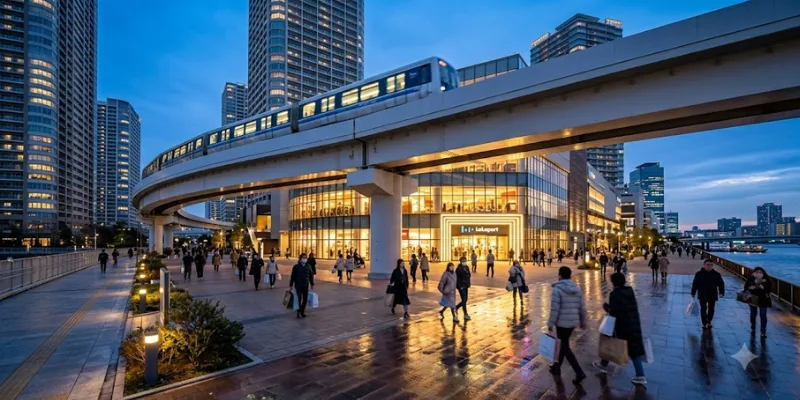
LaLaport Toyosu anchors the neighborhood’s daily life, functioning as both a shopping mall and a general gathering point, with a scale of retail and dining that most Tokyo residential neighborhoods don’t have on their doorstep. Combined with Toyosu Market’s food stalls and restaurants, the area has an unusually strong concentration of dining options for a neighborhood this residential. Supermarkets and everyday retail are also easier to find within a short walk here than in older, more scattered Koto-ku neighborhoods, since the area was planned with car and pedestrian access to large-format stores built in from the start.
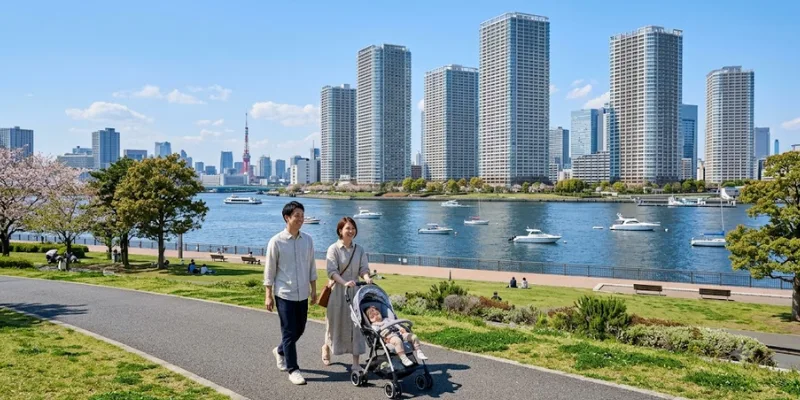
Green space is another defining feature. Waterfront parks run along the bay, and the planned Toyosu Sail Park adds further park space to the area. For families with young children, this combination of parks, wide sidewalks, and modern buildings is a major draw compared to denser, older parts of central Tokyo. Playgrounds and open lawns are more common here than in most inner-city neighborhoods, and the wide streets make the area genuinely stroller-friendly in a way older Tokyo districts often aren’t.
Toyosu also functions as a gateway to the wider Odaiba and Ariake waterfront area. Shin-Toyosu Station puts residents a short ride from TeamLab Planets and the convention facilities around Ariake, which adds a layer of weekend leisure options that inland Koto-ku neighborhoods don’t have as easily.
Practical Notes for Foreign Renters
A few Toyosu-specific points worth flagging before you start apartment hunting:
- Confirm the actual walk to your nearest station. Toyosu’s planned-city layout means blocks are larger than in older Tokyo neighborhoods. A listing quoting an 8 to 11-minute walk to Toyosu Station is common and normal here, not a red flag.
- Check which line you actually need. The Yurakucho Line and the Yurikamome serve different destinations. Confirm your commute works with Toyosu’s specific line before committing to a unit near the station.
- Ask about building age even within “new” developments. Toyosu’s redevelopment has spanned two decades, so towers built in the early 2000s sit alongside ones completed in the last few years. Specifications and rent can vary meaningfully between them.
Who Should Actually Live in Toyosu
This Toyosu neighborhood guide would be incomplete without being direct about fit. The area isn’t right for everyone.
Toyosu works well for:
- Families who want modern buildings, parks, and international-school access within a manageable commute
- Remote workers and couples who value new construction and waterfront views over historic character
- Anyone working in or around the food industry, given Toyosu Market’s presence
- Renters who want a mall, supermarkets, and dining within walking distance rather than scattered across the neighborhood
Toyosu is a weaker fit for:
- Renters drawn to traditional Shitamachi character, since Toyosu has essentially none of Koto-ku’s older streetscape
- Anyone who wants a short, sub-10-minute commute to central Tokyo, since Toyosu runs longer than Koto-ku’s inland stations
- Renters who prefer a dense, walkable street grid over a planned, spread-out layout
Toyosu vs. Nearby Koto-ku Areas
Toyosu is often compared with Kiba and Toyocho, both a few stops inland on the Tozai Line. Kiba and Toyocho offer older, more standard Tokyo apartment stock and shorter commutes, generally 6 to 10 minutes to Tokyo Station, but without Toyosu’s waterfront parks or mall-anchored daily life. Shinonome, just south of Toyosu, offers a similar new-build character at somewhat lower rents, with slightly less retail immediately on hand. For a wider look at how these areas and the rest of Koto-ku compare on rent and access, see our Koto apartments for rent guide.
Toyosu Neighborhood Guide: FAQ
Yes, particularly for families and renters who want modern buildings and waterfront green space. It suits people who prioritize newer construction and daily convenience over historic character or the shortest possible commute.
Toyosu Station, served by the Tokyo Metro Yurakucho Line and the Yurikamome. Shin-Toyosu Station, one stop further on the Yurikamome, serves the adjacent Ariake and TeamLab Planets area.
Koto-ku averages ¥89,194 for a 1K and ¥129,705 for a 1DK. Toyosu-specific 1K listings commonly run ¥130,000 to ¥155,000 in newer buildings, with larger family-sized units running higher in the area’s high-rise towers.
Yes. The combination of parks, wide streets, modern buildings, and LaLaport Toyosu’s retail and dining makes it one of Koto-ku’s more family-oriented neighborhoods.
About 15 minutes by train, longer than Koto-ku’s inland stations like Monzen-Nakacho, but still a manageable commute for most central Tokyo offices.
Looking for an apartment in Toyosu or elsewhere in Koto-ku? Browse verified listings on Arealty, all pre-confirmed for foreigner acceptance with English-language support throughout the application process. Or start from arealty.jp to search across all 23 Tokyo wards.

Real estate advisor at Arealty Japan, specialising in helping foreign residents navigate the Tokyo and Osaka rental markets. Lucy has guided hundreds of international renters — from Working Holiday visa holders to corporate relocations — through Japan’s apartment application process. Her writing draws on firsthand experience with landlord screening, guarantor companies, and foreigner-friendly listings across all 23 Tokyo wards and major Kansai cities.



Leave a Reply