


Finding the best residential areas for students in Tokyo is a multifaceted challenge that requires balancing academic proximity, personal safety, and lifestyle quality. For international students, exchange scholars, and private university attendees, the choice of a neighborhood serves as the foundation for their entire Japanese experience. While many students initially seek the lowest possible rent, those who prioritize a monthly budget of ¥100,000 to ¥150,000 often find a significantly higher standard of living, better structural safety, and a much smoother approval process from landlords.
Securing apartments in Japan involves navigating a unique rental culture where “foreigner-friendly” is not just a preference but a logistical necessity. This guide provides a professional, deep-dive analysis into the top-tier neighborhoods that cater to students who value modern amenities, secure environments, and efficient commutes. By choosing the right area, you ensure that your energy is spent on your studies and cultural immersion rather than on long train rides or housing disputes.
Defining the Standard for Premium Student Housing
A “good student area” in a megalopolis like Tokyo is defined by its ability to provide a “Safe Haven” effect. This concept refers to a living environment that actively reduces stress through urban design, reliable infrastructure, and community safety. International residents should choose districts where English-speaking services are available and local police stations (Koban) are accustomed to assisting non-Japanese speakers.
The benefits of investing in high-quality apartments in Tokyo Japan include:
- Structural Integrity: Buildings in the ¥100,000+ range are typically constructed using Reinforced Concrete (RC) or Steel Reinforced Concrete (SRC), offering superior earthquake resistance and soundproofing.
- Advanced Security: Features such as auto-lock main entrances, 24-hour video surveillance, and secure delivery lockers (宅配ボックス) ensure personal safety and package security.
- Approval Probability: Premium neighborhoods often house management companies that have standardized procedures for international tenants, drastically reducing the “foreigner rejection” rate common in cheaper, older areas.
For example, a student living in a modern 1K apartment in a premium district enjoys proximity to essential lifestyle hubs like Daikanyama for fashion, Inokashira Park for nature, and Shinjuku Gyoen for historical exploration.
Top-Tier Neighborhoods for Academic Success
Selecting an apartment for rent Japan requires a strategic look at Tokyo’s intricate train network. The following areas represent the gold standard for students attending major universities such as Waseda, Keio, Sophia, and Aoyama Gakuin.
Ebisu and Meguro: The Sophisticated International Hub
Many people widely consider Ebisu and Meguro to be the most desirable residential areas for young professionals and international students alike. These neighborhoods offer a clean, sophisticated atmosphere that feels distinctly “global.”
The commute considerations for students in these areas are exceptionally favorable. If you are attending Keio University’s Mita Campus, your commute is a mere 20-minute ride on the Yamanote Line. For students at Sophia University, direct connections make for a stress-free 25-minute journey. Furthermore, those at Aoyama Gakuin University find themselves within a short bus or train ride of the Shibuya-Omotesando area.
Why students choose Ebisu and Meguro goes beyond simple convenience. These districts are home to numerous international supermarkets like National Azabu, Meidi-Ya, and Seijo Ishii, where global food staples are easily found. The safety of these streets at 2:00 AM is comparable to most Western cities at 2:00 PM, making them ideal for students who maintain late-night study or work schedules.
Featured Residence: Rb Palm Crest Musashi-Koyama
Experience the perfect balance of modern living and convenience at Rb Palm Crest (Unit 304). Built in 2022, this stylish 23.92 m² apartment in Meguro-ku is designed for those who value both form and function.
- Commuter-Friendly: Just an 11-minute walk to Musashi-Koyama Station, offering quick access to central Tokyo and major universities.
- Modern Amenities: Features a high-tech kitchen, washlet, auto-lock security, and a quiet, reinforced concrete structure.
- Prime Value: At ¥145,000/month, it offers a refined, secure lifestyle in one of Tokyo’s most prestigious residential districts.
Whether for students or professionals, this property is a gateway to the sophisticated Meguro lifestyle.
Sendagaya and Yoyogi: The Academic Sanctuary
Sendagaya and Yoyogi occupy a unique niche in Tokyo—they are located in the heart of the city but remain remarkably quiet and residential. This “academic pocket” is bordered by the vast greenery of Yoyogi Park and the Meiji Jingu Shrine forest.
For Waseda University students, this area is a strategic masterpiece. You can reach the main campus in approximately 15-20 minutes, allowing for more rest and preparation time. Students at Sophia University or Meiji University also benefit from the central location, with commutes rarely exceeding 20 minutes via the JR Sobu or Chuo lines.
The residential quality in Sendagaya is high, featuring many low-rise, modern apartment complexes. Landlords here are historically more receptive to international students because of the long-standing presence of language schools and university dormitories in the vicinity. The abundance of quiet cafes, such as Tas Yard or Good Town Bakehouse, provides students with numerous “third spaces” for studying outside their apartments.
Featured Residence: Asyl Court Oji
For modern living that balances quality with cost-efficiency, Asyl Court Oji (built 2025) is an excellent choice.
- Commuter-Friendly: Only an 8-minute walk to Oji Station, providing direct access to the JR Keihin-Tōhoku and Tokyo Metro Namboku lines for quick university access.
- Modern Space: A spacious 28.4 m² (1DK) layout featuring premium amenities and pet-friendly policies.
- Smart Value: At ¥153,000/month with zero “Key Money,” it significantly reduces your upfront move-in costs.
Asyl Court Oji offers the perfect blend of comfort, security, and financial flexibility for students and professionals alike.
Nakameguro: Comfort Meets Culture
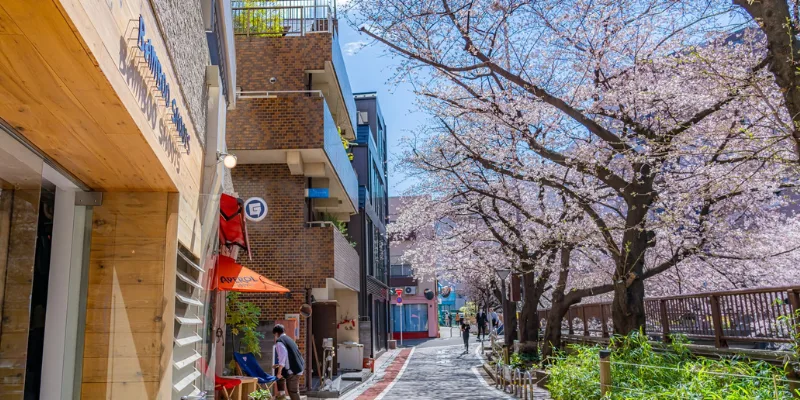
Nakameguro has evolved into one of the most stylish neighborhoods in Tokyo, famous for the Meguro River and its cherry blossom festivals. For an international student, it offers a perfect blend of high-end living and a relaxed, local vibe.
Regarding japan tokyo apartment rent, Nakameguro offers some of the highest-quality 1K and 1DK layouts in the city. The commute to Keio University is efficient via the Tokyu Toyoko Line, taking roughly 20 minutes with a quick transfer. Students at the University of Tokyo (Komaba Campus) can even reach their lectures within 15-20 minutes by bicycle or local train.
Safety and livability are the hallmarks of Nakameguro. Artisanal bakeries, boutique gyms, and international bookstores line the neighborhood’s streets. It is a community where the local shopkeepers are often familiar with their residents, creating a sense of security that is rare in larger urban hubs like Shinjuku or Ikebukuro.
The “Livable City” Champion: Kichijoji
Kichijoji consistently wins “Most Desirable Neighborhood” surveys in Tokyo for a reason. It offers an escape from the “concrete jungle” while maintaining a vibrant commercial center. This area is the primary choice for students attending International Christian University (ICU), Chuo University, or Musashino University.
Living in Kichijoji allows students to enjoy Inokashira Park, a massive green space featuring a pond, a zoo, and numerous walking trails. The air quality and lower building density provide a significant mental health boost during high-stress exam periods.
The practicality of Kichijoji is unmatched. Within a 5-minute walk of the station, you have access to the Sunroad Shopping Arcade, Tokyu Department Store, and Atre Kichijoji. This means you can find everything from imported pasta to high-end electronics without ever leaving your neighborhood. For the international student, this convenience minimizes the “culture shock” of navigating unfamiliar Japanese retail systems.
Featured Residence: Jasmine Garden Kichijoji
For students seeking to immerse themselves in Kichijoji’s renowned lifestyle, Jasmine Garden Kichijoji (Unit 208) offers a practical and welcoming home base.
- Unbeatable Access: Situated just a 7-minute walk from Kichijoji Station, it provides seamless, direct access to the JR Chūō and Chūō-Sōbu lines.
- Student-Ready: This furnished 1K apartment is designed for convenience. It features a south-facing layout for natural light and comes “Student Friendly,” making the transition into a new academic year smooth and stress-free.
- Affordable Living: With a total monthly fee of ¥106,330, it is an accessible option for those wanting to live in Tokyo’s most beloved neighborhood without compromising on location.
Jasmine Garden Kichijoji is more than just an apartment; it is an entry point into the vibrant, community-focused lifestyle that consistently earns Kichijoji its top-tier reputation among Tokyo residents.
Transit Excellence: Shinagawa and Osaki
For students who value modern infrastructure and perhaps plan to engage in part-time work or internships in the business sector, Shinagawa and Osaki are unbeatable. These areas boast ultra-modern high-rise apartments and state-of-the-art transit hubs, offering a premium living experience.
The transport connectivity is the primary draw. From Shinagawa Station, you have access to the Shinkansen (bullet train) for travel to Kyoto, the Narita Express for international flights, and the Yamanote Line for circling the city. Students attending Tokyo Institute of Technology (Ookayama) or Keio University (Hiyoshi) find these areas strategically located for a 20-30 minute commute.
Security in Shinagawa and Osaki is of the highest professional standard. Most apartment buildings feature double or triple-layer security gates, 24-hour on-site management, and earthquake damping technology. While these areas feel more “corporate” than Kichijoji, they offer a level of reliability and predictability that many international families find comforting.
Featured Residence: MSR
For those prioritizing proximity to major transport hubs and a modern, high-spec living environment, MSR is a standout choice in the Shinagawa-ku area.
- Elite Connectivity: Located just a 4-minute walk from Meguro Station, it offers instant access to the JR Yamanote Line, Tōkyū Meguro Line, and Tokyo Metro Namboku Line, putting all of Tokyo within easy reach.
- Spacious & Modern: Built in 2019 with durable reinforced concrete, this 38.18 m² (1K) unit is exceptionally spacious. It features a south-facing orientation for great natural light and is pet-friendly, a rare find for properties of this caliber.
- Premium Reliability: With high-end amenities like a system kitchen, auto-lock security, and a “No Deposit” policy, it offers a sophisticated, hassle-free lifestyle for busy students and young professionals.
MSR represents the best of Shinagawa’s corporate-grade living: reliable, secure, and perfectly positioned for those who move at the speed of Tokyo.
Why “Arealty” is the Essential Partner for Your Search
Navigating the Tokyo rental market is notoriously difficult for those without a local guarantor or high-level Japanese language skills. Arealty was founded to solve these specific hurdles for international students seeking premium housing. We do not just find you a room; we secure a lifestyle that matches your academic goals.
At Arealty, we understand that for a student, “Home” is where the most important work happens. We focus exclusively on the best residential areas for students in Tokyo, ensuring that every property we recommend meets strict safety and quality criteria.
Our services include:
- Curated Property Selection: We filter through thousands of listings to find buildings that actively welcome international students.
- Guarantor System Management: We coordinate with specialized guarantor companies to ensure your application is approved quickly and fairly.
- Seamless Onboarding: From setting up high-speed fiber-optic internet to registering your address at the local ward office, we provide end-to-end support.
If you are ready to move beyond basic dormitories and want a professional partner to navigate the japan tokyo apartment rent landscape, Arealty is your most reliable choice. We bridge the gap between your needs and the strict requirements of Japanese landlords.
Strategic Comparison of Apartment Layouts
When searching for apartments in Tokyo Japan, you must understand the “K”, “DK”, and “LDK” system to optimize your living space. In the ¥100,000 to ¥150,000 range, you are typically choosing between the following:
| Layout Type | Average Square Footage | Key Features |
| 1K | 22 – 28 m² | Separate kitchen and bedroom; ideal for high-focus studying. |
| 1DK | 28 – 35 m² | Includes a dedicated dining area; better for those who cook at home. |
| 1LDK | 35 – 45 m² | Separate living room and bedroom; provides the highest “work-life” separation. |
For students, a 1K is often the most efficient choice, as it provides enough space for a large desk, a comfortable bed, and a private kitchenette while remaining within the budget for premium areas like Ebisu or Nakameguro. If you plan to stay in Japan for a full degree (4 years), investing in a 1LDK can significantly prevent “cabin fever” during long winters or rainy seasons.
Understanding the True Cost of Commuting
Many students mistakenly opt for cheaper apartments in distant suburbs, only to realize that the hidden costs eventually erase their savings. A 60-minute commute each way robs them of 10 hours a week on crowded trains—precious time they could invest in studying, resting, or working part-time.
Furthermore, Tokyo’s train fares are calculated by distance. A student living in a central area like Yoyogi might pay ¥4,000 a month in transport, while a student living in far-west Tokyo might pay ¥15,000. When you add the value of your time, the “expensive” apartment in a premium area often becomes the more economical choice.
Premium areas also offer “Walking/Cycling” potential. Imagine the quality of life improvement when you can cycle to Aoyama Gakuin or Waseda in 10 minutes rather than standing on a packed train. This physical activity also contributes to better sleep and improved academic performance.
Avoiding Common Pitfalls in the Rental Process
International students should vet buildings individually, even in popular ‘student neighborhoods,’ because not every property meets the necessary standards.
- Wood-Frame Construction (Mokuzou): While charming, these older buildings often have poor soundproofing. You will hear your neighbors’ every move, which is detrimental during exam weeks.
- First-Floor Units: While often ¥5,000 cheaper, first-floor units in Tokyo are more prone to humidity and offer less privacy/security for female students.
- Low Foreigner History: If a building has never rented to a non-Japanese person, your chances of approval are low, regardless of your income. This is why working with an agency like Arealty is crucial—we know the “approval history” of specific buildings.
Successful students prioritize buildings with “Resident Managers” (Kanrijin). These staff members manage the waste disposal process, maintain a spotless lobby, and foster a peaceful environment for all residents.
Security and Wellness: A Non-Negotiable Priority
For parents sending their children to study in Tokyo, safety is the primary concern. In premium apartments in Japan, safety is multi-layered. It is not just about the lock on the door; it is about the “community of care.”
Areas like Shinagawa and Meguro are home to many families and high-income professionals. This demographic ensures that the local government invests heavily in street lighting, police patrols, and disaster preparedness. During the 2011 earthquake, residents in modern RC (Reinforced Concrete) buildings in these areas reported feeling significantly safer than those in older, wooden structures in the suburbs.
Wellness is also tied to your neighborhood. Access to high-quality healthcare is essential. Students in central Tokyo have access to renowned institutions like St. Luke’s International Hospital, The King Clinic (Omotesando), and Tokyo Medical University Hospital. Having English-speaking doctors within 15 minutes of your apartment provides an invaluable safety net for international students living alone for the first time.
Final Recommendations for International Students
Selecting the best residential areas for students in Tokyo is a decision that impacts your entire Japanese experience. While budget-friendly dormitories exist, the privacy, security, and prestige of a private apartment in a prime neighborhood offer a superior return on investment for your education.
Focus your search on the Yamanote Line or major private lines like the Tokyu Toyoko or Odakyu lines if you want to maintain a balance between campus life and urban exploration. Always verify the building’s construction date and the reputation of the management company before signing a contract.

Real estate advisor at Arealty Japan, specialising in helping foreign residents navigate the Tokyo and Osaka rental markets. Lucy has guided hundreds of international renters — from Working Holiday visa holders to corporate relocations — through Japan’s apartment application process. Her writing draws on firsthand experience with landlord screening, guarantor companies, and foreigner-friendly listings across all 23 Tokyo wards and major Kansai cities.



Leave a Reply