
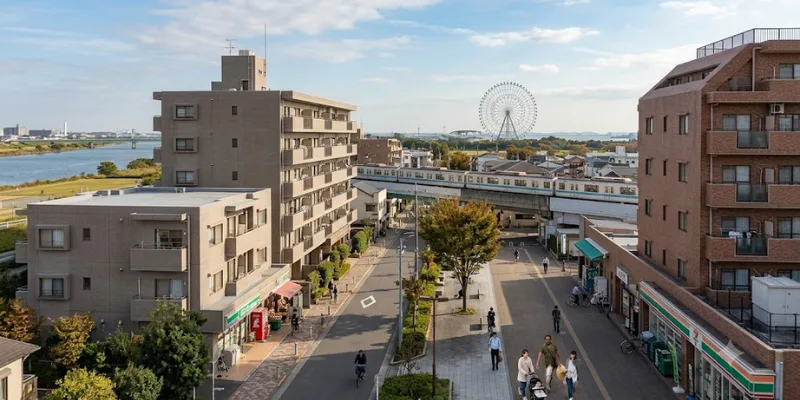

Living in Kasai means paying around ¥75,000 a month for a 1K and about ¥143,000 for a 2LDK, while riding the Tozai Line to Otemachi in roughly 18 minutes. Kasai sits in southern Edogawa, between the Arakawa River and Tokyo Bay. It suits commuters to Otemachi or Nihonbashi, families who want parks, and anyone who values space over a central address.
The trade-offs are real. Rapid trains skip the station, the morning Tozai Line is one of Tokyo’s most crowded rides, and the area sits on low ground with a known flood risk. This guide covers all of it, so you can decide with the full picture.
| Key fact | Kasai (2026) |
|---|---|
| Ward | Edogawa-ku, Tokyo |
| Main station | Kasai Station (Tokyo Metro Tozai Line, T17) |
| To Otemachi | About 18 minutes, no transfer |
| Average rent, 1K | ¥75,500 |
| Average rent, 2LDK | ¥142,600 |
| Big draw | Kasai Rinkai Park and Tokyo Bay waterfront |
| Main caution | Flood risk; rapid trains do not stop |
Rent figures are athome averages for listings near Kasai Station over the latest three months, checked October 2026 (athome).
Where Is Kasai, and What Is It Like?
Kasai is a residential district in the south of Edogawa City, Tokyo’s easternmost ward. It covers the blocks around Kasai Station, such as Naka-Kasai, Higashi-Kasai and Kasai-minami, and runs south to the bay. The Arakawa River lies to the west, and Chiba Prefecture starts just across the Kyu-Edogawa River to the east.
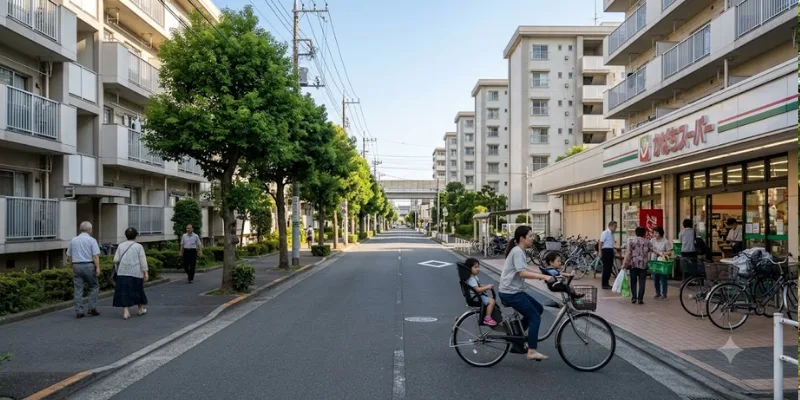
Most of Kasai was built up from the 1970s onward, after the Tozai Line opened. As a result, the streets are wide and flat, and the housing is mostly mid-rise mansions rather than old wooden homes. It feels orderly and practical, not trendy.
Locals often treat three stations as “the Kasai area”:
- Kasai Station (Tozai Line): the busy center, with the most shops and bus routes.
- Nishi-Kasai Station (Tozai Line): one stop west, known for its large Indian community.
- Kasai-Rinkai-Koen Station (JR Keiyo Line): on the waterfront, next to the big park.
This guide focuses on living in Kasai around the main station, with comparisons to the other two where it helps your choice.
How Much Is Rent in Kasai in 2026?
A 1K near Kasai Station averages about ¥75,500 a month, and a family-size 3LDK about ¥169,400. These are averages across all building ages and walking distances. Newer mansions close to the station often list 20 to 30% higher.
| Layout | Kasai | Nishi-Kasai | Kasai-Rinkai-Koen |
|---|---|---|---|
| 1R (studio) | ¥68,100 | ¥68,700 | ¥63,500 |
| 1K | ¥75,500 | ¥78,000 | ¥68,100 |
| 1LDK | ¥116,400 | ¥119,900 | ¥105,700 |
| 2LDK | ¥142,600 | ¥149,200 | ¥134,800 |
| 3LDK | ¥169,400 | ¥177,500 | ¥161,000 |
Source: athome station averages for the latest three months, checked October 2026 (Kasai, Nishi-Kasai, Kasai-Rinkai-Koen). Figures show base rent; management fees are usually extra.
Three things stand out. First, Nishi-Kasai costs slightly more than Kasai at every size, mostly for its newer buildings and Little India appeal. Second, Kasai-Rinkai-Koen is the cheapest of the three, because most homes there are a bus ride or long walk from the station. Third, family layouts are where Kasai shines: a 3LDK here costs about what a 1LDK costs in many central wards.
Remember that monthly rent is only part of your budget. Plan for deposit, key money and agency fees too, as explained in our guide to apartment move-in costs in Japan.
How Is the Commute from Kasai?
Kasai has one train line, the Tokyo Metro Tozai Line, and it runs straight into the business core. Local trains reach Otemachi in about 18 minutes and Nihonbashi in about 20, with no transfer. From Otemachi you can change to the Marunouchi, Chiyoda, Hanzomon, Mita and JR lines.
| From Kasai Station | Approx. time | Route |
|---|---|---|
| Otemachi | 18 min | Tozai Line, direct |
| Nihonbashi | 20 min | Tozai Line, direct |
| Iidabashi | 25 min | Tozai Line, direct |
| Tokyo Station | 25 min | Tozai to Otemachi, walk |
| Shinjuku | 35 min | Tozai to Kudanshita, Toei Shinjuku Line |
| Haneda Airport | 45 to 60 min | Direct limousine bus from Kasai Station |
Times are typical weekday figures and vary by train and time of day.
The rapid-train catch
This is the detail most guides miss. According to the Tokyo Metro Tozai Line map, Rapid (Kaisoku) trains skip both Kasai and Nishi-Kasai. Only Local and Commuter Rapid trains stop here, the latter during the morning peak.
In practice, trains are still frequent, so the impact is small. Just avoid boarding a Rapid by mistake on the way home, or you will end up in Urayasu.
Buses fill the gaps
Kasai Station is a big bus hub. Routes run south to Kasai Rinkai Park, east toward Tokyo Disney Resort, and north to the Toei Shinjuku Line at Ichinoe and Funabori. The direct airport limousine to Haneda is a real bonus for frequent flyers.
What Is Daily Life in Kasai Like?
Daily life in Kasai is easy and self-contained. You can shop, eat out, see a doctor and take kids to a park without leaving the neighborhood.
Shopping. Several supermarkets sit within a few minutes of the station. For bigger trips, Ario Kasai is a shopping mall in the south of the area, and large home centers sell furniture and household goods at suburban prices. Nishi-Kasai adds the smaller Patria Kasai mall.
Food. The station area is packed with ramen shops, chain restaurants, izakaya and 24-hour eateries. Thanks to the nearby Indian community, Kasai and Nishi-Kasai also have some of Tokyo’s best curry houses and South Asian grocery stores.
An international neighborhood. Edogawa has the largest Indian population of Tokyo’s 23 wards, centered on Nishi-Kasai. Many residents work in IT and finance, and the India International School in Japan is nearby. For newcomers, this means English is heard more often, and international families are a normal part of daily life.
A hidden gem: the Subway Museum. Tokyo Metro’s Subway Museum sits right under the tracks at Kasai Station. It is a small, cheap and genuinely fun rainy-day outing with kids.
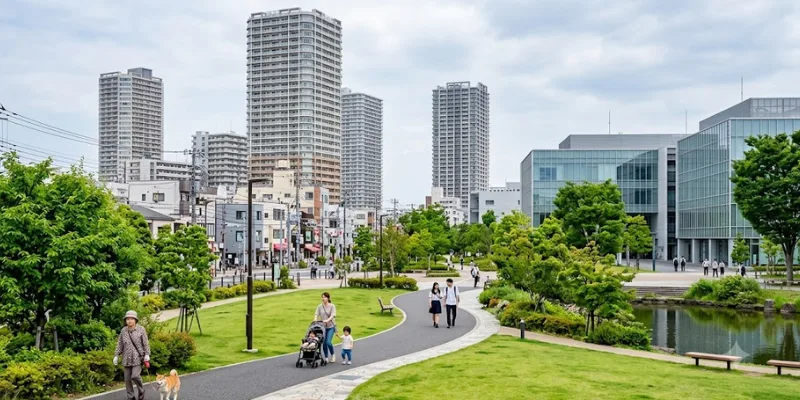
Parks everywhere. Beyond the famous seaside park, Kasai has many neighborhood parks with play equipment, plus long green paths for walking and cycling. Leashed dogs are welcome in most of them.
Why Kasai Rinkai Park Is a Reason to Live Here
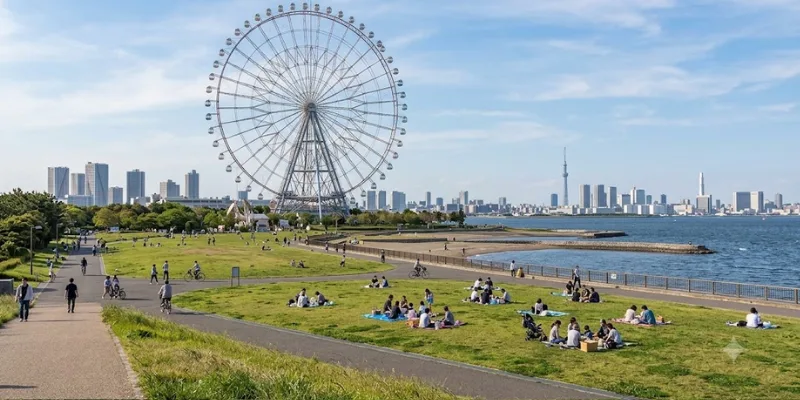
Kasai Rinkai Park is the main reason many families choose living in Kasai. It is one of Tokyo’s largest waterfront parks, with lawns, a bird sanctuary, a giant Ferris wheel and views across Tokyo Bay. On weekends it fills with picnics, barbecues and kids on bikes.
The park is also home to Tokyo Sea Life Park, the city-run aquarium. Its 1989 building is being replaced by a new aquarium on the same grounds, which the Tokyo Metropolitan Government is targeting to open in 2028 (Time Out Tokyo). For residents, that means a brand-new attraction a short bus ride away.
Just offshore, Kasai Marine Park has two man-made beaches, West and East Nagisa. The tidal flats are a Ramsar-listed wetland, so parts are protected, but the west beach is open for walks and seasonal events. You reach the park from JR Kasai-Rinkai-Koen Station or by bus from Kasai and Nishi-Kasai.
Tokyo Disney Resort is also close. It is about one stop away on the JR Keiyo Line from Kasai-Rinkai-Koen, so annual-pass holders often look at this area first.
What Are the Downsides of Living in Kasai?
Kasai has three honest drawbacks: flood risk, a crowded morning train and a weather-sensitive line. None is a deal-breaker, but each is worth planning around.
Flood risk
Edogawa is bordered by the Edogawa River, the Arakawa River and Tokyo Bay, and around 70% of the ward sits below sea level at high tide (PreventionWeb). In 2019 the ward’s hazard map made headlines by telling residents to leave the ward before a major flood rather than shelter locally.
Levees protect the area day to day, and large floods are rare. Still, take these steps before you sign:
- Check the address on the Edogawa City hazard map for expected flood depth.
- Prefer the third floor or higher in a reinforced concrete building.
- Read the hazard map section of the pre-contract explanation (juyo jiko setsumei), which agents in Japan must cover.
- Know your wide-area evacuation route, often toward higher ground in western Tokyo.
A crowded Tozai Line
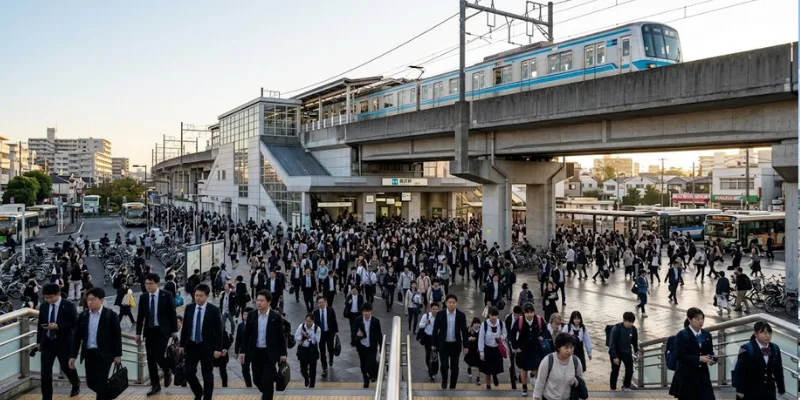
The Tozai Line is famous for its morning rush, and inbound trains from Kasai are packed between about 7:30 and 9:00. If your office allows flexible hours, starting before 7:30 or after 9:30 makes a big difference.
Wind delays
The line runs above ground over the Arakawa River between Minami-Sunamachi and Nishi-Kasai. Strong winds can slow or stop trains on this stretch, so keep a backup route via bus to the Toei Shinjuku Line.
Who Is Living in Kasai Best For?
Living in Kasai works best for people who commute to the east side of central Tokyo and want more space for their money.
| You are… | Is Kasai a good fit? | Why |
|---|---|---|
| Working in Otemachi, Nihonbashi or Kayabacho | Yes | Direct Tozai Line, about 18 to 22 minutes |
| A family with young children | Yes | Big parks, 2LDK and 3LDK at ward-low prices |
| Part of the Indian or South Asian community | Yes | Nishi-Kasai community, groceries, school nearby |
| A frequent flyer | Yes | Direct bus to Haneda Airport |
| Working in Shibuya or Shinagawa | Maybe | Workable, but 40+ minutes with transfers |
| Wanting nightlife and trendy cafes | Probably not | Kasai is quiet and practical after dark |
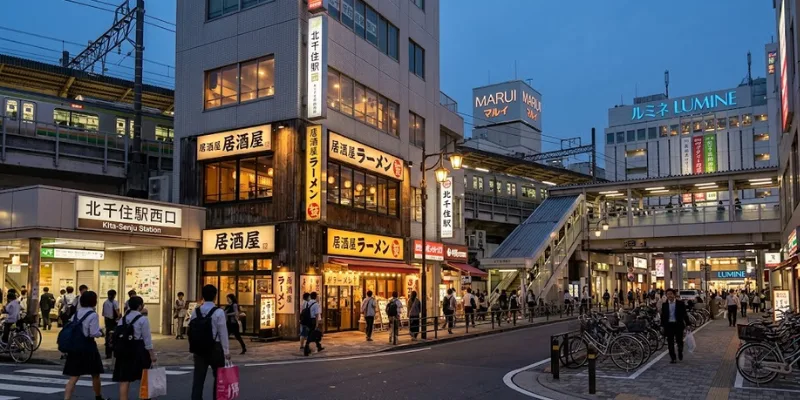
If you like the east side but want a different feel, compare Kasai with our guides to Kanamachi and Kita-Senju.
Living in Kasai: FAQ
Yes. Kasai and neighboring Nishi-Kasai have a large international community, especially Indian residents, plus English-friendly bus signs and international schools nearby. Rents are moderate, and many landlords in the area are used to foreign tenants.
About 25 minutes. Take the Tozai Line to Otemachi in roughly 18 minutes, then walk underground to Tokyo Station. There is no single-seat ride to Tokyo Station itself.
Slightly. In October 2026, a 1K averaged ¥75,500 near Kasai and ¥78,000 near Nishi-Kasai on athome. The gap widens a little for larger layouts.
Kasai is a quiet residential area with low crime typical of Tokyo suburbs. The bigger safety question is flooding, so check the hazard map and choose a higher floor.
No. Rapid trains on the Tozai Line skip Kasai and Nishi-Kasai. Local trains stop at both, and Commuter Rapid trains also stop during the morning peak.
Usually, yes. Most listings accept a guarantor company instead of a personal guarantor. See our guide to renting in Japan without a guarantor for how it works.
Find Your Apartment in Kasai with Arealty
Living in Kasai gives you space, parks and a direct line to central Tokyo at a fair price. The key is choosing the right building: close to the station, on a higher floor, and with a landlord who welcomes foreign tenants.
Arealty lists foreigner-friendly apartments across Edogawa, with English support from viewing to contract. Browse current apartments for rent in Edogawa-ku, search all rentals across Japan, or visit Arealty to talk with our team.



Leave a Reply