
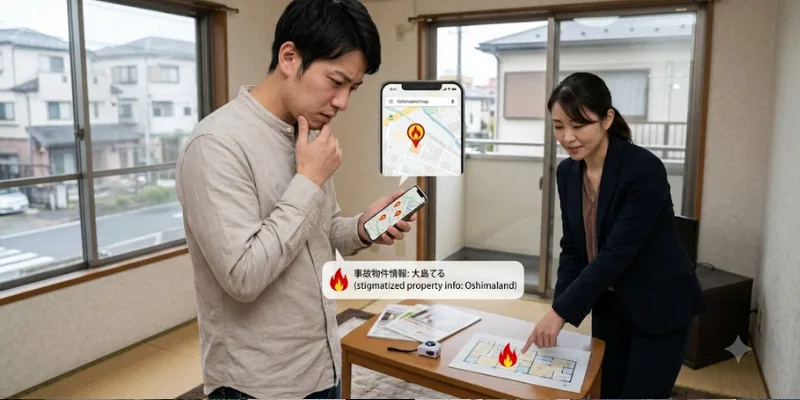

Quick answer: Search the address on Oshimaland (大島てる). It’s a free, crowdsourced map that logs reported deaths and incidents at specific buildings across Japan. It’s the most widely used way to check a property’s history before renting, but it isn’t official and it isn’t complete. Japanese law separately requires landlords to disclose certain serious incidents directly to prospective tenants, whether or not the property shows up on the map.
This article is for general reference only. It does not name specific addresses, buildings, or incidents, and it isn’t legal advice. Always confirm disclosure details directly with your landlord or real estate agent before signing a lease.
Some listings look unusually cheap for their location. That’s often the first clue that leads foreign renters to ask the same question: has something happened here? This guide walks through how to check a property’s history before renting, what Oshimaland actually shows, and what the law separately requires your landlord to tell you.
What Is a Jiko Bukken (Stigmatized Property)?
A jiko bukken (事故物件), literally “incident property,” is a home where a death or serious event took place. This could be a suicide, a homicide, or a solitary death that went undiscovered for some time. It’s a legal, everyday category in the Japanese rental market. It isn’t hidden or shameful under Japanese law.
Many renters feel uneasy about a property’s history. Because of that, these units are often priced well below comparable listings nearby — sometimes by 20–30%. Understanding this category is the first step before you check a property’s history before renting. Once you know what you’re looking for, a tool like Oshimaland becomes far more useful.
What Is Oshimaland and How Does It Work?
Oshimaland is a free, crowdsourced map launched in the mid-2000s. Users submit reports of incidents tied to specific addresses. Each listed property shows a small flame icon. More flames generally mean a more severe or more recent incident. The site is searchable in Japanese, and on a simpler scale, in English.
It works like a layer on top of a regular map. You zoom into a neighborhood or search an address. Any flagged buildings appear with a short description of what was reported, and when. The site is community-maintained, similar in spirit to a collaborative wiki. That means entries can be added, disputed, or removed as new information comes in.
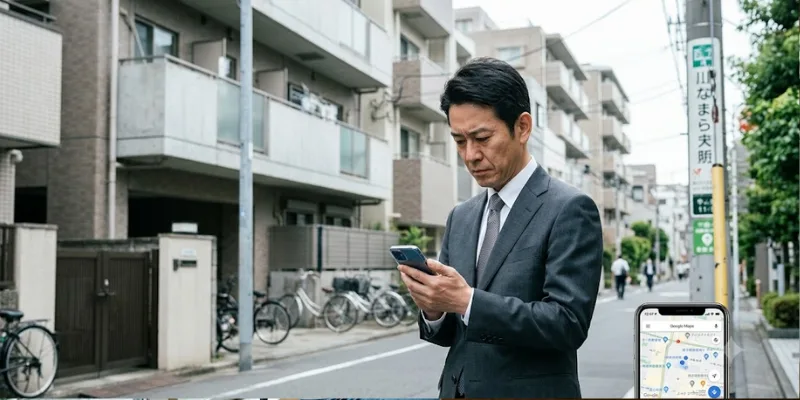
Step-by-Step: How to Check a Property’s History Before Renting
- Get the exact address. Ask your real estate agent for the building name and unit number, not just the street address — jiko bukken records are tied to specific units.
- Search the address on Oshimaland’s map. Zoom in until you can see individual buildings rather than a whole block.
- Look for a flame icon on the building. If one appears, click it to read the reported incident summary and date.
- Remember that no result isn’t a guarantee. Oshimaland only shows what’s been reported. A building with no flame icon may simply have no public report yet.
- Cross-check with your agent. If you have any doubt, ask directly whether the specific unit is classified as a jiko bukken. Agents are required to answer this truthfully if asked.
This process takes a few minutes per listing. It’s worth building into any apartment search as a habit, rather than treating it as a one-time check reserved for suspicious listings.
What Japan’s Disclosure Law Actually Requires
Since 2021, Japan’s Ministry of Land, Infrastructure, Transport and Tourism (MLIT) has published guidelines on this. They clarify when agents and landlords must proactively disclose a property’s incident history. In broad terms:
- Landlords and agents must disclose a serious incident, such as a suicide or homicide, to the first tenant who moves in after it occurred.
- This proactive disclosure duty is generally understood to apply for roughly the following few years. Serious incidents can still need disclosure later if a prospective tenant asks directly.
- A natural death from illness generally does not trigger the same disclosure requirement. Neither does an accidental death unrelated to the property itself.
The law and Oshimaland work as two separate layers. The law obligates disclosure in defined situations. Oshimaland is a public record that may catch older cases, or cases that were never formally disclosed at all.
Limitations of Relying on Oshimaland Alone
Oshimaland is a useful first check. But it has real gaps that matter if you want a complete picture:
- User-submitted, not verified. Reports can be inaccurate, exaggerated, or occasionally submitted as pranks. Reputable entries are usually cross-referenced against news coverage, but not all are.
- Coverage is incomplete. Many incidents were never reported to the site. This is especially true for older cases, or ones in smaller buildings.
- It doesn’t cover every kind of “incident.” Some renters also want to know about disputes, structural issues, or neighborhood problems. Oshimaland tracks none of these.
- Entries can be removed. Property owners or managers can sometimes request that an entry be taken down. A past listing might disappear from the map without the underlying history changing.
Treat Oshimaland as one input in your decision, not the final word. Pairing it with a direct question to your agent gives a far more complete picture than either source alone.
How Jiko Bukken Pricing Compares to Market Rent
The discount is the main reason non-superstitious renters seek these units out deliberately. A unit that would normally rent for a given market rate in a central ward can sometimes list 20–30% below that, purely because of its history. The discount tends to shrink over time as the incident recedes further into the past, and it can vary a great deal by landlord and by how severe the reported incident was.
For context on what typical market rent looks like in Tokyo before you compare, our guide to cheap apartments in Tokyo covers pricing across several budget-friendly wards. If a listing is priced far below everything else in that guide for a similar size and location, checking its history on Oshimaland becomes a sensible next step.
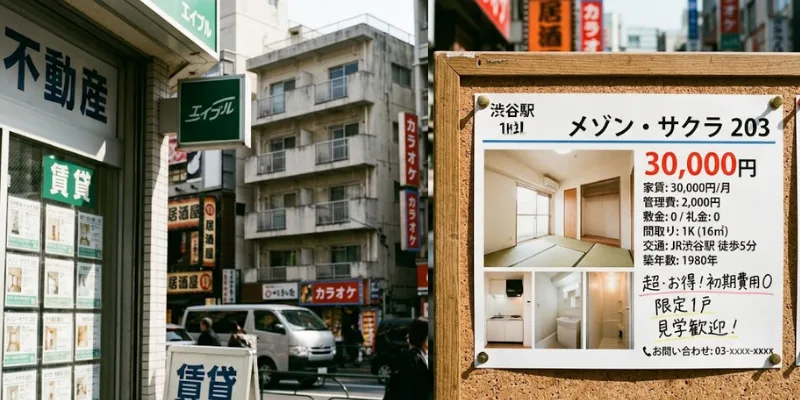
Other Ways to Research a Property Beyond Oshimaland
Oshimaland is the best-known tool, but it isn’t the only one worth using if you want a fuller picture before renting.
- Ask your agent for the property’s rental history. A unit that’s changed tenants unusually often, or sat vacant for a long stretch, is worth a direct question even if nothing shows on Oshimaland.
- Search the address in Japanese news archives. Major incidents are sometimes covered by local news outlets, which can surface details that never made it onto a crowdsourced map.
- Ask about specialized jiko bukken agencies. Some agencies focus specifically on stigmatized properties, cleaning and re-listing them at a discount. If your agent works with one of these, they’ll usually be upfront about a unit’s classification from the start, since it’s central to how they market the listing.
- Check with the building or ward office in serious doubt. This is a slower route and won’t always yield results, but it’s an option if you want to go beyond what a real estate agent can confirm.
No single source will give you complete certainty, and that’s true even for lifelong Japan residents. Combining two or three of these methods, rather than relying on any one alone, gives you the most realistic picture.
Should You Rent a Jiko Bukken? Weighing the Trade-Offs
There’s no universally right answer here. It comes down to personal comfort, not practicality alone.
Reasons some renters choose one: The rent discount is real. It can be significant, especially in central, otherwise expensive neighborhoods. If you’re not superstitious about a property’s history, a jiko bukken can be one of the more cost-effective ways to rent centrally.
Reasons some renters avoid one: Cultural attitudes toward these properties run deep in Japan. Some renters find the psychological weight isn’t worth the savings, regardless of how long ago the incident occurred. Resale or re-rental can also be harder later, since the stigma tends to follow the unit if you want to sublet or transfer the lease.
You don’t need to disclose your reasoning to a landlord either way. If you’d rather avoid the category entirely, just tell your agent you want listings confirmed as non-jiko bukken before viewing.
What to Do If You Find Your Prospective Apartment Listed
Say a search turns up a flame icon on a building you’re considering. Don’t panic, and don’t necessarily walk away immediately. A few practical next steps:
- Read the listed date. An incident reported a decade ago carries different weight for most renters than one from last year.
- Ask your agent to confirm the specific unit, not just the building. A large apartment block might have one flagged unit among dozens of others that are unaffected.
- Ask what disclosure, if any, the landlord has given. Also ask whether the rent already reflects a jiko bukken discount.
- Decide based on your own comfort level, not pressure to close quickly. A good agent will give you space to think it over.
If you decide to move forward, the rest of the rental process stays the same. Screening, guarantor, and documentation don’t change based on this classification. Our guides on required documents for renting in Japan and renting an apartment in Tokyo cover that process in full. Our Japanese apartment vocabulary guide will help you follow the lease terms once you’re ready to sign.
FAQ: Checking a Property’s History Before Renting
Yes. It’s free, and it doesn’t require an account to search.
It aims to, and it’s the largest resource of its kind in Japan. But coverage depends entirely on what users have reported, so rural areas and older buildings tend to be underrepresented.
No. Under current MLIT guidance, agents are expected to answer honestly if a prospective tenant directly asks whether a specific unit is a jiko bukken.
Not automatically, but it’s common practice. Landlords generally need to make the listing attractive despite the history.
Physically, yes. There’s no structural or health risk tied to the classification itself. The consideration is entirely psychological and cultural.
It only takes a couple of minutes per address. Many renters make it a standard part of their shortlist process, rather than a special case reserved for suspiciously cheap listings.
Sources: Oshimaland (大島てる); MLIT Guidelines on Disclosure of Deaths in Real Estate Transactions (2021)

Real estate advisor at Arealty Japan, specialising in helping foreign residents navigate the Tokyo and Osaka rental markets. Lucy has guided hundreds of international renters — from Working Holiday visa holders to corporate relocations — through Japan’s apartment application process. Her writing draws on firsthand experience with landlord screening, guarantor companies, and foreigner-friendly listings across all 23 Tokyo wards and major Kansai cities.



Leave a Reply