
Quick answer: Saikyo Line apartments cost about ¥71,000 to ¥170,000 a month for a studio or 1K. The JR Saikyo Line runs 36.9 km from Osaki in Tokyo to Omiya in Saitama, with 19 stations. North of Ikebukuro, rent falls fast. Akabane averages ¥106,800, and Kita-Akabane, one stop further, averages ¥84,700. Kita-Yono, next to Omiya, is the cheapest stop at ¥70,800. Akabane is about 13 minutes from Shinjuku with no transfer.
Saikyo Line key facts
| Item | Detail |
|---|---|
| Operator | JR East |
| Route | Osaki (Tokyo) to Omiya (Saitama) |
| Length | 36.9 km |
| Stations | 19 |
| Opened as the Saikyo Line | 30 September 1985 (Akabane to Omiya) |
| Train types | Local, Rapid, Commuter Rapid |
| Akabane to Shinjuku | About 13 minutes |
| Omiya to Shinjuku | About 30 to 35 minutes by rapid |
| Through service | Rinkai Line to Shin-Kiba, Sotetsu Line to Ebina, Kawagoe Line to Kawagoe |
| Cheapest studio rent | Kita-Yono, about ¥70,800 |
| Most expensive studio rent | Shibuya, about ¥169,800 |
Rent figures are LIFULL HOME’S averages for studio, 1K and 1DK apartments within a 10-minute walk of each station, excluding management fees, checked October 2026.
Why Choose Saikyo Line Apartments?
The Saikyo Line is a JR East commuter line. Its name joins “Sai” from Saitama and “Kyo” from Tokyo. It runs north from Osaki through Shibuya, Shinjuku and Ikebukuro, then crosses the Arakawa River into Saitama.
Renters choose Saikyo Line apartments for three main reasons.
One train to Shinjuku and Shibuya from budget areas. Most cheap areas in north Tokyo connect to Ikebukuro or Tokyo Station. The Saikyo Line goes on to Shinjuku, Shibuya and Ebisu without a change. That is rare for this price level.
Rent falls quickly after Ikebukuro. A studio at Shinjuku averages ¥143,100. At Akabane, 13 minutes away, it is ¥106,800. At Kita-Akabane, it drops to ¥84,700.
Fast trains from Saitama. Rapid and commuter rapid trains skip most stops between Akabane and Musashi-Urawa. Some trains also start at Omiya, Musashi-Urawa or Akabane, so you have a chance to get a seat.
Saikyo Line Rent by Station (2026)
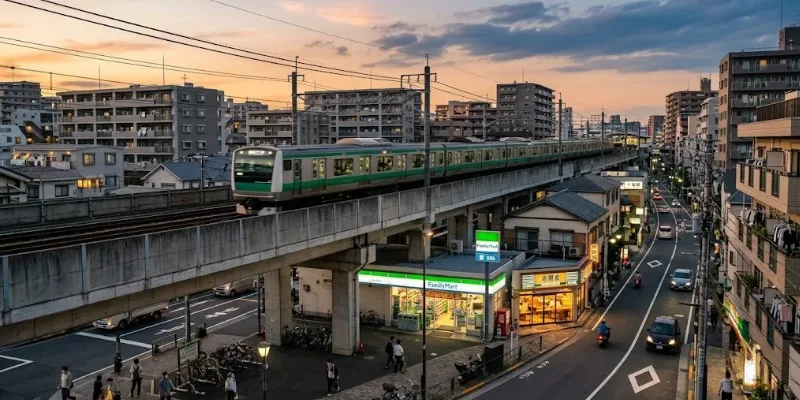
The table lists all 19 stations from Osaki to Omiya. Between Osaki and Ikebukuro, the Saikyo Line runs next to the Yamanote Line but stops only at five big stations. North of Akabane, the faster trains skip some stops. “Fastest stop” shows the fastest train type that stops there.
| Station | Area | km from Osaki | Fastest stop | Studio/1K rent |
|---|---|---|---|---|
| Osaki | Shinagawa-ku | 0.0 | Commuter rapid | ¥119,900 |
| Ebisu | Shibuya-ku | 3.6 | Commuter rapid | ¥168,200 |
| Shibuya | Shibuya-ku | 5.2 | Commuter rapid | ¥169,800 |
| Shinjuku | Shinjuku-ku | 8.6 | Commuter rapid | ¥143,100 |
| Ikebukuro | Toshima-ku | 13.4 | Commuter rapid | ¥123,600 |
| Itabashi | Kita-ku / Itabashi-ku | 15.2 | Commuter rapid | ¥116,800 |
| Jujo | Kita-ku | 16.9 | Commuter rapid | ¥108,000 |
| Akabane | Kita-ku | 18.9 | Commuter rapid | ¥106,800 |
| Kita-Akabane | Kita-ku | 20.4 | Local | ¥84,700 |
| Ukima-Funado | Itabashi-ku | 22.0 | Local | ¥89,200 |
| Toda-Koen | Toda | 24.4 | Rapid | ¥89,100 |
| Toda | Toda | 25.7 | Local | ¥85,100 |
| Kita-Toda | Toda | 27.1 | Local | ¥80,200 |
| Musashi-Urawa | Saitama (Minami-ku) | 29.5 | Commuter rapid | ¥89,400 |
| Naka-Urawa | Saitama (Minami-ku) | 30.7 | Rapid | ¥75,900 |
| Minami-Yono | Saitama (Chuo-ku) | 32.4 | Rapid | ¥73,500 |
| Yonohommachi | Saitama (Chuo-ku) | 34.0 | Rapid | ¥79,600 |
| Kita-Yono | Saitama (Chuo-ku) | 35.1 | Rapid | ¥70,800 |
| Omiya | Saitama (Omiya-ku) | 36.9 | Commuter rapid | ¥85,100 |
Source: LIFULL HOME’S, average rent for studio, 1K and 1DK apartments within a 10-minute walk, excluding management fees, checked October 2026. Distances and stopping patterns from JR East timetable data as listed on Wikipedia. Commuter rapid trains run on weekday mornings and evenings. Rapid trains run at other times.
Five patterns stand out in the data.
Kita-Akabane vs Akabane. Kita-Akabane is one stop from Akabane, but only local trains stop there. It averages ¥84,700, about ¥22,100 less than Akabane. That is about ¥265,000 a year.
You do not need to leave Tokyo to save. Kita-Akabane is cheaper than Toda-Koen, the first stop in Saitama, by about ¥4,400. Ukima-Funado in Itabashi-ku and Toda-Koen cost almost the same.
Itabashi is close to Ikebukuro prices. Itabashi is one stop from Ikebukuro and averages ¥116,800, only ¥6,800 less. Jujo, two stops out, saves about ¥15,600.
Musashi-Urawa vs Naka-Urawa. Musashi-Urawa is the only commuter rapid stop between Akabane and Omiya. Naka-Urawa, the next stop north, averages ¥75,900, about ¥13,500 less.
Kita-Yono is the line’s cheapest stop. At ¥70,800, it is about ¥14,300 cheaper than Omiya, one stop away.
Saikyo Line Neighborhoods, Section by Section
Osaki to Ikebukuro: the city section
This part of the line runs next to the Yamanote Line. Saikyo trains stop only at Osaki, Ebisu, Shibuya, Shinjuku and Ikebukuro. They are useful as a fast alternative to the Yamanote Line between these hubs.
Rent here is the highest on the line, from about ¥120,000 to ¥170,000. Most renters on a budget live further north and ride in. Shibuya has more lines than any other stop. Our Shibuya Station train lines guide explains where each one goes.
Ikebukuro is the line’s link to the north. It connects to the Tobu Tojo, Seibu Ikebukuro, Marunouchi, Yurakucho and Fukutoshin lines. For the area itself, read our Ikebukuro apartments guide.
Itabashi and Jujo: the first budget stops
Itabashi Station sits where Itabashi, Kita and Toshima wards meet. It is about 9 minutes from Shinjuku and 14 minutes from Shibuya with no transfer. Shin-Itabashi on the Toei Mita Line is a 5 to 10-minute walk away, which gives you a direct route to Otemachi. See our Itabashi apartments guide for the wider ward.
Jujo is the busiest Saikyo Line station that has no other rail line. Its west side has Jujo Ginza, a covered shopping street with more than 170 shops, the largest in Kita-ku. A 39-floor tower with a supermarket and shops opened by the west exit in late 2024. Teikyo University’s Itabashi campus and hospital are about a 10-minute walk away.
Akabane: the north Tokyo hub
Akabane is the main transfer point in north Tokyo. Besides the Saikyo Line, it has the Keihin-Tohoku, Utsunomiya, Takasaki and Shonan-Shinjuku lines. You can reach Ikebukuro in about 7 minutes and Shinjuku in about 13.
Akabane is known for Ichibangai, a maze of small bars and restaurants by the east exit. The west side is calmer, with newer buildings. Our Akabane neighborhood guide covers each sub-area, flood risk near the river, and the new tower planned by the east exit.
Kita-Akabane and Ukima-Funado: the cheap Tokyo end
These are the last two stations in Tokyo. Kita-Akabane is in Kita-ku and Ukima-Funado is in Itabashi-ku. Only local trains stop, but the ride to Akabane is short, and from there all trains run to Shinjuku.
Ukima Park, with its large pond, is next to Ukima-Funado Station. For more on the ward, read our Kita-ku apartments guide.
Toda-Koen to Kita-Toda: across the river
After the Arakawa River, the line enters Toda City in Saitama. Toda-Koen is a rapid stop. Its name comes from the Toda rowing course, built for the 1964 Tokyo Olympics. The station has its own shopping building.
Toda and Kita-Toda are local stops. Kita-Toda is the cheapest of the three, at ¥80,200. From Toda-Koen, Shinjuku is about 23 minutes by local train with no transfer.
Musashi-Urawa to Omiya: Saitama City
Musashi-Urawa is the key station in this section. All trains stop here, including the commuter rapid. It connects to the JR Musashino Line, and some trains toward Tokyo start here. In rush hour, Shinjuku is about 28 minutes away.
Naka-Urawa, Minami-Yono, Yonohommachi and Kita-Yono are quieter rapid stops. They are among the cheapest on the line, at about ¥71,000 to ¥80,000.
Omiya is the largest station north of Tokyo. It has the Tohoku, Joetsu and Hokuriku Shinkansen, several department stores, and Omiya Park next to Hikawa Shrine.
Saikyo Line Through Service: Kawagoe Line Stations
Some Saikyo Line trains continue past Omiya on the JR Kawagoe Line to Kawagoe. These stations are not part of the Saikyo Line, but you can ride to Shinjuku without a change on through trains.
| Station | Area | Studio/1K rent |
|---|---|---|
| Nisshin | Saitama (Kita-ku) | ¥69,500 |
| Nishi-Omiya | Saitama (Nishi-ku) | ¥65,200 |
| Sashiogi | Saitama (Nishi-ku) | ¥67,300 |
| Minami-Furuya | Kawagoe | ¥58,400 |
| Kawagoe | Kawagoe | ¥71,800 |
Source: LIFULL HOME’S, same conditions as the main table, checked October 2026.
From the March 2026 timetable, a weekday commuter rapid leaves Kawagoe at 6:09 and reaches Shinjuku at 7:03. That is about 54 minutes. The rent savings are large, but the commute is long.
How Long Is the Commute from Saikyo Line Apartments?
| Live at | To | Time | Studio rent |
|---|---|---|---|
| Itabashi | Shinjuku | About 9 min | ¥116,800 |
| Itabashi | Shibuya | About 14 min | ¥116,800 |
| Akabane | Ikebukuro | About 7 min | ¥106,800 |
| Akabane | Shinjuku | About 13 min | ¥106,800 |
| Akabane | Shibuya | About 18 min | ¥106,800 |
| Toda-Koen | Shinjuku | About 23 min (local) | ¥89,100 |
| Musashi-Urawa | Shinjuku | About 28 min (rush hour) | ¥89,400 |
| Omiya | Shinjuku | About 30 to 35 min | ¥85,100 |
| Kawagoe | Shinjuku | About 54 min (commuter rapid) | ¥71,800 |
Typical times from ekitan, station guides and JR East timetables. Local trains and rush-hour trains can take longer. Shibuya is about 5 minutes beyond Shinjuku on the same train.
Saikyo Line vs Keihin-Tohoku Line: Which Is Better for Saitama Commuters?
Both lines cross the Arakawa River from Akabane into Saitama and end at Omiya. The difference is where they take you in Tokyo.
| Saikyo Line | Keihin-Tohoku Line | |
|---|---|---|
| Main Tokyo stops | Ikebukuro, Shinjuku, Shibuya | Ueno, Akihabara, Tokyo, Shinagawa |
| First stop in Saitama | Toda-Koen, ¥89,100 | Kawaguchi, ¥91,300 |
| Urawa area example | Musashi-Urawa, ¥89,400 | Urawa, ¥84,000 |
| Busiest section, FY2025 | Itabashi to Ikebukuro, 167% | Kawaguchi to Akabane, 158% |
Rent from LIFULL HOME’S (studio to 1DK, within 10 minutes’ walk). Congestion from Japan’s transport ministry, as reported in September 2026.
Choose the Saikyo Line if you work on the west side of central Tokyo. Choose the Keihin-Tohoku Line if you work near Tokyo Station, Akihabara or Shinagawa. Rent is similar on both.
Which Saikyo Line Station Is Best for You?
Work in Shinjuku or Shibuya on a budget: Kita-Akabane or Ukima-Funado
You stay inside Tokyo and pay under ¥90,000. Change to a faster train at Akabane, or ride straight through on a local.
Want a fast train and lower rent: Toda-Koen or Musashi-Urawa
Both are faster-train stops under ¥90,000. Musashi-Urawa also has trains that start there, which helps you get a seat.
Lowest budget with one train to Shinjuku: Kita-Yono or Minami-Yono
Studios average about ¥71,000 to ¥74,000. Rapid trains stop at both.
Students and young workers: Jujo or Akabane
Both have big shopping streets, cheap food and all trains stopping. For more cheap areas across the city, see our cheap apartments in Tokyo guide.
Lots of space for less: Kawagoe Line stations
Minami-Furuya averages ¥58,400, but plan for a commute of close to an hour.
How Crowded Is the Saikyo Line at Rush Hour?
The Saikyo Line is one of the most crowded lines in Japan. In fiscal 2025, the section from Itabashi to Ikebukuro ran at 167% of capacity in the busiest morning hour. That was the third highest in the country and up from 163% the year before.
| Line | Busiest section | FY2025 congestion |
|---|---|---|
| JR Saikyo Line | Itabashi to Ikebukuro | 167% |
| Tokyo Metro Hibiya Line | Minowa to Iriya | 163% |
| Tokyo Metro Tozai Line | Kiba to Monzen-Nakacho | 160% |
| JR Chuo Line (Rapid) | Nakano to Shinjuku | 158% |
| JR Keihin-Tohoku Line | Kawaguchi to Akabane | 158% |
| Keio Line | Shimo-Takaido to Meidaimae | 145% |
Source: Ministry of Land, Infrastructure, Transport and Tourism survey results for fiscal 2025, as reported by Tetsudo Channel. Tokyo area average: 143%.
For a line that is easier at rush hour, compare our Keio Line apartments guide and Odakyu Line apartments guide.
What Are the Downsides of Saikyo Line Apartments?
Morning trains are very full. At 167% of capacity, expect to stand from Saitama to Ikebukuro on weekday mornings.
Many stops get local trains only. Kita-Akabane, Ukima-Funado, Toda and Kita-Toda are skipped by faster trains. Check the timetable before you sign a lease.
Few trains between the big hubs in central Tokyo. South of Ikebukuro, Saikyo trains stop only at five stations. If you work near Mejiro or Harajuku, you will change to the Yamanote Line.
Delays can spread. Saikyo trains share tracks and through services with the Rinkai, Sotetsu and Kawagoe lines, so a problem on one can affect the others.
Women-only cars at rush hour. Some cars are reserved for women during rush hours. Check the platform signs so you board the right car.
How to Rent a Saikyo Line Apartment as a Foreigner
- Set your budget. Plan for rent plus about four to six months of rent in move-in costs. Our move-in cost guide breaks down each fee.
- Choose your commute limit. Decide how many minutes to Shinjuku or Ikebukuro you accept, then pick two or three stations from the tables.
- Check walking time. Many listings are 10 to 15 minutes from the station. Our guide on walking distance to train stations explains what each minute means.
- Check the flood map near the Arakawa River. Low streets near the river in Akabane, Kita-Akabane, Ukima-Funado and Toda carry more flood risk than higher ground.
- Prepare documents. You will usually need your residence card, passport, proof of income or enrollment, and a Japanese phone number.
- Use a guarantor company. Most landlords require one. Arealty can help you choose a company that accepts foreign tenants.
For the full process, read our guide to renting in Tokyo as a foreigner.
Frequently Asked Questions
A studio or 1K costs about ¥71,000 to ¥170,000 a month in 2026. Shibuya is the most expensive station and Kita-Yono is the cheapest.
Kita-Akabane in Kita-ku is the cheapest Saikyo Line station inside Tokyo, at about ¥84,700 for a studio. It is one stop from Akabane.
About 13 minutes, with no transfer.
Not right at the border. Toda-Koen, the first Saitama stop, costs about the same as Ukima-Funado in Tokyo. Rent drops more around Naka-Urawa, Minami-Yono and Kita-Yono, at about ¥71,000 to ¥76,000.
Yes, at rush hour. In fiscal 2025, the section from Itabashi to Ikebukuro ran at 167% of capacity in the busiest morning hour, the third highest in Japan.
Yes. It stops at Shinjuku, Shibuya, Ebisu and Osaki. Many trains then continue on the Rinkai Line to Odaiba and Shin-Kiba.
Find Saikyo Line Apartments with Arealty
Arealty lists apartments along the Saikyo Line, from Itabashi and Akabane to Toda, Musashi-Urawa and Omiya. Every listing is in English, and our team helps with applications, guarantor companies and contracts.
- Browse all apartments for rent on Arealty
- Start your search on Arealty
- Read more on the area: Akabane neighborhood guide and Kita-ku apartments guide
Tell us your station, budget and move date, and our bilingual team will send matching options.
About this guide
This guide was written by Lucy Nguyen, Marketing Specialist at Arealty, using station-level rent data and official railway and government information. Rent and train details change, so check current listings before you decide.
Sources
- LIFULL HOME’S: JR Saikyo Line rent by station
- Wikipedia: Saikyo Line
- Tetsudo Channel: FY2025 congestion rates from MLIT
- Tetsudo Channel: March 2026 Saikyo Line commuter rapid from Kawagoe
- Traffic News: 2019 timetable change, rapid stops north of Musashi-Urawa
- Mitsubishi Estate House Net: Akabane Station access
- Mitsubishi Estate House Net: Musashi-Urawa Station access
- Mitsubishi Estate House Net: Omiya Station
- Mitsubishi Estate House Net: Jujo Station
- ekitan: Itabashi to Shinjuku
- ekitan: Itabashi to Shibuya
- ekitan: Toda-Koen to Shinjuku
- CHINTAI: Saikyo Line station guide
- CHINTAI: Toda-Koen area guide
- Teikyo University: Itabashi campus access (PDF)